LSI Calculator Guide: Understanding the Langelier Saturation Index


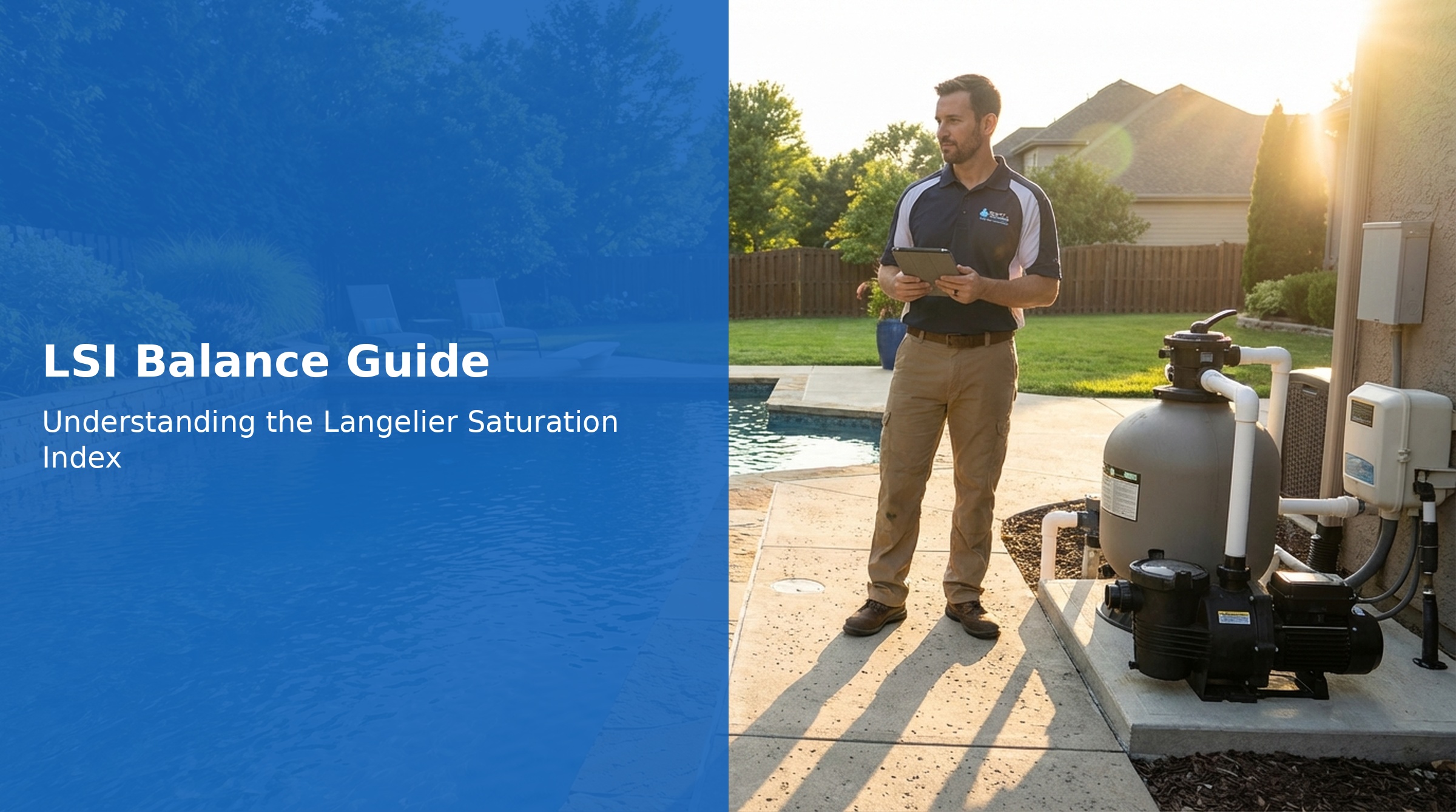
The Langelier Saturation Index (LSI) tells you whether your pool water is balanced, corrosive, or scale-forming. Understanding LSI helps prevent expensive damage to pool surfaces, equipment, and plumbing—problems that cost far more to fix than they do to prevent.
Key Takeaways
- LSI measures water's tendency to deposit calcium scale or dissolve surfaces
- Target range is -0.3 to +0.3 for balanced water
- Negative LSI = corrosive (etches plaster, corrodes metal)
- Positive LSI = scale-forming (deposits calcium on surfaces)
- Temperature significantly affects LSI—check in summer and winter
Calculate Your LSI
Enter your water chemistry for instant results
What is the Langelier Saturation Index?
Developed by Dr. Wilfred Langelier in 1936, the LSI predicts whether water will deposit calcium carbonate scale or dissolve it. For pools, this translates directly to surface and equipment longevity.
Think of LSI as a balance scale:
- Balanced water (LSI ≈ 0) neither deposits nor dissolves calcium
- Positive LSI means water is supersaturated—it will deposit scale
- Negative LSI means water is undersaturated—it will dissolve calcium from surfaces
The LSI Formula
LSI combines five water chemistry factors:
Langelier Saturation Index Formula
Where TF = Temperature Factor, CF = Calcium Factor, AF = Alkalinity Factor
Each factor is derived from lookup tables based on your actual water readings. Here's what each represents:
| Factor | Based On | What It Measures |
|---|---|---|
| pH | pH reading | Acidity/alkalinity of water |
| TF (Temperature Factor) | Water temperature °F | How temperature affects calcium solubility |
| CF (Calcium Factor) | Calcium hardness ppm | Amount of dissolved calcium |
| AF (Alkalinity Factor) | Total alkalinity ppm | Water's buffering capacity |
Factor Lookup Tables
Temperature Factor (TF):
| Temperature °F | TF Value |
|---|---|
| 32°F | 0.0 |
| 50°F | 0.3 |
| 60°F | 0.4 |
| 70°F | 0.5 |
| 77°F | 0.6 |
| 84°F | 0.7 |
| 95°F | 0.8 |
| 105°F | 0.9 |
Calcium Factor (CF):
| Calcium Hardness ppm | CF Value |
|---|---|
| 25 ppm | 1.0 |
| 50 ppm | 1.3 |
| 75 ppm | 1.5 |
| 100 ppm | 1.6 |
| 150 ppm | 1.8 |
| 200 ppm | 1.9 |
| 300 ppm | 2.1 |
| 400 ppm | 2.2 |
| 600 ppm | 2.4 |
| 800 ppm | 2.5 |
Alkalinity Factor (AF):
| Total Alkalinity ppm | AF Value |
|---|---|
| 25 ppm | 1.4 |
| 50 ppm | 1.7 |
| 75 ppm | 1.9 |
| 100 ppm | 2.0 |
| 125 ppm | 2.1 |
| 150 ppm | 2.2 |
| 200 ppm | 2.3 |
| 300 ppm | 2.5 |
| 400 ppm | 2.6 |
Example LSI Calculation
Water readings:
pH: 7.6 | Temperature: 84°F | Calcium: 250 ppm | Alkalinity: 100 ppm
Factor lookup:
TF = 0.7 | CF = 2.0 | AF = 2.0
Calculation:
LSI = 7.6 + 0.7 + 2.0 + 2.0 - 12.1 = +0.2
Result: Slightly positive but within balanced range. Water is stable.
What Negative LSI Does to Your Pool
Corrosive water (negative LSI) actively seeks calcium to reach equilibrium. Since your pool water is in constant contact with plaster, grout, and metal, that's where it finds calcium.
Signs of Corrosive Water Damage
- Etched plaster: Rough, pitted surface that feels like sandpaper
- Faded plaster: Loss of color, especially in colored plaster finishes
- Exposed aggregate: Pebble or quartz aggregate becomes visible
- Metal corrosion: Green staining from copper, rust from iron
- Heater damage: Shortened heat exchanger life
- Deteriorating grout: Tile grout becomes soft and washes away
Plaster Damage is Expensive
Replastering a pool costs $10,000-$20,000+. Maintaining proper LSI costs almost nothing. The math is simple.
What Positive LSI Does to Your Pool
Scale-forming water (positive LSI) has more calcium than it can hold in solution. The excess precipitates out onto surfaces.
Signs of Scale Buildup
- White crusty deposits: On tile, waterline, and spillways
- Cloudy water: Calcium precipitating in suspension
- Reduced flow: Scale buildup inside pipes and equipment
- Heater inefficiency: Scale insulates heat exchangers
- Salt cell scaling: Calcium deposits on chlorine generator plates
- Rough surfaces: Scale deposits create texture on smooth surfaces
How to Adjust LSI
Each factor in the LSI formula can be adjusted to bring water into balance:
To Raise LSI (Fix Corrosive Water)
- Raise pH: Add soda ash (sodium carbonate)
- Raise alkalinity: Add baking soda (sodium bicarbonate)
- Raise calcium: Add calcium chloride
To Lower LSI (Fix Scaling Water)
- Lower pH: Add muriatic acid or dry acid
- Lower alkalinity: Add muriatic acid (will also lower pH)
- Lower calcium: Partial drain and refill with softer water
For chemical dosing amounts, use our chemical dosage calculator.
Temperature's Impact on LSI
Water temperature significantly affects LSI. The same water chemistry can be balanced in winter and scaling in summer—or vice versa.
Same Pool, Different Seasons
Winter (60°F): pH 7.6, TF 0.4, CF 2.0, AF 2.0
LSI = 7.6 + 0.4 + 2.0 + 2.0 - 12.1 = -0.1 (balanced)
Summer (95°F): Same chemistry, TF 0.8
LSI = 7.6 + 0.8 + 2.0 + 2.0 - 12.1 = +0.3 (borderline scaling)
The 35°F temperature difference shifted LSI by 0.4 points.
This is why pools in hot climates often need lower pH targets (7.2-7.4) to compensate for high temperatures pushing LSI positive.
LSI and Salt Pools
Salt chlorine generators create localized high-pH conditions at the cell, which can cause scaling even when bulk water LSI is balanced. Salt pool operators should:
- Target the lower end of the balanced range (-0.3 to 0)
- Keep calcium below 400 ppm
- Inspect and clean cells regularly
- Consider reverse polarity cells that self-clean
Learn more about salt pool chemistry in our salt calculator.
LSI and CYA (Cyanuric Acid)
Cyanuric acid (stabilizer) affects how chlorine and pH interact, and some argue it should be factored into LSI calculations. The traditional LSI formula doesn't include CYA, but high CYA levels can mask pH effects.
For pools with CYA above 50 ppm, some professionals use a "corrected alkalinity" that subtracts one-third of CYA from total alkalinity before calculating LSI. Our CYA calculator can help you understand your stabilizer levels.
When to Check LSI
Calculate LSI:
- Seasonally: At minimum, check in peak summer and winter
- After significant water addition: Refills change calcium and alkalinity
- After chemical adjustments: Verify changes achieved desired result
- When troubleshooting: Scale or etching problems
- New pool startup: Critical for protecting fresh plaster
LSI Is a Decision Tool, Not Proof of Cause
A one-line PoolPros question asked whether pH can be in the sixes if LSI is balanced. Do not use a calculated index to excuse an out-of-range individual parameter. LSI estimates calcium-carbonate saturation; it does not replace sanitizer requirements, product limits, local code, swimmer comfort, or the need to verify an unusual test result.
The same caution applies when a surface changes color. A technician with 25 years of experience reported adding too much acid to a scaled white gunite pool and finding black staining at the next visit. Another new-finish pool turned teal after chlorine additions in the presence of suspected copper.
"I added too much acid. The next service the surface was stained BLACK."
— Pool pro via Reddit
Those reports do not establish a universal reaction or a diagnosis for another pool. They support a safer workflow: retest, document the full water panel and treatment history, identify the surface and metal sources, use a controlled spot test when appropriate, and refer uncertain finish damage before adding another corrective dose.
Common LSI Mistakes
Ignoring Temperature
Many pool operators calculate LSI once and assume it stays constant. Temperature changes throughout the year—and even throughout the day—affect LSI significantly.
Chasing Perfect Zero
LSI doesn't need to be exactly 0. The -0.3 to +0.3 range is stable. Constantly adjusting to hit zero wastes chemicals and time.
Fixing the Wrong Factor
If LSI is negative, raising pH is the easiest fix. But if your pH is already 7.8+, the real problem is low calcium or alkalinity. Use the formula to identify which factor is actually out of range.