
How to Calculate Pool Volume: Formulas for Every Shape

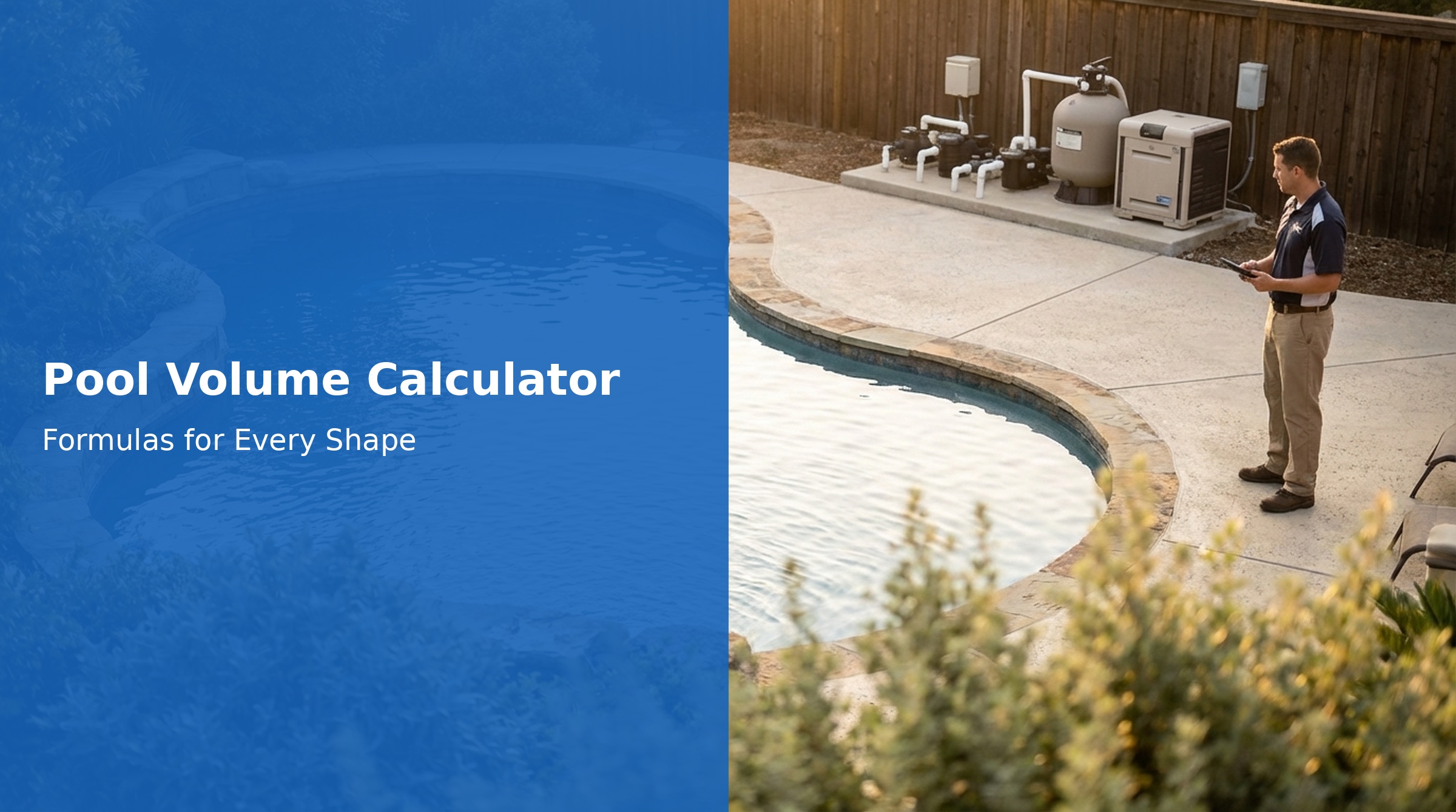
Knowing your pool's volume in gallons is essential for proper chemical dosing, equipment sizing, and turnover rate calculations. An incorrect volume estimate means over- or under-dosing chemicals, which leads to water balance problems and wasted money.
Quick Reference
- Rectangular: Length × Width × Average Depth × 7.5
- Circular: Diameter × Diameter × Average Depth × 5.9
- Oval: Length × Width × Average Depth × 6.7
- Irregular: Surface Area × Average Depth × 7.5
Skip the Math
Use our free calculator for instant results
Why Pool Volume Matters
Pool volume is the foundation for nearly every pool maintenance calculation:
- Chemical dosing: Chlorine, acid, and other chemicals are dosed based on gallons
- Pump sizing: Flow rate requirements depend on pool volume
- Turnover rate: Health codes often require 6-8 hour turnover times
- Heater sizing: BTU requirements scale with water volume
- Salt calculations: Salt pools need precise ppm adjustments
A 10% error in volume estimation means a 10% error in every chemical addition. Over time, this compounds into serious water balance issues.
The Universal Multiplier: 7.5
The number 7.5 appears in pool volume calculations because one cubic foot of water equals 7.48 gallons. We round to 7.5 for simpler math.
All pool volume formulas follow the same pattern:
Basic Formula
Where measurements are in feet
The only difference between pool shapes is how you calculate the surface area.
Rectangular Pool Volume
Most residential and many commercial pools are rectangular, making this the most common calculation.
Rectangular Pool Formula
Example: Standard Backyard Pool
Dimensions: 32 ft long × 16 ft wide
Depth: 3.5 ft shallow end, 8 ft deep end
Average depth: (3.5 + 8) ÷ 2 = 5.75 ft
Calculation: 32 × 16 × 5.75 × 7.5 = 22,080 gallons
Calculating Average Depth
For pools with a consistent slope from shallow to deep end:
Average Depth (Sloped Bottom)
For pools with a hopper bottom (flat shallow, then drops to deep end), you'll get more accurate results by calculating each section separately and adding them together.
Circular Pool Volume
Round pools use a modified formula that accounts for the circular surface area (π × radius²).
Circular Pool Formula
The 5.9 multiplier = 7.5 × π ÷ 4
Example: Above-Ground Round Pool
Diameter: 24 ft
Depth: 4 ft (uniform)
Calculation: 24 × 24 × 4 × 5.9 = 13,594 gallons
Oval Pool Volume
Oval pools combine elements of rectangular and circular calculations.
Oval Pool Formula
Where Length and Width are the longest and shortest dimensions
Example: Oval Above-Ground Pool
Dimensions: 18 ft long × 12 ft wide
Depth: 4 ft (uniform)
Calculation: 18 × 12 × 4 × 6.7 = 5,789 gallons
Irregular and Freeform Pools
Kidney-shaped, lagoon-style, and custom freeform pools require a different approach. You have two options:
Method 1: Surface Area Estimation
Estimate the surface area by breaking the pool into simpler shapes (rectangles and half-circles), then use:
Irregular Pool Formula
Method 2: The 80% Rule
For a kidney-shaped pool, calculate as if it were a rectangle using the longest length and widest width, then multiply by 0.80:
Kidney Pool Shortcut
This accounts for the curved sides that reduce total volume compared to a full rectangle.
Spa and Hot Tub Volume
Spas typically use the same formulas as pools but on a smaller scale. Most residential spas hold 300-500 gallons.
| Spa Size | Typical Volume |
|---|---|
| 2-3 person | 150-250 gallons |
| 4-5 person | 250-350 gallons |
| 6-7 person | 350-500 gallons |
| 8+ person | 500-800 gallons |
Manufacturer specifications are more accurate for spas since the molded shell shape makes manual calculation difficult.
Common Pool Volumes by Size
Use this table for quick estimates:
| Pool Size | Average Depth | Approximate Gallons |
|---|---|---|
| 12' × 24' Rectangle | 5 ft | 10,800 |
| 16' × 32' Rectangle | 5 ft | 19,200 |
| 18' × 36' Rectangle | 5.5 ft | 26,730 |
| 20' × 40' Rectangle | 5.5 ft | 33,000 |
| 15' Round | 4 ft | 5,310 |
| 18' Round | 4 ft | 7,646 |
| 24' Round | 4 ft | 13,594 |
| 27' Round | 4 ft | 17,205 |
Using Volume for Chemical Dosing
Once you know your pool volume, you can calculate chemical additions. Most dosing charts assume 10,000 gallons, so you'll need to adjust proportionally.
Proportional Dosing Formula
Example: Chlorine Dosing
Pool volume: 22,000 gallons
Chart says: 10 oz chlorine per 10,000 gallons to raise 1 ppm
Your dose: (22,000 ÷ 10,000) × 10 = 22 oz chlorine
For more precise calculations, use our chemical dosage calculator which factors in your current and target levels.
Turnover Rate Calculations
Health departments often require pools to "turn over" (filter all the water) within 6-8 hours. Knowing your volume lets you verify your pump is adequate.
Turnover Rate Formula
Example: Checking Pump Adequacy
Pool volume: 20,000 gallons
Pump flow: 60 GPM
Turnover: 20,000 ÷ (60 × 60) = 5.5 hours
This meets the 6-hour requirement.
Need help sizing a pump? Check our pump run time calculator and DOE pump regulations guide.
Measurement Tips for Accuracy
Accurate measurements lead to accurate volume calculations:
- Measure at water level, not the coping or tile line
- Take multiple depth readings for irregular bottoms
- Account for steps and benches by subtracting their volume
- Measure to the water line, not the top of the wall
- Use a tape measure, not pacing or estimation
For existing pools, check the builder's specifications or permit documents—they often include calculated volume.