Best Business Phone Systems for Pool Service (2026)


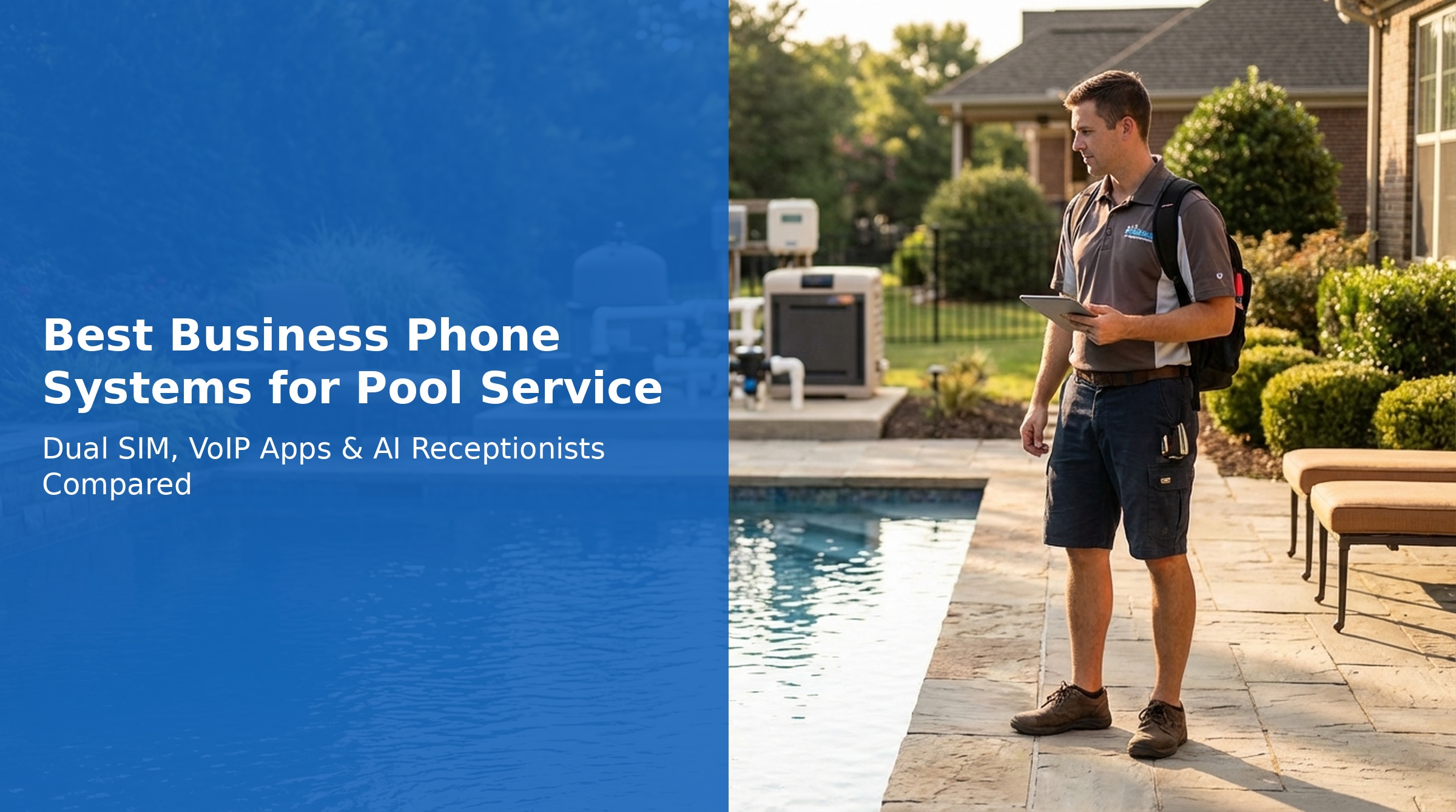
You're elbow-deep in a green pool when your phone rings. It's a new lead. You can't answer because your hands are covered in algae and muriatic acid. By the time you call back 20 minutes later, they've already booked with another company. Sound familiar?
This is the daily reality for pool service professionals who use their personal cell phone as their business line. A recent discussion on r/PoolPros captured this exact struggle: a pool pro starting out wanted a dedicated business line that could ring on two different phones, so he and his wife could share call duties. The thread exploded with suggestions ranging from dual SIM cards to VoIP apps to full business phone systems.
If you're starting a pool service business or looking to professionalize your phone setup, this guide breaks down every option pool pros are actually using, with real pricing and honest tradeoffs.
Key Takeaways
- Dual SIM is the cheapest option ($15-16/mo) but only works on one phone
- VoIP apps like Quo and Grasshopper ($14-20/mo) let multiple people share one business number
- Full phone systems like RingCentral and Ooma ($20-30/mo) add advanced features but cost more
- AI receptionists can answer calls 24/7 when you're in the field, so you never miss a lead
- The best solution depends on whether you need to share call duties with a partner or team
Why Pool Pros Need a Dedicated Business Line
Using your personal number for business calls creates problems that compound as you grow. Customers call at all hours. You can't tell if it's a personal call or business call until you answer. Your voicemail greeting either sounds professional or personal, but not both. And when you're on a roof cleaning a cartridge filter, you can't answer at all.
The original poster on r/PoolPros nailed the requirements that most pool service operators share:
What Pool Pros Need in a Business Phone
- Standalone local number that's separate from your personal line
- Sounds like a real phone call to the customer (no "Google Voice user" announcements)
- Rings on multiple phones so a partner, spouse, or employee can pick up
- Caller ID distinction so you know it's a business call before answering
- Separate voicemail with a professional business greeting
- Business hours control so calls don't ring your phone at 10 PM
That last point deserves emphasis. As one commenter put it: "I schedule business hours and outside of those hours I don't hear my phone ring or texts come through." Setting boundaries between work and personal life is critical for avoiding burnout, especially when you're a solo operator running 20-30 stops per week.
Option 1: Dual SIM / Second Phone Line
The simplest approach is adding a second line to your existing smartphone. Modern iPhones support dual eSIM, and most Android phones support at least one physical SIM plus one eSIM.
One pool pro in the thread described their setup: "I run a second line on my personal cell. iPhone with two eSIMs. Personal line on AT&T and a business line through Mint Mobile for $15 a month. Separate contact lists and everything on one device."
With dual SIM, you can choose which line to send messages or make calls from, and assign default lines to each contact. Your phone displays which line is ringing, so you always know if it's business or personal.
The Problem with Dual SIM for Pool Service
As the original poster quickly pointed out: "Only problem with that is I can't virtually hand off phone responsibilities to my wife/partner when I'm busy in the field."
This is the deal-breaker for many pool service operations. When you're servicing a pool, you literally can't answer the phone. If your spouse or office manager is handling calls while you're on route, they need to be able to receive those calls on their own phone. Dual SIM locks the number to one device.
Dual SIM Works If...
- You're a true solo operator
- You handle all calls yourself
- You don't mind missing calls while servicing
- Budget is the top priority
Dual SIM Falls Short If...
- A spouse or partner helps with calls
- You want calls answered while you're in the field
- You plan to hire and need to transfer the number
- You want business hours and auto-replies
Option 2: VoIP Business Phone Apps
VoIP (Voice over Internet Protocol) apps give you a dedicated business number that lives in an app on your phone. The number isn't tied to a physical SIM card, so multiple people can use the same number from different devices. This is what most pool pros in the Reddit thread recommended.
Quo (formerly OpenPhone)
Quo was the most-recommended option in the thread. One pool pro shared: "I've used Quo (used to be OpenPhone) for years. I personally haven't had any issue with it." At $15/month per user on their Starter plan (billed annually), it includes a local number, unlimited US/Canada calling and texting, voicemail transcription, and shared phone numbers for team use.
The key feature for pool pros is the ability to set business hours. Outside those hours, calls go straight to voicemail and you can configure auto-text replies for missed calls. You still see notifications, but your phone doesn't ring.
Grasshopper
Grasshopper takes a different pricing approach: it charges per account rather than per user. Plans start at $14/month and the top tiers include unlimited users. This makes it cost-effective if you and a partner both need access. It includes call forwarding, voicemail transcription, automated text replies, and call reports.
The catch is that advanced features like call recordings cost extra as add-ons, and a $14 base plan can climb to $60-100/month once you add the extras.
RingCentral
RingCentral is the enterprise option that some pool pros use. Starting at $20/user/month (billed annually), it offers IVR phone menus, SMS/MMS messaging, integrations with Google and Microsoft, and 99.9% uptime. The Advanced plan at $25/user adds automatic call recording and CRM integrations.
It's more phone system than most solo pool pros need, but it scales well if you're building a multi-technician operation. As one commenter noted: "Ring Central can do this, if you haven't checked them out."
Ooma Office
Ooma was praised for its flexibility: "We use Ooma business. You can have a dedicated physical phone if you want for your office desk. But we mostly use the app on multiple smartphones and it has all the functionality you're asking about. You can even text the number."
Plans start at $19.95/user/month for the Essentials tier. The Pro tier at $24.95 adds the desktop app, SMS texting, video conferencing, and call recording.
Vonage Business
Vonage was mentioned as capable but potentially pricey for a two-person operation: "Vonage business allows you to do pretty much everything you want on their iOS app. I'm not sure the pricing for only two lines but may be a bit high for you if you're just starting out."
VoIP Comparison for Pool Service
| Feature | Quo | Grasshopper | RingCentral | Ooma |
|---|---|---|---|---|
| Starting Price | $15/user/mo | $14/account/mo | $20/user/mo | $19.95/user/mo |
| Local Number | Yes | Yes | Yes | Yes |
| Multi-Phone Ring | Yes | Yes | Yes | Yes |
| SMS Texting | Unlimited | Unlimited | Yes | Pro plan+ |
| Business Hours | Yes | Yes | Yes | Yes |
| Auto-Reply Texts | Yes | Yes | No | No |
| Voicemail Transcription | Yes | Yes | Yes | Pro plan+ |
| Call Recording | Business plan | Add-on | Advanced plan | Pro plan+ |
| Per-User Pricing | Per user | Per account | Per user | Per user |
| Best For | Solo & small teams | Budget-conscious | Growing companies | Office + field |
The Spouse/Partner Handoff Problem
The Reddit thread revealed the most common phone arrangement for small pool service operations: the owner handles calls when possible, and a spouse or partner picks up when the owner is servicing pools. This "handoff" model is how most single-operator businesses handle call volume without hiring a receptionist.
For this setup, VoIP apps have a clear advantage over dual SIM. With Quo, Grasshopper, or Ooma, you can have the same business number ringing on both your phone and your spouse's phone simultaneously. When one person answers, it stops ringing on the other device.
Some systems also let you control routing. You could set it so calls go to your phone first during certain hours, and to your spouse's phone during others. Or have it ring both phones at the same time and whoever is free picks up.
Option 3: AI Receptionist
VoIP apps solve the "dedicated number" problem, but they still require a human to answer the phone. When you're in the field and your spouse is running errands, calls go to voicemail. Studies show that 62% of calls to small businesses go unanswered, and most callers won't leave a voicemail.
AI receptionists represent a newer category that's gaining traction among pool service businesses. Instead of just routing calls to a phone that may or may not be answered, an AI receptionist actually answers the call, speaks with the customer, gathers their information, and either handles their request or routes them to you.
For pool service specifically, an AI receptionist can:
- Answer every call 24/7, even when you're servicing pools
- Capture new lead information (name, address, pool type, what service they need)
- Answer common questions about your services, pricing, and service area
- Schedule callbacks so you can return calls when you're done for the day
- Send text follow-ups to callers with your business information
This approach eliminates the handoff problem entirely. You don't need to coordinate who's watching the phone because the AI handles every incoming call. You review the call summaries during lunch or at the end of your route and follow up with the leads that matter.
For context on how an AI receptionist fits into the broader software landscape for pool businesses, see our pool service software comparison.
Never Miss Another Call on Your Route
PoolDial's AI receptionist answers every call, captures lead information, and handles customer questions 24/7. No more missed calls while you're servicing pools.
See How It WorksWhich Option Is Right for You?
Consider your situation honestly:
- If you're bootstrapping and solo: Start with dual SIM. It's $15/month and solves the basic problem of separating personal and business calls. You can always upgrade later.
- If you have a spouse/partner helping with calls: Go with a VoIP app. Quo at $15/user/month or Grasshopper starting at $14/account are the most popular choices among pool pros. Both let your partner answer your business line from their own phone.
- If you're growing and adding technicians: Consider RingCentral or Ooma for more robust call routing, recording, and team management features.
- If missed calls are costing you money: An AI receptionist ensures every call gets answered professionally, even at 7 AM on a Saturday when you're loading the truck. At $100-175/month per pool, a single captured lead can pay for months of phone service.
What to Avoid
The Reddit thread also surfaced a few warnings worth noting:
- Conversations (by GoDaddy): Multiple pool pros warned against it. One commenter said plainly: "Don't use Conversations, it's horrible."
- Google Voice: The announcement message ("the Google Voice user you have called...") makes your business sound amateur. Several commenters flagged this as a non-starter.
- Overpaying for features you don't use: Enterprise phone systems with 300+ integrations and CRM connections are overkill for a solo pool operator. Start simple and upgrade when you actually need the features.
Setting Up Your Business Phone: A Quick Checklist
Whichever system you choose, make sure you handle these items:
Phone Setup Checklist
- Choose a local area code number (customers trust local numbers more)
- Record a professional voicemail greeting with your business name and hours
- Set up business hours so your phone doesn't ring during personal time
- Configure auto-reply texts for missed calls ("Thanks for calling [Business Name], we'll get back to you within the hour")
- Put the number on your truck, business cards, and website immediately
- Add the number to your Google Business Profile for local search visibility
- Test it by calling from a friend's phone to hear what customers experience
Getting your phone setup right is one of the foundational steps when starting your pool service business. It's also worth understanding your true cost per pool to make sure the phone expense fits within your operating budget.
Bottom Line
Most pool pros start with the cheapest option that meets their needs and upgrade as they grow. If you're a solo operator, dual SIM at $15/month gets the job done. If you have a partner sharing call duties, a VoIP app like Quo or Grasshopper is the sweet spot. And if you're tired of missing calls while you're shoulder-deep in a filter clean, an AI receptionist might be worth the investment.
The cost of any phone system is trivial compared to the cost of missed leads. A single new weekly maintenance customer at $125/month generates $1,500/year in recurring revenue. If your phone setup captures even one extra lead per month that you would have otherwise missed, it pays for itself many times over.