
Pool Chemical Storage: Renting Space for Your Growing Business


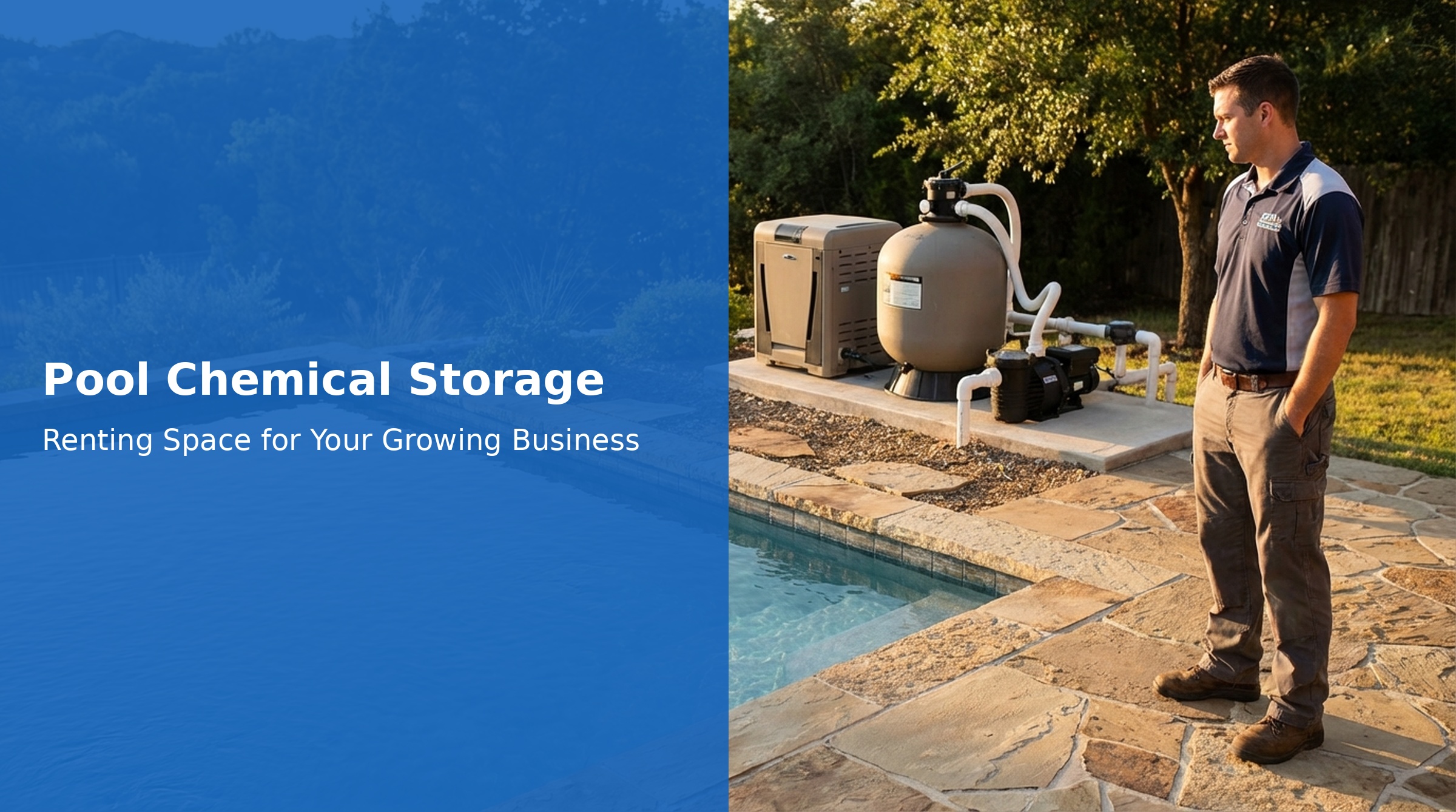
At some point, every growing pool service business hits the same wall: the truck is full, the garage is overflowing, and you need a dedicated place to store chemicals. It's a natural milestone. As the Pool Nation Podcast put it in an episode on profitability: "You now have a storage unit or an office to operate out of. Your days start blurring together."
But figuring out what to rent, how much to pay, and how to do it safely isn't straightforward — especially when you're dealing with oxidizers and corrosives. This guide covers the practical options, real costs, and safety requirements you need to know.
Key Takeaways
- Storage units run $120–$250/month for a 10x15 to 10x20 space, but many facilities prohibit hazardous chemicals
- Segregate incompatible products according to each label and SDS, the adopted fire and building codes, and the fire official's direction
- Talk to your insurer, landlord, fire official, zoning office, and hazardous-materials regulator before signing a lease
- Factor storage costs into your cost per pool — it's overhead that affects your margins
Why You Need Dedicated Storage
When you're running 30–40 pools, you can keep most chemicals on the truck and restock as needed. But once you start buying in bulk to improve margins, employing techs who need to load their own vehicles, or servicing routes spread across a wide area, on-truck storage stops working.
Dedicated storage lets you:
- Buy in bulk from your distributor at better pricing (and have them deliver directly)
- Stage vehicles — techs can load up each morning without coming to your house
- Store equipment — backup pumps, motors, parts inventory, and tools
- Separate incompatible chemicals properly, which is nearly impossible in a truck bed
One operator on the Talking Pools Podcast described the progression: a depot in the next town for bulk salt, a shop in the middle of their service area, and a warehouse on the southern end of their route. As you grow, you may need multiple staging points — not just one.
Storage Options Compared
Self-Storage Units
The most common starting point. A 10x15 or 10x20 unit gives you enough room for chemicals, a few shelves of parts, and maybe a workbench. Pool pros on Reddit report paying around $200/month for this size, which tracks with national averages of $120–$250 depending on market.
The catch: many self-storage facilities prohibit hazardous, corrosive, oxidizing, or pesticide products in their lease agreements. The contract and the facility's written approval matter; silence from the desk is not permission. An unapproved chemical inventory can create lease, insurance, emergency-response, and regulatory problems.
"If by storage unit, you mean renting one at a storage facility, most will not allow you to store chemicals."
— Pool pro via Reddit
A unit may still work for equipment, parts, tools, and supplies that the lease permits. Do not assume a familiar pool product is nonhazardous. Review its current label and SDS, disclose it accurately, and get the allowed inventory in writing.
The 55-Gallon California Threshold Is Not a Storage Permit
A recent PoolPros storage thread surfaced a number that is easy to misuse:
"After some digging I found that the limit is 55 gallons of liquid chlorine before you could get in trouble for residential storage here in Southern California."
— Pool pro via Reddit
California Health and Safety Code section 25507 generally uses 55 gallons for liquids, 500 pounds for solids, and 200 cubic feet for compressed gases as Hazardous Materials Business Plan reporting thresholds, subject to exceptions and more stringent local requirements. It is not a declaration that every material, building, zoning district, lease, or residential property is lawful or safe below that quantity. It also is not specific to liquid chlorine.
For a California location, ask the local Certified Unified Program Agency (CUPA) for a written determination based on every product, concentration, maximum quantity, container size, and storage address. Separately verify zoning, fire-code permits, building classification, wastewater and spill rules, pesticide requirements, landlord approval, and insurance. Other states use different systems and thresholds.
Renting a Shop or Commercial Space
This is the better long-term solution. A small commercial or industrial bay — 500 to 2,000 square feet — gives you room for proper chemical separation, ventilation, and a loading area. National average warehouse rent runs about $9/sq ft annually, so a 1,000 sq ft space averages roughly $750/month. In high-cost markets like Southern California or New Jersey, expect $1,500–$2,000/month for the same space.
On the Talking Pools Podcast, one guest running a larger operation described a 4,000 sq ft warehouse with safety data available, an eyewash station, and fire extinguishers on vehicles and throughout the space. Facility size does not determine which safeguards apply. The inventory, exposure assessment, product labels and SDS files, adopted codes, and authority having jurisdiction do.
Shared or Flex Warehouse Space
Co-warehousing companies now offer small warehouse bays (200–2,000 sq ft) with month-to-month leases, loading docks, and shared amenities. These are worth investigating if a full commercial lease feels like too big a commitment. You'll still need to verify that the landlord permits hazardous material storage.
Chemical Storage Safety Requirements
This is the part most pool pros skip — and the part that matters most. Pool chemicals aren't just heavy and annoying to move. They're hazardous materials with real regulatory requirements.
Mixing hypochlorite products with acid can release toxic chlorine gas. Do not rely on an internet distance rule. Use separate compatible containment and storage areas as directed by the product labels and SDS files, adopted code, facility design professional, and fire official.
"Don't store acid and chlorine together indoors, ever."
— Pool pro via Reddit
The warning is directionally right, but moving both products outdoors does not make them compatible. A leak, storm, damaged container, shared drain, vehicle impact, or fire stream can still bring them together. Storage must be purpose-designed for the actual products and protected from weather, heat, unauthorized access, and cross-contamination.
Separation and Layout
The EPA's current pool-chemical safety alert emphasizes keeping products dry and preventing accidental mixing. Build the layout from each current label and SDS plus local code. At minimum:
- Store chemicals in original containers with labels intact
- Separate incompatible products and prevent a leaking liquid from reaching another product
- Keep dry products protected from roof leaks, rain, wet floors, drains, plumbing leaks, and cleanup water
- Use stable, corrosion-resistant storage and keep containers from falling, tipping, or being struck
- Keep gasoline, oil, solvents, oily rags, trash, and other combustible materials away from oxidizers
- Use separate, clearly identified tools and spill containers for incompatible products
"Like, we don't store calhypo in the same deck box as Trichlor."
— Pool pro via Reddit
That is an important compatibility distinction. Calcium hypochlorite, trichlor, sodium hypochlorite, acid, and other products should not be treated as one generic “chlorine” group. A consumer deck box or extra bucket is not automatically an approved chemical cabinet or container. Do not repackage a product or obscure its original label unless the manufacturer, label, and applicable rules expressly allow the system.
Ventilation
Ventilation requirements depend on the products, quantity, room, adopted mechanical and fire codes, and facility classification. Do not copy a generic air-change number into a lease buildout. Have a qualified designer and the authority having jurisdiction specify corrosion-resistant exhaust, makeup air, discharge location, controls, and any gas detection required for the inventory.
Safety Equipment
A properly equipped chemical storage area needs:
- Current labels and Safety Data Sheets (SDS) accessible to workers for every product on site
- Emergency drenching or flushing facilities selected and located from the corrosive-exposure assessment and applicable rules; OSHA requires suitable facilities within the work area for immediate emergency use where eyes or the body may be exposed to injurious corrosives
- Fire protection selected by the fire official and fire-protection professional for the chemicals and building; do not improvise extinguisher media
- Product-specific spill supplies and a written response plan that prevents incompatible cleanup waste from mixing
- Task-specific PPE selected from the hazard assessment, label, and SDS rather than a generic minimum list
Insurance and Regulatory Considerations
Before you sign a lease, have two conversations:
1. Talk to Your Insurance Company
Do not assume an existing liability, property, or vehicle policy covers chemical storage at a separate location. Give the insurer and broker a written inventory, maximum quantities, address, building details, delivery method, and handling activities, then obtain written coverage terms. Insurance does not make a prohibited site lawful, and a policy can contain exclusions, conditions, deductibles, and limits that matter after a spill or fire.
2. Talk to Your Local Fire Marshal
Fire code requirements vary by jurisdiction. Your local fire marshal can tell you:
- Whether the space you're considering is zoned for hazardous material storage
- What signage, placarding, and emergency information are required for the actual products and quantities
- Whether you need a hazardous materials storage permit
- Specific separation, ventilation, and containment requirements for your area
In some states (particularly California), the requirements are stricter than federal standards. If you're in a regulated state, check our guides for California, Texas, and Florida legal requirements.
Oxidizer Storage Limits
Maximum allowable quantity depends on the product's hazard classification and concentration, whether the quantity is per control area, storage conditions, sprinkler protection, building use, adopted code edition, and local amendments. Crossing a threshold can change permits, control-area design, occupancy classification, fire protection, and emergency-planning duties. Ask the fire official to review a product-by-product maximum inventory before you sign a lease or order bulk chemicals.
Factor It Into Your Costs
Storage rent is overhead, and overhead that you don't track is profit you're losing without knowing it. Add your monthly storage cost to your cost per pool calculation alongside fuel, chemicals, insurance, and vehicle costs. If you're paying $500/month for a small commercial bay and servicing 80 pools, that's $6.25 per pool per month — a real cost that should be reflected in your pricing.
Use our truck breakeven calculator to model whether adding a storage location (and the route efficiency it enables) justifies the cost as you scale.
Practical Tips
- Start with what you need, not what you might need. A 10x20 storage unit for non-hazardous supplies plus a separate small bay for chemicals beats leasing 2,000 sq ft you won't fill.
- Get deliveries sent to your storage location. Multiple pool pros report having their supply house deliver directly — this saves you a pickup trip and lets you buy in larger quantities.
- Plan for route geography. If your routes span a large area, a centrally located storage point saves drive time. Some larger operations set up satellite locations with just salt and a few high-use chemicals near the edges of their service area.
- Watch for price hikes. Storage facilities — especially corporate-owned ones — frequently raise rates after the first year. Negotiate a multi-year rate or be prepared to move.
- Don't store more than you can safely turn over. Set reorder levels from usage, supplier lead time, product shelf life, label storage conditions, legal thresholds, and emergency-planning capacity.
Track Every Cost in Your Pool Business
PoolDial helps you manage routes, track chemical costs, and understand your true cost per pool — so overhead like storage doesn't eat your margins.
See Pricing