
The 5 Stages of Pool Service Business Growth: Data-Driven Industry Insights


Where does your pool service business stand? More importantly, what's holding you back from reaching the next level? These questions matter because the difference between a $75,000 solo operation and a $5 million enterprise isn't just about working harder--it's about understanding which specific challenges you need to overcome at each growth stage.
Key Takeaways
- 76% of pool service businesses remain solo operations - understanding your specific blocker is crucial for intentional growth
- Each stage has a different primary blocker: Time, Sales, Marketing + Service, Hiring, Strategy
- Revenue stages range from $0-$150K to $3M-$10M with corresponding team sizes from 1 to 50 people
- Owner's Intent matters most - deliberately choosing your target stage is more valuable than defaulting into growth
- What works at $1M may not apply at $100K - stage-appropriate advice prevents wasted effort
Industry research with Casey Graham (co-founder of Yummy Pools, one of the most successful pool companies ever built) identified what separates thriving pool businesses from those stuck at a plateau. The findings draw from:
- 1,000+ pool company owners consulted about their growth experiences
- Hundreds of financials reviewed to identify revenue patterns
- Real-world insights from building Yummy Pools into a multi-million dollar operation
The Pool Service Business Landscape at a Glance
Before diving into each stage, let's look at where pool service businesses actually are today. The distribution is striking--and perhaps explains why your "competitors" may look very different depending on who you're comparing yourself to.

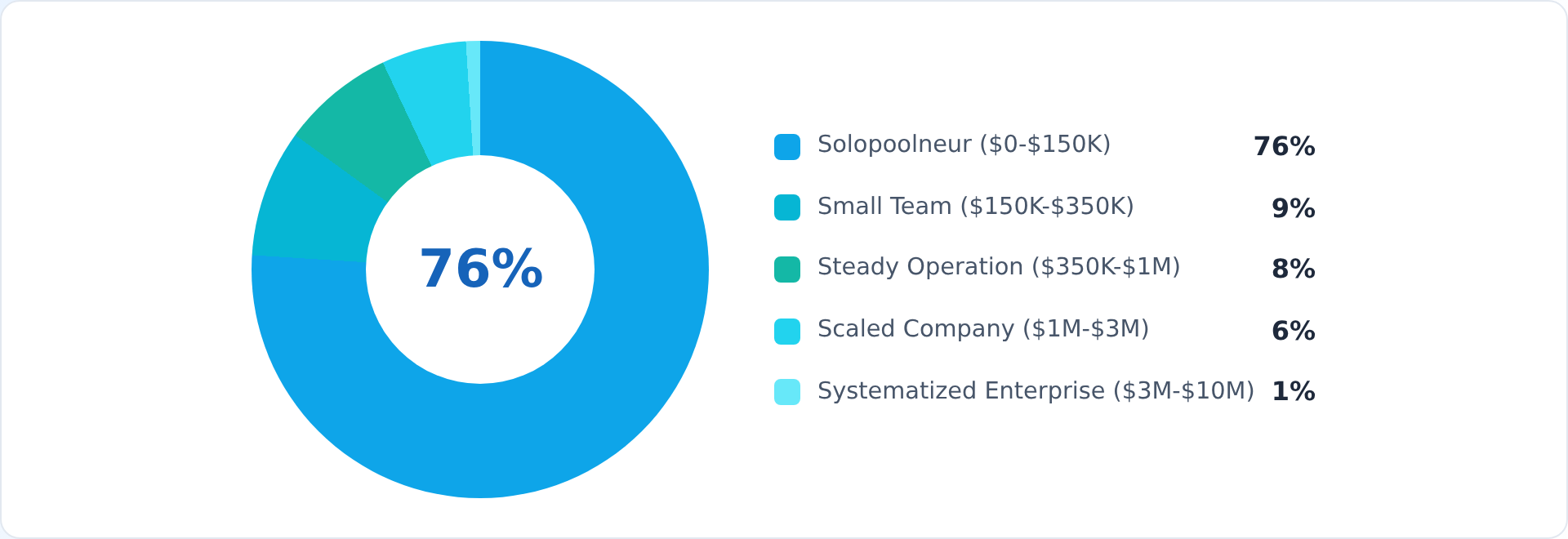
Key Insight: The vast majority of pool service businesses (76%) remain solo operations. This isn't necessarily a problem--many owners intentionally choose this path. The important thing is understanding what your specific blocker is and whether you want to address it.
Stage 1: The Solopoolneur ($0-$150K)
The Solopoolneur represents the largest segment of the pool service industry by far. At 76% of all pool service businesses, this is where most operators spend their careers--and for many, that's exactly the plan. The Solopoolneur is typically earning between $0 and $150,000 annually, working solo, and facing one overwhelming constraint: time.
The Reality of Solo Operations
As a Solopoolneur, you're wearing every hat. You're the technician cleaning pools, the salesperson closing new accounts, the accountant managing invoices, the customer service representative handling complaints, and the marketer trying to get the phone to ring. There are only so many hours in a day, and every hour spent on administrative work is an hour you're not earning money in the field.
According to industry research, the typical Solopoolneur:
- Services 40-80 pools per week
- Spends 25-40% of their time on non-billable activities
- Struggles to take vacations or time off
- Often works evenings and weekends on paperwork
Breaking Through the Time Barrier
Skimmer's framework identifies three key levers for Solopoolneurs looking to grow:
- Understand why customers hire you -- Before investing in marketing, know what makes customers choose your service over alternatives
- Build a referral system -- Happy customers are your best (and cheapest) source of new business
- Implement tools that reclaim time -- Automation for scheduling, billing, and customer communication can recover 10+ hours per week
Where PoolDial Helps: Solopoolneurs miss calls constantly--you're in the pool, on a ladder, or driving between stops. Every missed call is a potential customer who moves on to the next listing. PoolDial's AI receptionist answers every call 24/7, captures lead information, and books estimates directly into your calendar--so you focus on service while never missing an opportunity.
Stage 2: The Small Team ($150K-$350K)
Making the jump from solo to having even one employee changes everything. You've now got payroll to meet, someone else representing your company, and the need for consistent work flow to keep your team busy. Only 9% of pool service businesses reach this stage, and the primary blocker here is sales.
The Sales Challenge
When you were solo, you could survive on word-of-mouth and a handful of leads each month. With a team, you need a steady stream of new business to cover increased overhead and keep employees productive. The math is brutal: if your technician can service 60 pools per week but you only have 45, you're paying for capacity you're not using.
At this stage, Industry research shows businesses typically:
- Need 30-50% more recurring customers than a solo operation
- Face the challenge of selling while also managing operations
- Struggle with inconsistent lead flow
- Often underprice services because sales skills haven't been developed
Building a Sales Engine
According to the Skimmer framework, Small Team operators need to focus on:
- Recruiting the right people -- Your first hires set the culture and standard for everyone who comes after
- Creating a sales process -- Move from reactive (waiting for the phone to ring) to proactive (generating consistent leads)
- Training for consistent quality -- Your reputation now depends on someone else's work

Stage 3: The Steady Operation ($350K-$1M)
At 8% of pool service businesses, the Steady Operation represents a significant achievement. You've built a real company with multiple technicians, possibly some office support, and revenue approaching or exceeding $1 million. But this stage introduces a dual challenge: maintaining marketing momentum while ensuring service quality doesn't slip.
The Dual Challenge
This is the stage where many owners feel stuck between two fires. Growth requires continued marketing investment and lead generation, but every new customer puts pressure on service quality. Add one too many accounts without proper systems, and you start losing customers as fast as you acquire them.
Industry research highlights common Steady Operation challenges:
- Marketing costs increase faster than revenue
- Service callbacks and complaints rise with scale
- The owner can't personally oversee every job
- Customer retention becomes as important as acquisition
Building Systems That Scale
The framework recommends focusing on:
- Developing leadership below you -- You need people who can make decisions without your direct involvement
- Creating marketing systems -- Move from sporadic efforts to consistent, measurable campaigns. A pool-specific marketing agency can accelerate this significantly
- Standardizing service delivery -- Every customer should get the same high-quality experience regardless of which technician shows up
Where PoolDial Helps: At this stage, your phone is ringing constantly--existing customers with questions, new leads, vendor calls. PoolDial's AI receptionist handles routine inquiries, schedules service calls, and routes urgent matters appropriately. This frees your office staff to focus on quality control and customer retention rather than being tied to the phone.
Stage 4: The Scaled Company ($1M-$3M)
Only 6% of pool service businesses achieve Scaled Company status. At $1-3 million in revenue with 11-20 employees, you're running a substantial operation. But the primary blocker at this stage might surprise you: it's not sales, marketing, or even capital. It's hiring.
The People Problem
At this scale, your growth is directly limited by your ability to find, train, and retain quality employees. The pool service industry faces chronic labor shortages, and companies at this stage are competing not just for customers but for talent. Every open position represents lost capacity--pools you can't service, estimates you can't give, growth you can't achieve.
According to industry research, Scaled Companies typically:
- Spend 15-25% of management time on hiring and training
- Experience 30-50% annual technician turnover
- Lose potential revenue due to unfilled positions
- Face increasing wage pressure from competitors
Building a Talent Pipeline
The framework emphasizes:
- Creating a leadership team -- Multiple people who can hire, train, and manage without the owner
- Developing career paths -- Show technicians a future beyond just cleaning pools
- Building company culture -- Become a place where people want to work, not just a job
Stop Missing Growth Opportunities
At every growth stage, missed calls mean missed revenue. PoolDial's AI receptionist ensures you capture every lead, book every estimate request, and maintain professional communication--without hiring additional office staff.
Start Free TrialStage 5: The Systematized Enterprise ($3M-$10M)
The rarest category in pool service, comprising just 1% of all businesses. The Systematized Enterprise has solved the operational challenges that stop most companies. At $3-10 million in revenue with 21-50 employees, the business runs on systems rather than the owner's direct involvement. The blocker at this stage is strategy--the big-picture decisions about where the company goes next.
Strategic Decisions at Scale
At enterprise level, the questions change entirely. You're no longer asking "How do I grow?" but rather "Where should I grow?" and "What's the exit strategy?" Strategic decisions at this stage include:
- Geographic expansion versus market deepening
- Acquisition of smaller competitors
- Vertical integration (adding related services)
- Exit planning and valuation optimization
- Private equity or strategic partnership opportunities
Industry research shows that Systematized Enterprises:
- Operate with documented processes for every function
- Have multiple layers of management
- Generate consistent profits regardless of owner involvement
- Attract interest from acquirers and investors
Building for the Future
At this stage, the focus shifts to:
- Professionalizing operations -- Systems that would satisfy an investor or acquirer's due diligence
- Developing second-tier leadership -- People who could run the company if you stepped away
- Maximizing enterprise value -- Building a company worth more than the sum of its customer contracts
The Growth Funnel: Visualizing the Journey
Understanding where businesses actually are helps contextualize your own position. The funnel below shows how businesses distribute across stages--and why each transition is progressively more difficult.

The Challenge Evolution: How Blockers Change at Each Stage
One of the most valuable insights from industry research is how the primary challenge evolves as businesses grow. What holds you back at $100K won't be the same thing limiting you at $1M.

This progression explains why advice from a $5M company owner might not apply to your $200K business--and vice versa. The challenges are fundamentally different. A Solopoolneur needs time management and referral systems; a Scaled Company needs recruitment infrastructure and management depth.
Complete Stage Comparison
| Stage | Revenue | Team Size | Primary Blocker | % of Businesses |
|---|---|---|---|---|
| Solopoolneur | $0-$150K | 1 | Time | |
| Small Team | $150K-$350K | 2-4 | Sales | |
| Steady Operation | $350K-$1M | 5-10 | Marketing + Service | |
| Scaled Company | $1M-$3M | 11-20 | Hiring | |
| Systematized Enterprise | $3M-$10M | 21-50 | Strategy |
Owner's Intent: The Question Before Growth
Perhaps the most important insight from industry research isn't about growth at all--it's about clarity. Before asking "How do I grow?", Casey Graham recommends asking "Do I even want to?"
The framework introduces the concept of Owner's Intent: deliberately choosing where you want your business to be rather than defaulting into growth (or stagnation). Questions to consider:
- What lifestyle do you want? A $150K solo business with no employees offers freedom. A $3M operation with 20 employees offers income but also significant responsibility.
- What's your time horizon? Building to sell in 5 years requires different decisions than building for long-term lifestyle income.
- What energizes you? Some owners love the field work and customer relationships. Others love building systems and leading teams. Know yourself.
- What are you willing to sacrifice? Each stage requires trading something--time, control, simplicity, direct customer relationships.
Key Takeaway: There's no "right" stage. A profitable Solopoolneur with work-life balance has achieved something as valuable as an Enterprise owner with a larger exit. The goal is intentionality--knowing where you want to be and making deliberate decisions to get (or stay) there.
Practical Next Steps by Stage
If You're a Solopoolneur
- Track where your time actually goes for two weeks
- Identify which non-billable tasks could be automated or eliminated
- Build a simple referral program with existing customers
- Implement tools that answer calls and capture leads when you're in the field
If You're a Small Team
- Document your sales process and train others to use it
- Create a consistent lead generation system (not just referrals)
- Build training materials so new hires reach competency faster
- Establish quality standards that don't require your direct oversight
If You're a Steady Operation
- Identify and develop your next layer of leadership
- Create marketing systems that generate predictable lead flow
- Implement customer satisfaction measurement and tracking
- Build standard operating procedures for every customer touchpoint
If You're a Scaled Company
- Build a recruiting and training infrastructure
- Create career development paths for high performers
- Develop company culture deliberately, not by accident
- Consider what makes your company attractive to potential employees
If You're an Enterprise
- Document all systems to institutional quality
- Develop succession planning for key roles
- Consider strategic options: expansion, acquisition, or exit
- Build relationships with potential strategic partners or acquirers
Get the Complete Framework
This article provides an overview of industry research into pool service business growth stages.
Professional Communication at Every Stage
Whether you're a Solopoolneur missing calls in the field or an Enterprise ensuring consistent customer experience across locations, PoolDial's AI receptionist helps you capture every opportunity and provide professional service around the clock.
Start Free TrialKey Takeaways
- 76% of pool service businesses remain solo operations--this isn't failure, but it means understanding your specific blocker matters
- Each stage has a different primary blocker: Time, Sales, Marketing + Service, Hiring, Strategy
- Owner's Intent matters: Deliberately choosing your target stage is more valuable than defaulting into growth
- The right advice depends on your stage: What works at $1M may not apply at $100K (and vice versa)
- Transitions are where companies get stuck: Understanding the next blocker helps you prepare before it stops you
The pool service industry offers remarkable opportunity for those who understand the growth journey. Whether you choose to stay a profitable Solopoolneur or build toward an enterprise exit, the key is making that choice intentionally--and addressing the specific blockers that stand between you and your goal.