State of Pool Service 2026: Key Insights from 1,600+ Professionals


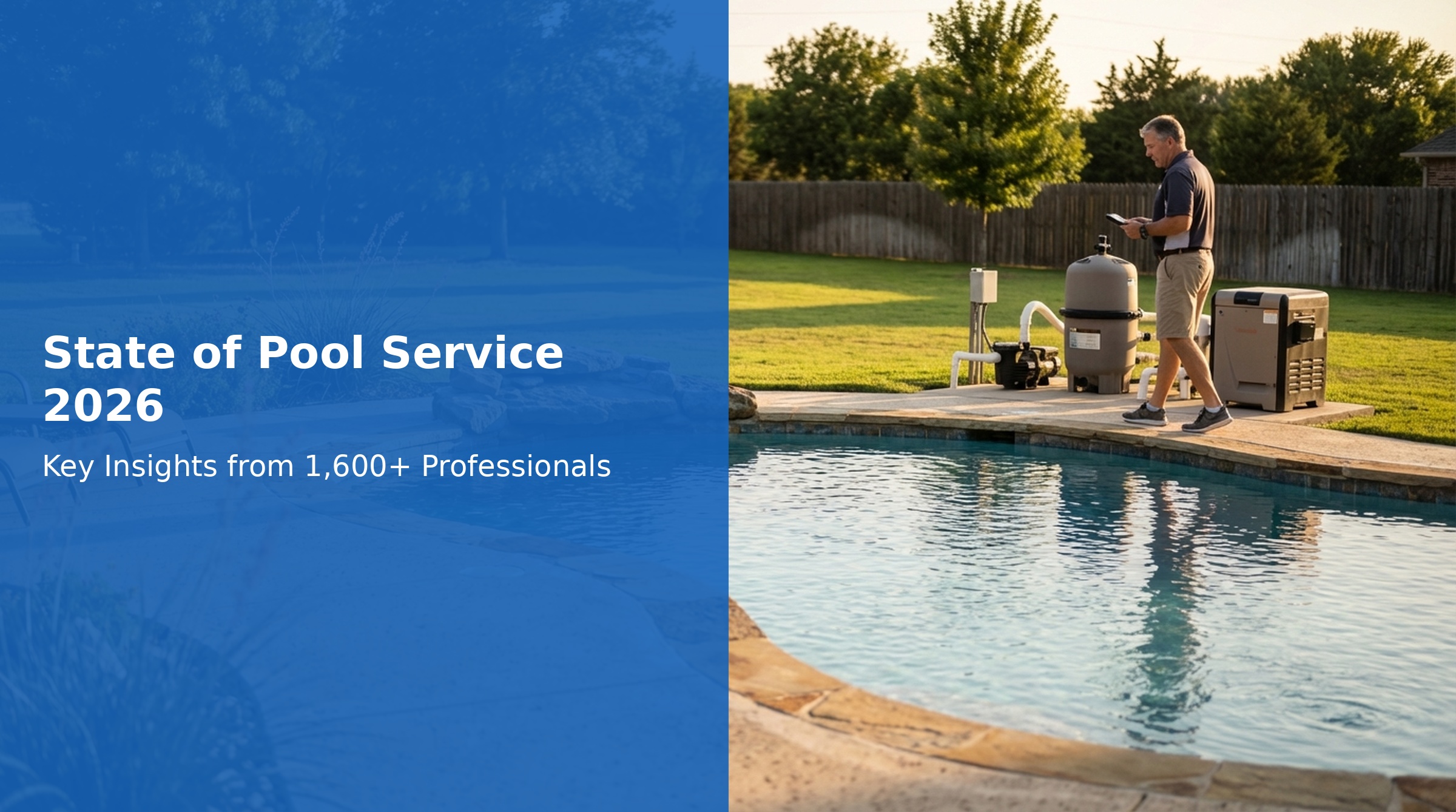
The pool service industry is entering 2026 with something it hasn't had in years: stability. According to Skimmer's third annual State of Pool Service Report—surveying over 1,600 pool professionals—the market is maturing, operators are running more structured businesses, and confidence is at a multi-year high.
Here's what the data reveals about pricing, hiring, technology adoption, and what success looks like in the year ahead.
Key Takeaways
- 84% of businesses expect higher revenue in 2026
- 58% plan price increases of 10% or less—disciplined, not aggressive
- 60% plan to hire, but teams remain lean
- 68% shopping for software want an all-in-one solution
- AI adoption is growing: 47% of companies are actively using or testing AI tools
Revenue Outlook: Grounded Optimism
The headline number: 84% of pool service businesses expect higher revenue in 2026 than in 2025. Only 3% anticipate a decline, and just 1% plan to sell.
This isn't irrational exuberance. It's grounded confidence based on:
- Stable recurring demand from 10.7 million U.S. pools
- Residential pool owners spending an average of ~$1,700/year on maintenance
- A $7.2 billion pool cleaning market growing toward $7.8 billion by 2029
The businesses driving this optimism aren't chasing unchecked growth. They're pursuing disciplined expansion—tighter pricing, measured hiring, and efficiency gains.
Biggest Challenges: The Same Trio Dominates
When owners rank what keeps them up at night, three issues consistently top the list:
- Economic conditions (inflation, interest rates, consumer spending) — 40% call this the #1 factor
- Finding and retaining talent — climbed to second place this year as qualified technicians become scarcer
- Rising costs (chemicals, materials, parts) — persistent margin pressure across the board
Competition and regulation rank lower. The real constraint? Qualified technicians are scarce, making onboarding, training, and retention critical for sustainable growth.
Tariffs: A Mild Headwind
Most pros expect some cost impact from tariffs:
- 47% expect slight cost increases
- 18% expect significant increases
- 20% are unsure
The uncertainty leaves room for volatility, especially in parts and repair categories. Smart operators are maintaining updated vendor agreements and revisiting equipment pricing.
Pricing Strategy: Disciplined and Measured
Pricing strategy has matured. Most companies plan modest increases rather than aggressive hikes:
The companies holding flat aren't ignoring costs—they've either made recent adjustments or are prioritizing growth in routes and staff. But flat pricing without cost visibility is risky. Even small chemical and labor increases compound across a route.
Use our Service Price Calculator to model different pricing scenarios, or the Price Increase Calculator to see how adjustments impact your annual revenue.
Chemical Billing Is Shifting
The biggest pricing evolution is how chemicals are handled:
This shift away from "chems included" reflects years of unpredictable chemical costs. Hybrid and plus-chems models protect margins without pushing service prices too high. See our Chemical Pricing Guide for detailed strategies.
Hiring: Controlled Expansion
Six in ten businesses plan to add employees in 2026. But the approach is disciplined:
Teams remain lean. More than half of businesses operate with 0-1 full-time office staff. But there's a subtle shift toward larger organizations—companies with 7+ technicians increased from 18% to 21% year-over-year.
W-2 Employment Is Rising
The industry is formalizing:
- 55% use W-2 employees (up from 52%)
- 30% use contractors
- 14% use both
W-2 structures give owners tighter control over training, scheduling, safety, and brand standards—all of which tie directly to consistency and customer experience. Use our Technician Compensation Calculator to model different pay structures.
Marketing: Lean, Local, and Referral-Led
Marketing budgets remain modest, but intentional. Nearly half of businesses plan to increase spend:
Referrals remain the #1 channel—65% of companies rely on them, and 51% say they deliver the best leads. The standout shift is SEO adoption, jumping 7 percentage points. Pool pros are investing more in showing up when homeowners Google "pool service near me."
For detailed strategies, see our Marketing Strategies Guide.
The $5K Marketing Budget Playbook
For companies with limited budgets, the report suggests:
Technology: Suites Over Point Tools
Software has become a differentiator. The most popular tools:
Among companies shopping for new software, 68% plan to buy an all-in-one solution. The trend is consolidation—fewer disconnected tools, tighter workflows. See our Pool Service Software Landscape for a detailed comparison.
AI: Cautious Experimentation
AI adoption is growing but measured:
Where owners see the most value:
- Reducing admin time — 47% rate this "very valuable"
- Customer communication (drafting emails, responding to reviews) — 39% using
- Marketing (ads, social media copy) — 29% using
Where owners draw the line:
- 40% would never trust AI with invoicing/payments
- 28% wouldn't trust it with quotes/estimates
- 29% wouldn't trust it with customer communication
The takeaway: AI is welcome as an assistant, not an autonomous agent—especially for revenue-critical tasks. Read more in our AI in Pool Service guide.
Customer Expectations Are Rising
Pool owners expect more professionalism:
Businesses that invested in communication, documentation, and technician consistency last season saw better customer satisfaction and stronger retention.
Private Equity: Watching, Not Panicking
PE roll-ups are more visible, but sentiment is measured:
Views on PE Consolidation
- 55% view it neutrally
- 26% view it negatively
- 19% view it positively
Would You Sell to PE?
- 38% say no (up 4 points from 2025)
- 34% are unsure
- 28% would consider it
Most owners aren't anti-PE—they're realistic. They're watching how roll-ups behave before deciding what it means for their business. With strong demand and rising professionalism, many see more value in building independently.
For valuation guidance, see our Pool Route Valuation Guide.
What Success Looks Like in 2026
The report identifies five priorities for operators who want to win:
The Bottom Line
The pool service industry isn't entering a year of upheaval. It's entering a year of steady, disciplined growth built on stronger fundamentals than ever before.
The gap between "organized" and "winging it" is growing wider. For operators ready to lean into tight processes, clear pricing, better tools, and consistent communication—2026 offers one of the most predictable growth landscapes the industry has seen in years.
Ready to Streamline Your Operations?
PoolDial helps pool service professionals manage routes, track customers, handle billing, and communicate with homeowners—all in one platform.
Start Free Trial