
The 4 Phases Every Pool Business Goes Through (And How to Skip the Burnout)


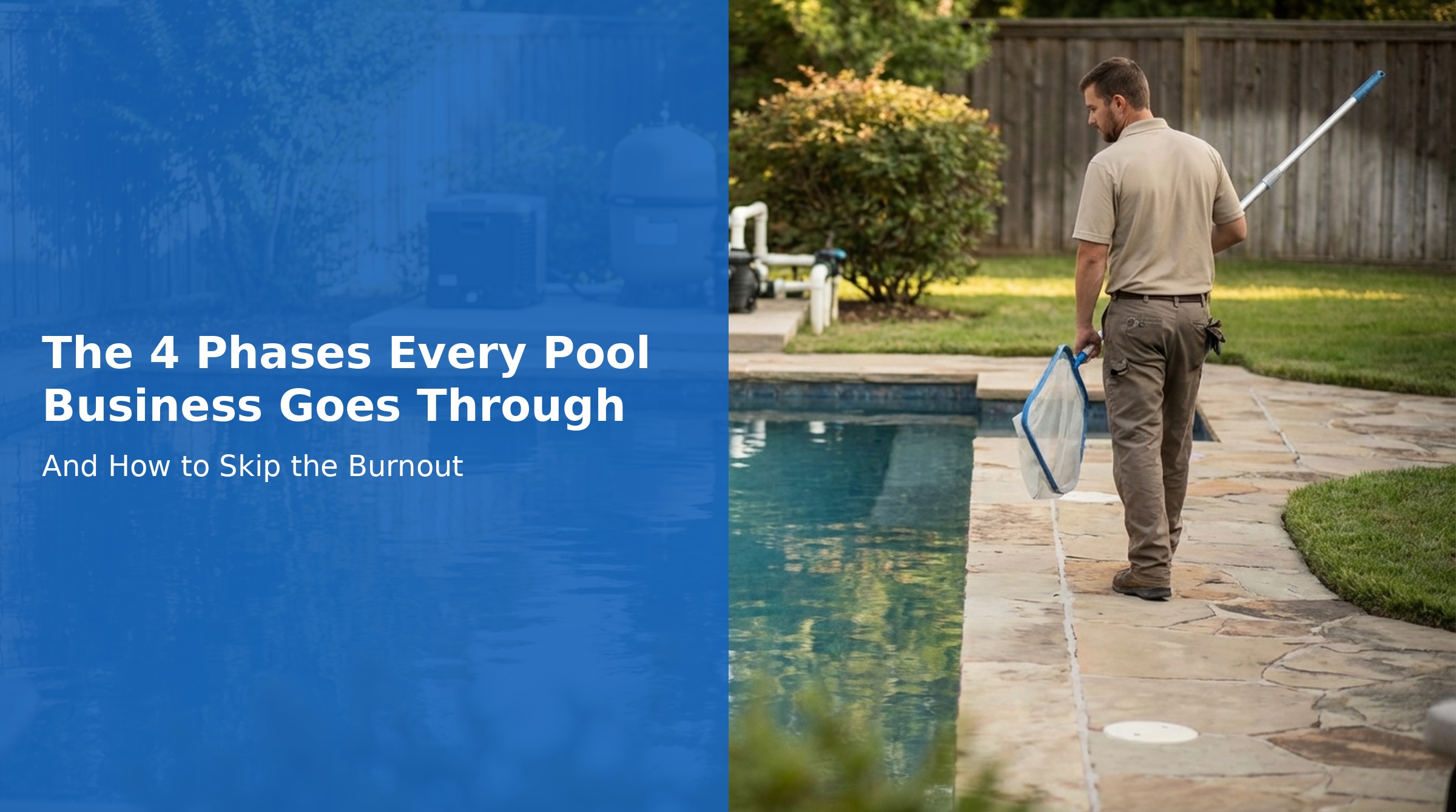
Here's a pattern we see over and over in the pool industry: A technician starts their own business, grinds for 5-7 years working seven days a week, and finally reaches a breaking point. They're making money—but they're not keeping any of it. They're exhausted. And they're wondering if this is really what they signed up for.
The hosts of the Pool Nation Podcast call this the "Roadmap to Profitability"—the predictable journey that almost every pool service business goes through. The problem? Most owners go through these phases in the wrong order, burning years of their life before they figure out what actually matters.
Understanding these four phases—and knowing which one you're stuck in—can save you years of grinding and help you build a business that actually pays you what you're worth.
The Four Phases of Pool Business Growth

Sound familiar? Here's the uncomfortable truth: Phase 4 should be Phase 1. The most successful pool companies we've talked to figured out the business side early—and it changed everything about their trajectory.
Phase 1: The Chemistry Obsession
When you first start a pool service business, you're terrified of one thing: turning a pool green and losing the customer. So you dive deep into water chemistry. pH, alkalinity, CYA, calcium hardness—you become obsessed with understanding every variable.
This makes sense. There's no formal training required to start a pool business, so most owners learn by doing. And the immediate threat—green pools and angry customers—drives all your attention to the technical side.
"Nobody got into this business thinking, 'I can't wait to learn about profit margins and cost accounting.' We all got into it because we thought we'd be outside, working with our hands, being our own boss."
The danger here isn't the focus on chemistry—it's the absence of business thinking. While you're mastering the difference between trichlor and dichlor, you're also probably:
- Underpricing your service because you don't know your true costs
- Taking on every customer who calls, regardless of profitability
- Not paying yourself a real salary
- Building habits that will haunt you for years
Phase 2: The Repairs Revelation
At some point—usually after you've rebuilt a valve or watched someone install a pump—a lightbulb goes off. You realize you just made more money in 30 minutes of repair work than you made servicing a pool all month.
This is the "cha-ching moment" that pulls most pool pros into repairs. And it creates a dangerous trap.
The logic seems sound: If repairs pay more per hour than service, I should do more repairs. So you start learning equipment—pumps, heaters, salt systems, automation. Each new skill opens up more revenue.
But here's what nobody tells you: repair revenue doesn't automatically mean repair profit. Without understanding your true costs, you might be quoting repairs at $600 when the job actually costs you $550. You're working harder and taking on more risk for $50.
Phase 3: The Burnout Crossroads
This is where most pool businesses either die or transform. You've been grinding for years. You've mastered service and repairs. You have a decent-sized route. And you're absolutely exhausted.

The symptoms of Phase 3 are unmistakable:
- Working 7 days a week with no end in sight
- Living on cash flow—whatever's in the account is your "salary"
- Chasing every account because losing one feels catastrophic
- No savings, no buffer for emergencies or slow seasons
- Resentment building toward customers, the industry, even the work itself

The brutal irony of Phase 3: you're busier than ever, but you might actually be losing money on some of your accounts. You don't know because you've never calculated your true cost per pool.
Phase 4: The Business Awakening
For the owners who don't quit at the crossroads, something shifts. They realize that all their technical expertise means nothing if they can't run a profitable business. So they start learning—really learning—the numbers.
"Without profit, you don't have a business. You have a job. And a bad one—because at least employees get paid consistently and get days off."
Phase 4 is about three fundamental shifts:
1. Knowing Your Numbers
This means calculating your actual cost per pool—not guessing, but knowing. When you add up labor, drive time, chemicals, equipment wear, insurance, and overhead, what does it actually cost you to service each stop?
For most pool pros, this is a wake-up call. They discover that pools they thought were profitable are actually losing money. That $125/month pool that seemed like easy money? After calculating true costs, it might be netting you $15—or costing you $10.
Use our Cost Per Pool Calculator to find out where you really stand.
2. Quality Over Quantity
Once you know your numbers, something counterintuitive becomes obvious: you can make more money with fewer pools.
Instead of chasing every account, you start being selective. You raise prices on underpriced accounts—and you're okay if some customers leave. You fire problem customers who take up disproportionate time. You focus on high-value accounts in tight geographic clusters.
"I used to think 200 pools was the goal. Now I know guys with 80 pools making more money than I was with 150—because they priced right, chose their customers carefully, and actually built a business instead of just a route."
3. Building Systems (Not Just Skills)
The final shift is from technician to business owner. This means building systems that don't depend on you being present for every decision.
Training systems so new hires become productive in days instead of weeks. Service checklists that ensure consistency. Route planning that maximizes efficiency. Pricing systems based on data, not gut feelings.
Systems create freedom. When your business doesn't live entirely in your head, you can actually take a day off. You can hire help. You can scale without burning out.
The Shortcut: Start with Phase 4 Thinking
Here's what the most successful pool business owners figured out: you don't have to wait until burnout to focus on profitability. You can start with Phase 4 thinking from day one.
This doesn't mean ignoring chemistry or avoiding repairs. It means making business decisions with profit in mind from the beginning:
Phase 4 Thinking From Day One
- Calculate your cost per pool before setting prices. Don't guess—use real numbers. Our Service Price Calculator can help.
- Pay yourself first. Set a salary and treat it as a fixed expense, not whatever's left over.
- Track your time obsessively. Know how long each pool actually takes, including drive time.
- Say no to bad customers. Not every account is worth having. Some customers cost you money.
- Build systems early. Document your processes now, even if you're solo. You'll thank yourself later.
- Review your numbers monthly. You can't improve what you don't measure.
Which Phase Are You In?
Be honest with yourself. Where are you right now?
If you're in Phase 1: Keep learning chemistry—but also learn your numbers. Calculate your cost per pool this week. Set prices based on data, not what your competitors charge.
If you're in Phase 2: Before taking on more repairs, make sure your service route is profitable. Create a simple spreadsheet tracking actual costs vs. revenue for each account.
If you're in Phase 3: You're at the crossroads. The next decision you make determines whether you build a real business or burn out completely. Start with one change: calculate your true cost per pool and identify your least profitable accounts.
If you're in Phase 4: Keep optimizing. There's always room to improve margins, systemize operations, and build a business that runs without you in the truck every day.
The Bottom Line
Every pool business goes through these phases. The question is whether you'll spend 5-7 years grinding through them the hard way, or whether you'll shortcut the process by focusing on profitability from the start.
The pool pros who thrive aren't necessarily better technicians. They're better business owners. They understand that a profitable 80-pool route beats an unprofitable 150-pool route every single time.
They've learned the lesson that took most of us years to figure out: profit isn't what's left over at the end of the month. Profit is what you plan for, measure, and protect—from day one.
Know Your Numbers
Stop guessing and start managing your pool business with real data. PoolDial helps you track costs, manage routes, and build a profitable business.
Start Your Free Trial