


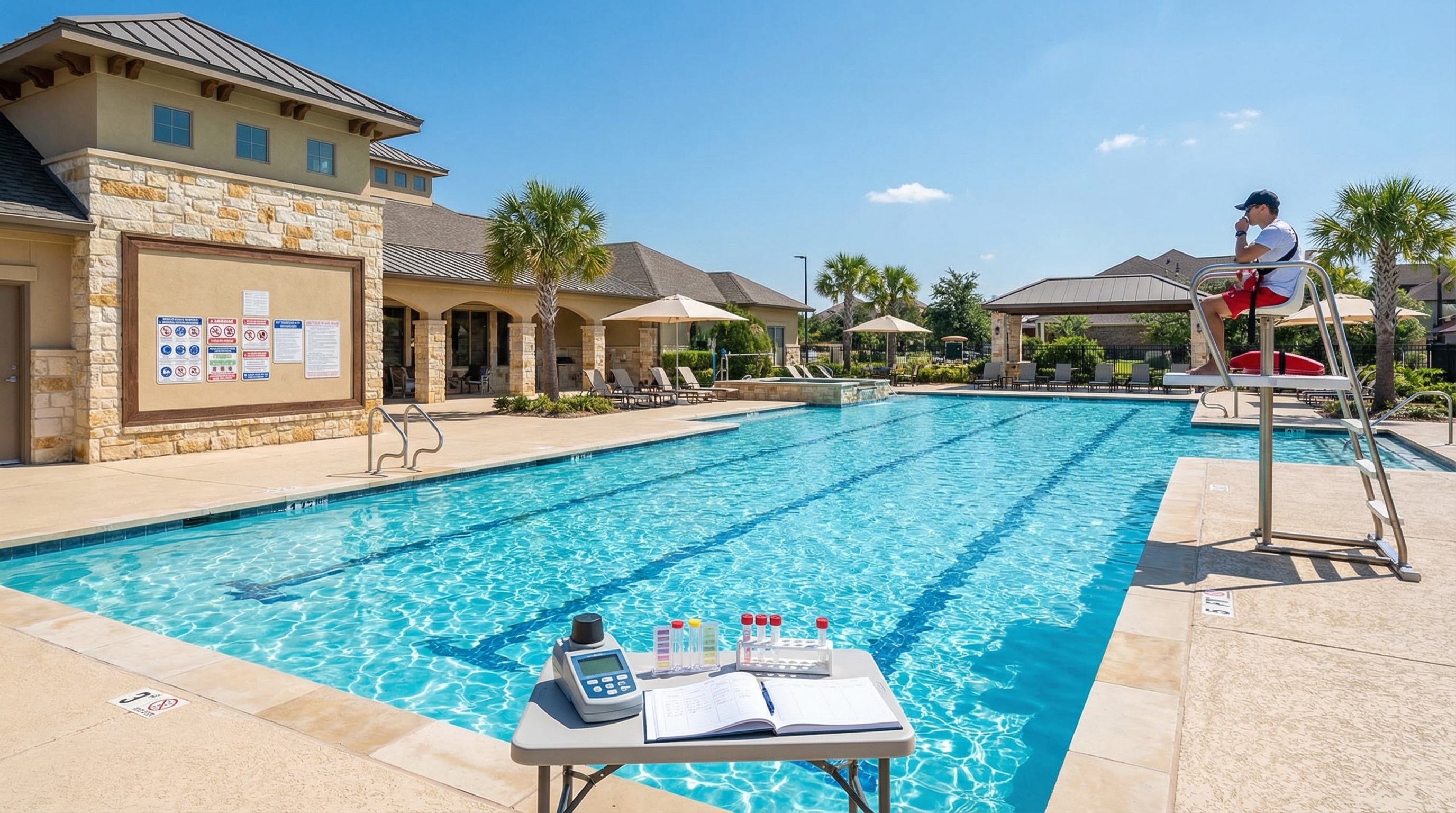
Public swimming pools and spas in Texas are governed by the Texas Administrative Code (TAC) Title 25, Chapter 265. These rules establish the minimum standards for "operation and management, water quality, safety standards... and safety features intended to reduce to a practical minimum the possibility of drowning". Whether a pool is in a municipal park, a hotel, or an apartment complex, it must adhere to these rigorous health and safety protocols.[1]25 TAC Chapter 265Public Swimming Pools and Spasdshs.texas.gov
Key Takeaways
- CPO Requirement — All public pools must be supervised by a trained and certified operator[1]25 TAC Chapter 265Public Swimming Pools and Spasdshs.texas.gov
- Classifications — Pools are categorized as Class A (competitive), Class B (public), or Class C (hotels/apartments)[1]25 TAC Chapter 265Public Swimming Pools and Spasdshs.texas.gov
- Chlorine Limits — Free available chlorine must be maintained between 1.0 and 8.0 ppm for pools[1]25 TAC Chapter 265Public Swimming Pools and Spasdshs.texas.gov
- Testing Frequency — Disinfectant and pH must be tested as often as every 2 hours for Class A and B pools[1]25 TAC Chapter 265Public Swimming Pools and Spasdshs.texas.gov
- Safety Gear — Reaching poles (12 ft) and ring buoys are mandatory based on pool size[1]25 TAC Chapter 265Public Swimming Pools and Spasdshs.texas.gov
- No Lifeguard Signs — Specific 4-inch lettering is required if a lifeguard is not on duty[1]25 TAC Chapter 265Public Swimming Pools and Spasdshs.texas.gov
Pool Classifications and Personnel
Texas divides public aquatic venues into three distinct classes, each with its own set of rules. Class A pools are those used for accredited competitive events; Class B pools are open to the general public (like city pools); and Class C pools are limited to residents or members, such as those at apartments, HOAs, or hotels. Regardless of the class, all these facilities must be under the direction of a "properly trained and certified operator".[1]25 TAC Chapter 265Public Swimming Pools and Spasdshs.texas.gov
"All Class A, Class B, and Class C pools and spas must be maintained under the supervision and direction of a properly trained and certified operator." — 25 TAC §265.194(b)
The operator does not need to be on-site 24/7, but they are responsible for ensuring staff is trained in day-to-day operations and that the circulation system is functioning correctly. Recognized certifications include the NSPF's Certified Pool Operator (CPO) and the NRPA's Aquatic Facility Operator (AFO).[2]DSHS Laws and RulesPublic Swimming Pools and Spasdshs.texas.gov
Water Quality and Testing Standards
Water chemistry is the primary focus of health inspections. For a public pool, free available chlorine must be kept between 1.0 and 8.0 parts per million (ppm), while pH must be maintained between 7.0 and 7.8. If cyanuric acid (stabilizer) is used, it cannot exceed 100 ppm, and its use is strictly prohibited in all indoor pools and spas.[1]25 TAC Chapter 265Public Swimming Pools and Spasdshs.texas.gov
The frequency of testing depends on the pool's classification and the equipment used. For Class A and B pools, staff must test and record disinfectant levels and pH every two hours. For Class C pools with on-site staff, the requirement is three times per day; if no staff is on-site, it is once per day. These logs must be maintained for three years and be available for inspection by the Department of State Health Services (DSHS) or local health authorities.[1]25 TAC Chapter 265Public Swimming Pools and Spasdshs.texas.gov
Water clarity is also strictly regulated. The main drain at the deepest point of the pool must be clearly visible from the pool deck at all times. This visibility requirement ensures lifeguards and operators can quickly identify submerged bathers in distress.
Mandatory Safety Equipment and Signage
Physical safety equipment is a non-negotiable requirement for public pools. Every facility must have at least one non-telescoping reaching pole (minimum 12 feet long) with a shepherd's crook and one USCG-approved ring buoy with a throwing rope. These items must be "visible and readily accessible from all areas of the pool yard".[1]25 TAC Chapter 265Public Swimming Pools and Spasdshs.texas.gov
Signage is equally critical. If a facility does not provide a lifeguard, it must post a sign stating "WARNING-NO LIFEGUARD ON DUTY" in letters at least 4 inches high. Other required signs include "No Diving" markers, emergency 911 directions, and notices regarding diarrhea and pet prohibitions. Furthermore, every public pool must have an emergency summoning device (like a landline phone or emergency call box) within 200 feet of the water that is capable of reaching 911 directly.[1]25 TAC Chapter 265Public Swimming Pools and Spasdshs.texas.gov
Requirements Summary
| Category | Standard | Citation |
|---|---|---|
| Chlorine (Pool) | 1.0 ppm min / 8.0 ppm max | 25 TAC §265.190 |
| pH Level | 7.0 min / 7.8 max | 25 TAC §265.190 |
| CPO Certification | Required for all Public Classes | 25 TAC §265.194 |
| Reaching Pole | 12 feet, non-telescoping | 25 TAC §265.199 |
| 911 Phone | Required within 200 feet of water | 25 TAC §265.199 |
| Log Retention | 3 years | 25 TAC §265.196 |
Sources
- [1] 25 TAC Chapter 265, Public Swimming Pools and Spas. dshs.texas.gov
- [2] DSHS Laws and Rules, Public Swimming Pools and Spas. dshs.texas.gov