
What is Acid Demand Test?

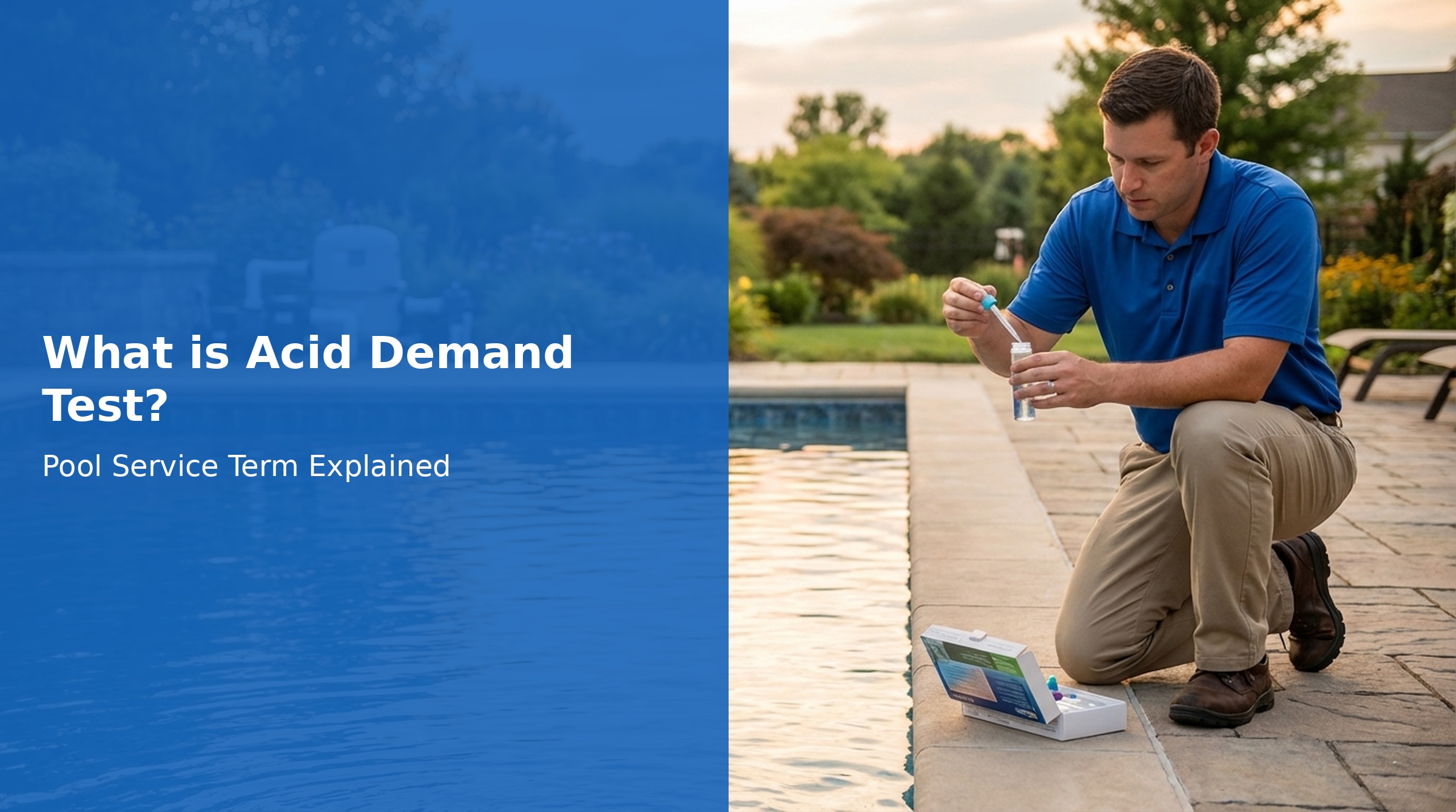
When it comes to precision pool chemistry, experienced pool service professionals know that generic dosing charts can only take you so far. While these charts provide helpful starting points, they often fall short when dealing with pools that have unique water chemistry profiles or require exact pH adjustments. This is where the Acid Demand Test becomes an invaluable tool in your professional arsenal.
Key Takeaways
- Acid Demand Tests provide precise acid dosing calculations rather than relying on general charts
- The test uses titration methodology to determine exact acid requirements for pH adjustment
- Most accurate for pools with high total alkalinity, unusual chemistry, or when precision is critical
- Can prevent over-dosing that leads to pH bounce and customer complaints
- Essential skill for pool professionals managing commercial pools or problem residential accounts
Understanding the Acid Demand Test
The Acid Demand Test is a precise titration procedure that determines the exact amount of acid needed to lower a pool's pH to your target level. Unlike standard dosing charts that provide generalized recommendations based on pool volume and current pH readings, this test accounts for your pool's specific water chemistry characteristics, including total alkalinity, dissolved solids, and buffering capacity.
The test works by taking a measured water sample and adding small, controlled amounts of acid while monitoring the pH change. This process reveals how your specific pool water will respond to acid additions, giving you the exact dosage needed before you add any chemicals to the actual pool.
Why Standard Dosing Charts Fall Short
Most pool professionals start their careers relying on dosing charts, and while these tools serve an important purpose, they have significant limitations. Standard charts assume average conditions: typical total alkalinity levels, normal dissolved solid content, and predictable buffering capacity. In reality, every pool is different.
Consider a pool with total alkalinity of 200 ppm versus one with 80 ppm. Both pools might have the same starting pH of 8.2, but they'll require dramatically different amounts of acid to reach a target pH of 7.4. The high-alkalinity pool will resist pH change much more strongly, requiring significantly more acid than any standard chart would suggest.
When to Perform an Acid Demand Test
While you won't need to perform this test on every service call, certain situations make it essential for professional-quality results:
High Total Alkalinity Situations
Pools with total alkalinity above 150 ppm often exhibit strong buffering that makes pH adjustments unpredictable. Without an Acid Demand Test, you might find yourself in a cycle of adding acid, seeing minimal pH change, adding more acid, and eventually overshooting your target, leading to the dreaded pH bounce.
New Customer Accounts
When taking over a new pool service account, performing an Acid Demand Test helps you understand that pool's unique chemistry signature. This initial investment of time prevents future problems and demonstrates your professional expertise to the customer.
Problem Pools with Persistent pH Issues
Some pools seem to fight every attempt at pH adjustment. These challenging accounts often have unusual water chemistry due to factors like certain types of sanitizers, mineral systems, or source water characteristics. An Acid Demand Test cuts through the guesswork and provides reliable dosing information.
Commercial and High-Volume Pools
Commercial pools, with their larger volumes and higher chemical demands, make precision dosing both more important and more cost-effective. Over-dosing acid in a 50,000-gallon commercial pool can create expensive problems and potential safety issues.
Performing the Acid Demand Test
The test procedure requires basic titration equipment and careful attention to detail. You'll need a water sample, typically 25 mL, measured acid solution, and a reliable pH testing method.
Step-by-Step Procedure
Start by collecting a representative water sample from the pool, ensuring it reflects the current water chemistry. Measure exactly 25 mL into your testing vessel and record the starting pH. Add acid solution in small, measured increments while stirring gently and monitoring pH changes after each addition.
Continue this process until you reach your target pH, carefully tracking the total amount of acid used. The key to accuracy lies in using small increments and allowing time for the pH to stabilize between additions.
Once you've determined how much acid was needed for your 25 mL sample, calculate the full-pool dosage using the ratio of your sample size to the total pool volume.
Calculating Pool Dosage
The math is straightforward but critical. If your 25 mL sample required 0.1 mL of acid solution to reach your target pH, and you're working with a 20,000-gallon pool, you'll scale up proportionally. Remember to account for the concentration of your test acid versus the actual pool acid you'll be using.
Integrating with Modern Pool Chemistry Management
While the Acid Demand Test provides unparalleled accuracy for pH adjustment, it works best when combined with comprehensive water balance management. Consider how your pH adjustments will affect other parameters, particularly when working with pools that require careful Langelier Saturation Index management.
Professional pool service software and chemical dosage calculators can incorporate your Acid Demand Test results into broader treatment planning, ensuring that your precise pH adjustments support overall water balance rather than creating new problems.
Professional Benefits and Customer Value
Mastering the Acid Demand Test sets you apart from competitors who rely solely on generic dosing approaches. Customers notice when their pool chemistry remains stable week after week, without the pH swings that characterize less precise chemical management.
This precision also reduces your chemical costs and callbacks. When you dose accurately the first time, you eliminate waste from over-treatment and avoid return trips to correct chemistry problems.
For pool professionals building their expertise, understanding advanced techniques like the Acid Demand Test demonstrates the depth of knowledge that separates true professionals from basic service providers. Consider expanding your technical vocabulary with resources like our comprehensive pool service terminology glossary.
Conclusion
The Acid Demand Test represents the difference between adequate pool service and professional-grade chemistry management. While it requires additional time and equipment investment, the results speak for themselves: more stable pH levels, fewer customer complaints, reduced chemical waste, and the confidence that comes from precision rather than guesswork.
In an industry where water chemistry expertise increasingly differentiates successful businesses, tools like the Acid Demand Test provide both immediate practical benefits and long-term competitive advantages. Master this technique, and you'll find that even the most challenging pool chemistry situations become manageable with the right approach and professional-grade testing methods.