What is Free Chlorine (FC) in Pool Water?

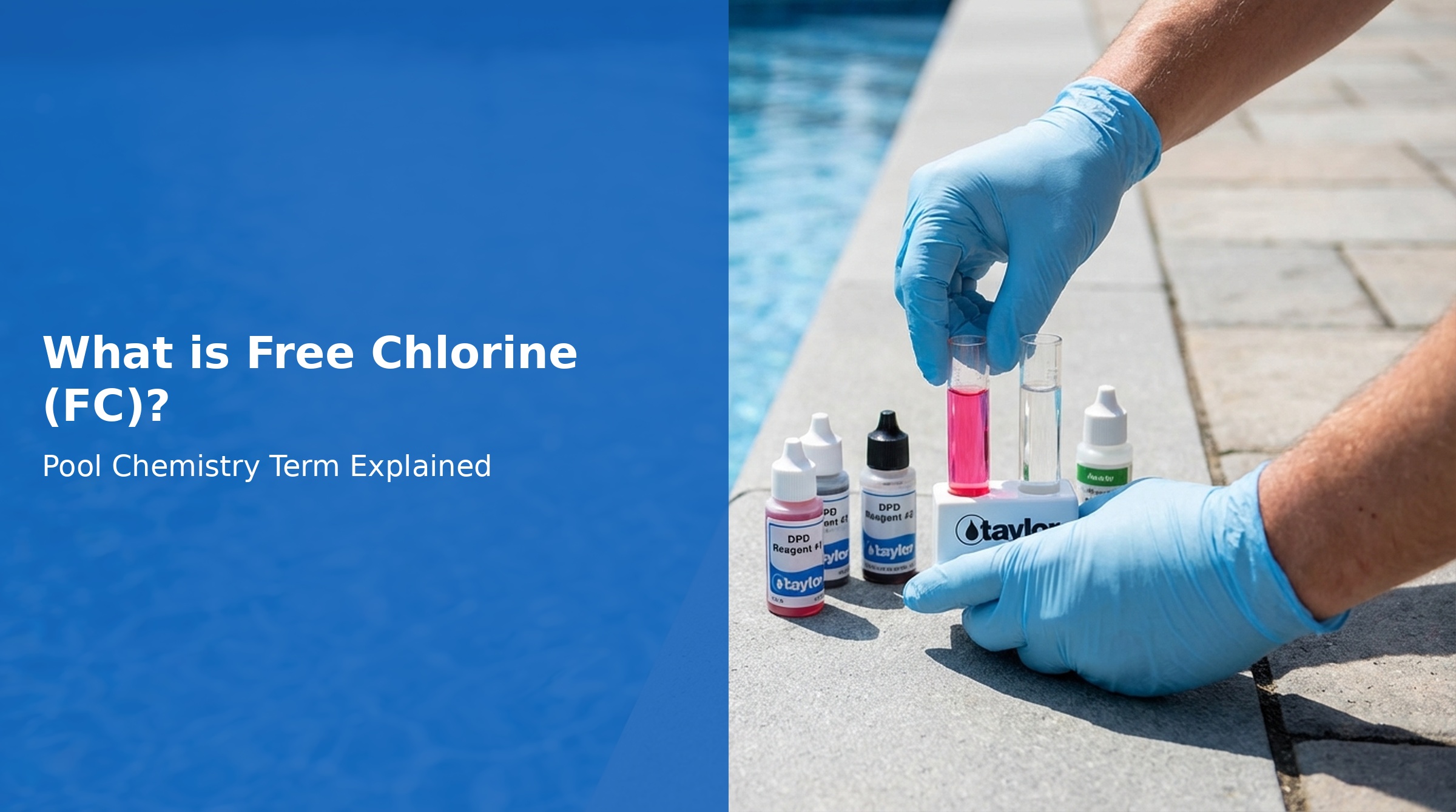
Free Chlorine (FC) is the amount of chlorine available in your pool water to actively sanitize and disinfect. It's the chlorine that's actually doing the work—killing bacteria, viruses, algae, and other contaminants that make pools unsafe for swimmers.
Quick Summary
- What it is: Chlorine available to kill germs and sanitize water
- Ideal range: 1-3 ppm for residential pools, 3-5 ppm for commercial
- How to test: DPD test kits, test strips, or digital testers
- How to raise: Add liquid chlorine, granular shock, or chlorine tablets
- How to lower: Wait for sun/UV to dissipate, add sodium thiosulfate, or dilute
Understanding free chlorine is essential for every pool service professional. It's the single most important water chemistry reading for pool sanitation, and maintaining proper FC levels is the foundation of safe, clear pool water.
FC vs CC vs TC: Understanding the Difference
Pool chlorine exists in three forms, and understanding each is crucial for proper water management:
| Type | What It Is | Purpose |
|---|---|---|
| Free Chlorine (FC) | Active, available chlorine | Sanitizes and kills contaminants |
| Combined Chlorine (CC) | Chlorine bound to ammonia/nitrogen | No longer effective; causes chlorine smell and irritation |
| Total Chlorine (TC) | FC + CC combined | Overall chlorine measurement |
Key insight: If TC is significantly higher than FC, you have a combined chlorine problem. Combined chlorine (also called chloramines) is what causes the "chlorine smell" at pools and can irritate eyes and skin. The solution is typically shocking the pool to break down the chloramines.
Ideal Free Chlorine Levels
The target FC level depends on your pool type, bather load, and local regulations:
| Pool Type | Ideal FC Range | Notes |
|---|---|---|
| Residential pools | 1-3 ppm | Most homeowner pools |
| Commercial pools | 3-5 ppm | Higher bather load requires more sanitizer |
| Hot tubs/spas | 3-5 ppm | Warm water and jets require higher levels |
| Saltwater pools | 1-3 ppm | Salt cell generates chlorine continuously |
The FC/CYA Relationship
Free chlorine effectiveness depends on your Cyanuric Acid (CYA) level. CYA protects chlorine from UV degradation but also reduces its killing power. Higher CYA means you need higher FC to achieve the same sanitation.
A common rule of thumb: maintain FC at approximately 7.5% of your CYA level for adequate sanitation. For example:
- CYA 30 ppm → Target FC around 2-3 ppm
- CYA 50 ppm → Target FC around 4-5 ppm
- CYA 80 ppm → Target FC around 6-7 ppm
This is why pools with very high CYA (100+ ppm) struggle to stay sanitized even with seemingly adequate chlorine readings.
How to Test Free Chlorine
There are several methods for testing FC, each with pros and cons:
DPD Test Kits
The most accurate field method. DPD (N,N-diethyl-p-phenylenediamine) reagent reacts with chlorine to produce a pink color. The intensity indicates chlorine level.
- DPD #1 measures Free Chlorine
- DPD #3 (added after #1) measures Total Chlorine
- The difference = Combined Chlorine
Test Strips
Quick and convenient but less accurate. Good for routine checks but not precise enough for troubleshooting. Compare strip color to chart within 15-30 seconds of dipping.
Digital Testers
Electronic meters that give digital readings. More expensive but eliminate color-matching errors. Require calibration and proper maintenance.
FAS-DPD Test
The gold standard for accuracy, especially at higher chlorine levels. Uses titration (drop counting) rather than color comparison. Essential for SLAM (Shock Level and Maintain) processes.
How to Raise Free Chlorine
When FC is too low, add chlorine using one of these methods:
Liquid Chlorine (Sodium Hypochlorite)
The professional's choice for regular chlorination. Typically 10-12.5% strength.
- Fast-acting, no residue
- Raises pH slightly (add acid to compensate)
- Use our chemical dosage calculator for precise amounts
Granular Shock (Calcium Hypochlorite)
Cal-hypo is about 65-73% available chlorine. Good for shock treatments.
- Must pre-dissolve in bucket before adding to pool
- Adds calcium to water (watch calcium hardness in hard water areas)
- Never mix with other chemicals
Chlorine Tablets (Trichlor)
Slow-dissolving tabs for continuous chlorination in feeders or floaters.
- Contains CYA—will raise stabilizer over time
- Acidic—lowers pH
- Don't place directly in skimmer (can damage equipment)
Salt Chlorine Generator
Saltwater pools generate chlorine from salt via electrolysis. Adjust cell output percentage or run time to raise FC.
Track Chemical Readings Across All Your Pools
PoolDial helps pool service professionals log water chemistry, track trends, and ensure consistent sanitation across every pool on your route.
Book a DemoHow to Lower Free Chlorine
Over-chlorinated water rarely requires intervention—chlorine naturally dissipates. But if you need to speed things up:
Wait It Out
Sunlight (UV) and bather load naturally consume chlorine. Uncover the pool and let nature work. FC drops 1-2 ppm per day in direct sunlight with no CYA.
Sodium Thiosulfate
A chlorine neutralizer that works quickly. Use carefully—it's easy to overshoot and remove all chlorine.
Partial Drain and Refill
Dilute the chlorine by replacing some water. Also helps if CYA is too high.
Common Free Chlorine Problems
FC Won't Stay Up
Possible causes:
- Low CYA: Chlorine burns off in sunlight without stabilizer
- High demand: Algae, bacteria, or contaminants consuming chlorine
- Phosphates: While controversial, very high phosphates can increase chlorine consumption
- Salt cell issues: If saltwater, check cell for buildup or failure
FC Too High
Usually from over-treating or salt cell running too long. Rarely dangerous but can bleach liners and irritate skin at very high levels (10+ ppm). Wait it out or neutralize.
Chlorine Smell Despite "Normal" FC
This indicates high combined chlorine. The smell is chloramines, not free chlorine. Solution: superchlorinate (shock) to break down chloramines. Target breakpoint chlorination at 10x your CC reading.
FC Testing Tips for Pool Pros
- Test FC and pH together: pH affects chlorine effectiveness dramatically
- Test before adding chemicals: Get a baseline before treating
- Test in shade: Direct sunlight can affect reagent accuracy
- Replace reagents annually: Old test chemicals give false readings
- Sample from elbow depth: Surface water may not represent the whole pool
Related Terms
Expand your pool chemistry knowledge with these related concepts from our pool service terminology glossary:
- CYA (Cyanuric Acid) - Chlorine stabilizer
- Total Chlorine - FC + CC combined
- Breakpoint Chlorination - Shocking to destroy chloramines
- PPM - Parts per million measurement