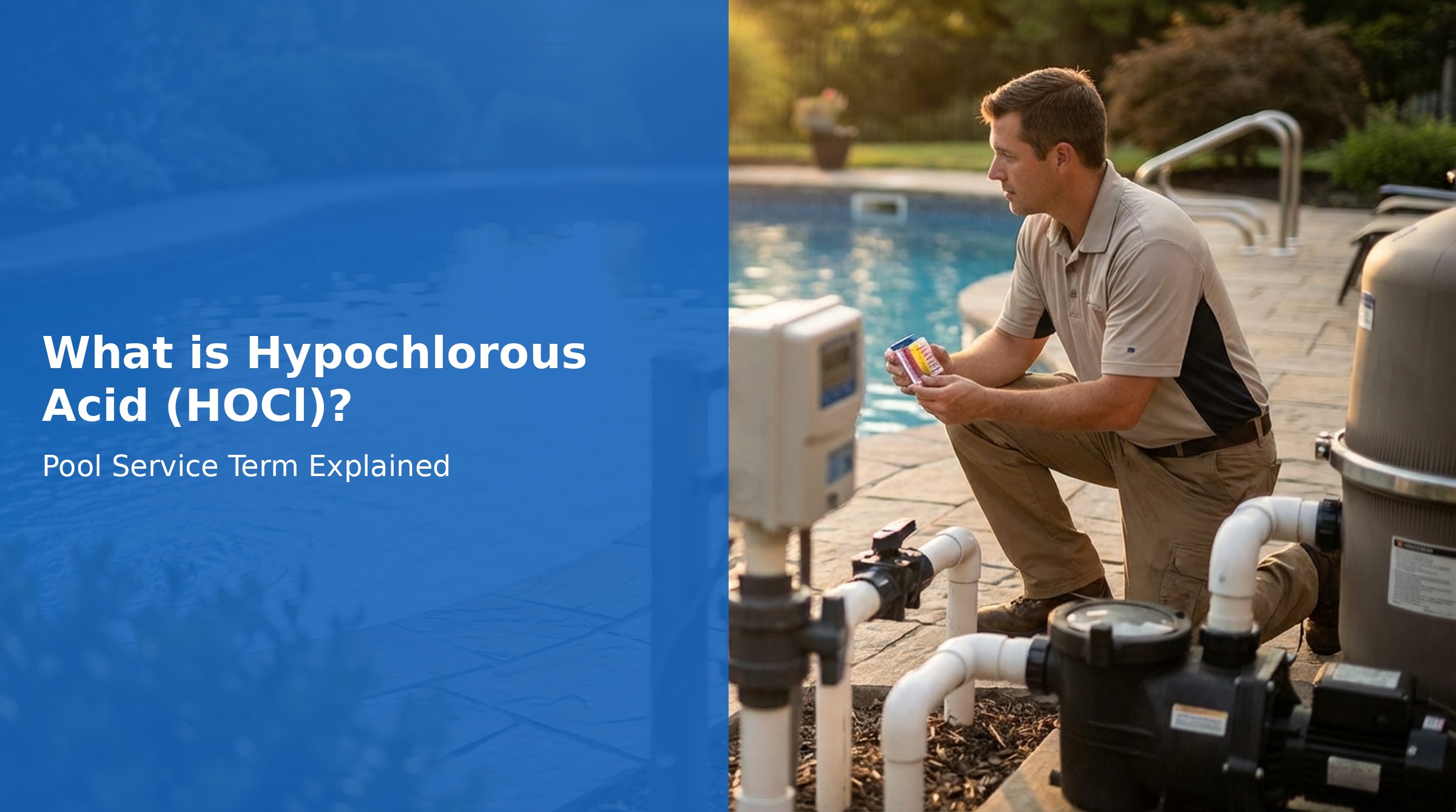
What is Hypochlorous Acid (HOCl)?

When pool service professionals talk about sanitization, the conversation inevitably leads to chlorine. But what most pool owners don't realize is that the chlorine they add to their pool isn't the actual sanitizer doing the heavy lifting. That honor belongs to hypochlorous acid (HOCl), the true workhorse of pool sanitization. Understanding HOCl and how to optimize its formation can dramatically improve your service efficiency and client satisfaction while reducing chemical costs.
Key Takeaways
- Hypochlorous acid (HOCl) is the active sanitizing form of chlorine in pool water
- pH levels directly impact HOCl effectiveness: lower pH = more active sanitizer
- At pH 7.2, chlorine is 66% effective; at pH 7.5, effectiveness drops to 50%
- Proper pH management can reduce chemical usage and improve sanitization
- Temperature and cyanuric acid levels also affect HOCl concentration
What Is Hypochlorous Acid (HOCl)?
Hypochlorous acid is the molecular form of chlorine that actually kills bacteria, viruses, and algae in pool water. When you add any chlorine-based sanitizer to a pool—whether liquid chlorine, granular chlorine, or chlorine tablets—it dissolves and forms a chemical equilibrium between two compounds: hypochlorous acid (HOCl) and hypochlorite ions (OCl⁻).
Think of it this way: the chlorine you add is like raw material, but HOCl is the finished product that does the sanitizing work. The proportion of each compound depends primarily on the pool's pH level, which is why pH management is so critical for effective sanitization.
HOCl is approximately 80-100 times more effective at killing pathogens than its counterpart, the hypochlorite ion. This massive difference in killing power explains why two pools with identical total chlorine readings can have vastly different sanitization effectiveness based solely on their pH levels.
The pH-HOCl Connection: Why It Matters for Pool Professionals
Understanding the Relationship
The relationship between pH and HOCl formation follows a predictable pattern that every pool service professional should memorize:
- pH 7.0: Approximately 80% HOCl, 20% OCl⁻
- pH 7.2: Approximately 66% HOCl, 34% OCl⁻
- pH 7.5: Approximately 50% HOCl, 50% OCl⁻
- pH 8.0: Approximately 22% HOCl, 78% OCl⁻
This data reveals why maintaining proper pH levels is more important than simply achieving target chlorine readings. A pool with 3 ppm total chlorine at pH 7.2 has roughly 2 ppm of active sanitizer, while the same chlorine level at pH 8.0 provides only 0.66 ppm of effective sanitization.
Real-World Impact on Service Routes
Consider this scenario: You're servicing two identical pools with the same bather load and environmental conditions. Pool A maintains pH at 7.2, while Pool B consistently runs at pH 7.8. Pool B will require significantly more chlorine to achieve the same level of sanitization, leading to higher chemical costs and potentially more frequent algae issues.
By prioritizing pH correction before adjusting chlorine levels, you can often resolve sanitization issues without adding more chemicals. This approach saves money for clients and demonstrates your expertise in water chemistry fundamentals.
Factors Affecting HOCl Formation
Temperature Considerations
Water temperature also influences the HOCl/OCl⁻ equilibrium, though to a lesser extent than pH. Higher temperatures slightly favor hypochlorite ion formation, meaning hot summer pools may require more attention to pH management to maintain optimal HOCl levels.
Cyanuric Acid Impact
Cyanuric acid (CYA) complicates HOCl availability by binding with chlorine molecules, making them temporarily unavailable for sanitization. While CYA protects chlorine from UV degradation, excessive levels can significantly reduce effective HOCl concentration. The ideal CYA range of 30-50 ppm balances protection with availability.
For precise CYA management, consider using our cyanuric acid calculator to determine optimal levels for your specific pools.
Practical Applications for Pool Service Professionals
Service Route Optimization
Understanding HOCl chemistry allows you to work smarter, not harder. Instead of automatically adding chlorine when test results show low readings, first check pH levels. Often, lowering pH from 7.8 to 7.2 can effectively double your sanitizer strength without adding any chemicals.
This approach is particularly valuable during algae treatment. Rather than shocking with massive chlorine doses at high pH levels, first lower the pH to maximize HOCl formation, then add chlorine. This method uses fewer chemicals and achieves faster results.
Client Communication
Educating clients about HOCl helps justify the importance of regular professional service. When pool owners understand that pH management directly affects sanitizer effectiveness, they're more likely to appreciate your expertise and less likely to skip service appointments.
Use simple analogies: "Think of pH like the gas pedal for your chlorine. Even with a full tank of gas, you won't get far if you can't press the accelerator."
Troubleshooting Common HOCl-Related Issues
Recurring Algae Problems
Persistent algae issues despite adequate chlorine readings often indicate poor HOCl formation due to high pH. Before increasing chlorine dosage, test pH and lower it to 7.2-7.4. Many algae problems resolve within 24-48 hours of proper pH correction.
Chlorine Demand Issues
Pools that seem to "eat" chlorine rapidly may suffer from pH-related HOCl deficiency. High pH levels mean most of your added chlorine exists as the less effective hypochlorite ion, requiring more frequent additions to maintain sanitization.
For accurate chemical dosing calculations, utilize our chemical dosage calculator to determine precise amounts needed for pH and chlorine adjustments.
Advanced HOCl Management Strategies
Professional pool services can implement several strategies to optimize HOCl formation:
- Priority pH Testing: Always test and adjust pH before evaluating chlorine needs
- Automated pH Control: For commercial accounts, recommend automated pH controllers to maintain optimal levels
- Alternative Sanitizers: Consider salt chlorine generators or UV systems that produce HOCl more directly
- Regular Water Balance: Use tools like the Langelier Saturation Index calculator to maintain overall water balance
Conclusion
Mastering hypochlorous acid chemistry sets professional pool services apart from basic maintenance providers. By understanding how pH affects HOCl formation and implementing proper management strategies, you can deliver superior results while reducing chemical costs and demonstrating true expertise.
Remember that effective pool sanitization isn't just about chlorine levels—it's about maximizing HOCl formation through proper pH management. This knowledge allows you to solve problems more efficiently, educate clients effectively, and build a reputation based on scientific understanding rather than trial and error.
For more technical terms and concepts that can enhance your professional knowledge, explore our comprehensive pool service terminology glossary.