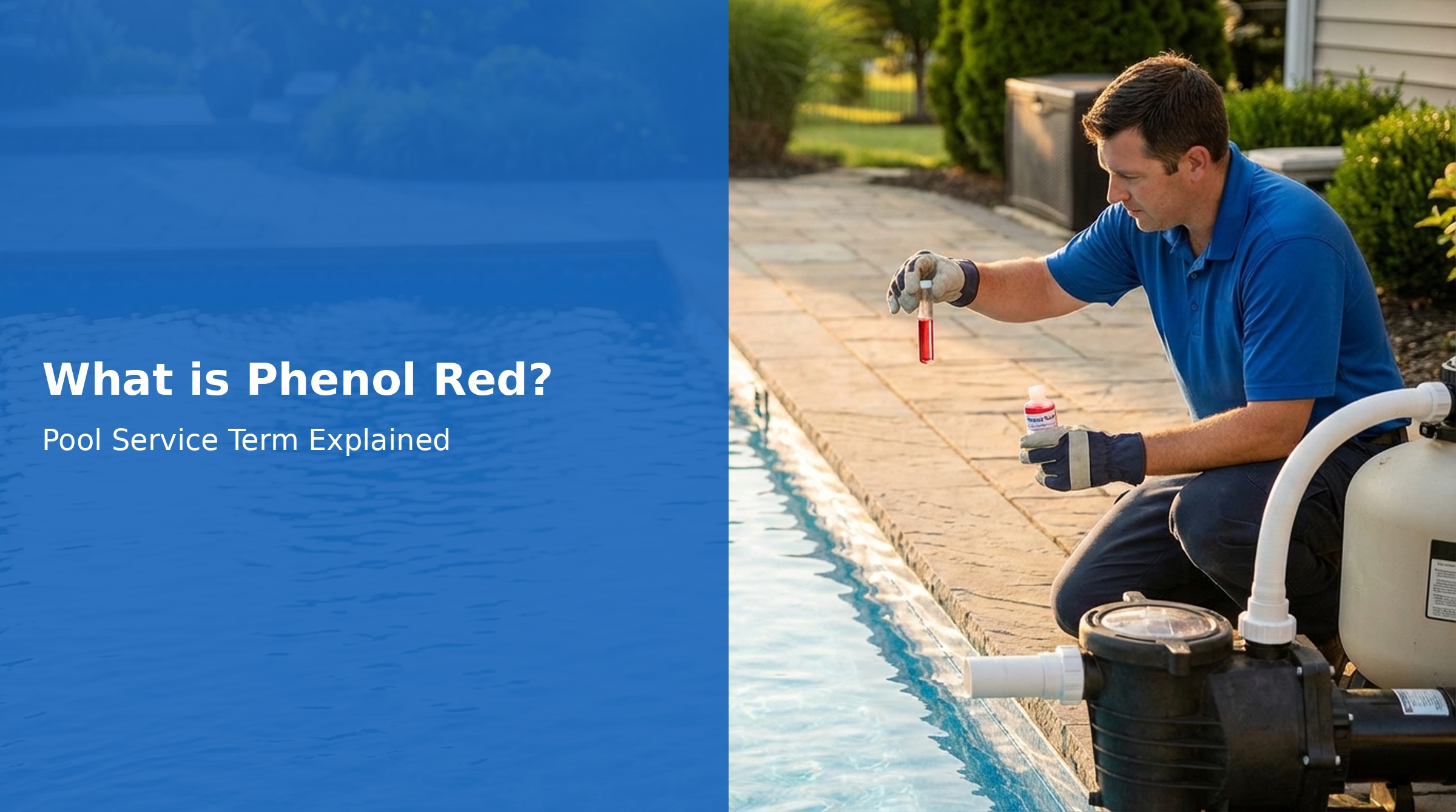
What is Phenol Red?

When pH test results show deep purple or blue readings that seem impossible, you're likely witnessing the phenol red interference phenomenon – one of the most misunderstood aspects of pool water testing. As a pool service professional, understanding why phenol red behaves this way during high-chlorine situations is crucial for accurate water chemistry management and avoiding costly mistakes during shock treatments.
Key Takeaways
- Phenol red is the standard reagent for pH testing, effective in the 6.8-8.4 range
- Chlorine levels above 15 ppm cause phenol red to form chlorophenol red, creating false purple/blue readings
- pH tests are unreliable during shock treatments – wait for chlorine levels to drop below 10 ppm
- Understanding this interference prevents incorrect chemical additions that can damage pool surfaces
- Alternative testing methods exist for high-chlorine situations
What is Phenol Red?
Phenol red is a pH indicator dye that serves as the backbone of residential and commercial pool pH testing. This synthetic compound changes color in response to hydrogen ion concentration, transitioning from yellow in acidic conditions to red at neutral pH, and purple in alkaline conditions. The reagent works most accurately within the 6.8 to 8.4 pH range – perfectly suited for pool water testing under normal circumstances.
In standard pool testing kits, whether liquid drop tests or digital photometers, phenol red provides reliable pH readings when chlorine levels remain within typical operational ranges (1-5 ppm). The color changes are predictable and consistent, making it the industry standard for routine water balance maintenance.
The Chlorophenol Red Problem
Chemical Reaction Explained
The issue arises when free chlorine concentrations exceed 15 parts per million. At these elevated levels, chlorine molecules begin bonding with phenol red molecules, creating a new compound called chlorophenol red. This chlorinated version of the indicator behaves completely differently from standard phenol red, producing intense purple or blue coloration regardless of the water's actual pH level.
This chemical interference means that a pool with a pH of 6.8 (highly acidic) and 20 ppm chlorine will show the same deep purple color as a pool with a pH of 8.4 (highly alkaline) and 20 ppm chlorine. The actual pH becomes masked by the chlorophenol red reaction, rendering traditional pH testing completely unreliable.
When This Occurs
Pool service professionals most commonly encounter this phenomenon during:
- Shock treatments – Whether using calcium hypochlorite, sodium hypochlorite, or other shock products
- Algae remediation – When high chlorine doses are necessary to eliminate stubborn algae blooms
- Equipment startup – After cleaning or replacing chlorine generators that may initially produce high output
- Accidental over-chlorination – From equipment malfunctions or calculation errors
Why This Matters for Pool Service Professionals
Avoiding Chemical Addition Mistakes
Understanding phenol red interference prevents costly and dangerous chemical addition errors. Many inexperienced technicians see the purple/blue reading and assume the pH is dangerously high, leading them to add muriatic acid or other pH reducers. This can result in:
- Plaster etching and surface damage from overly acidic conditions
- Metal corrosion in equipment and fixtures
- Swimmer discomfort from low pH levels
- Reduced chlorine effectiveness due to improper pH levels
The key insight is that the purple/blue coloration tells you nothing about the actual pH – only that chlorine levels are elevated enough to interfere with testing.
Maintaining Customer Trust
Customers often panic when they see deep purple pH readings, assuming something is seriously wrong with their pool chemistry. Professional pool technicians who understand and can explain the phenol red interference phenomenon demonstrate expertise while reassuring clients that the situation is temporary and manageable.
Best Practices for High-Chlorine Situations
Wait-and-Test Strategy
The most straightforward approach is patience. Allow chlorine levels to naturally decrease through UV degradation, chemical demand, and normal dissipation until readings drop below 10 ppm. At this point, phenol red testing becomes reliable again. This typically takes 24-48 hours depending on sunlight exposure, water temperature, and bather load.
Alternative Testing Methods
For situations requiring immediate pH assessment, consider these alternatives:
- Digital pH meters – Electronic sensors aren't affected by chlorine interference
- pH test strips – Some strips use different indicator chemistry less susceptible to chlorine
- Neutralization testing – Adding sodium thiosulfate to neutralize chlorine in test samples (advanced technique)
- Professional lab testing – For critical situations requiring precise measurements
Documentation and Communication
When servicing pools during shock treatments, document the elevated chlorine levels and note that pH testing is temporarily unreliable. This creates a paper trail explaining why pH adjustments weren't made during that service visit and demonstrates professional understanding of water chemistry principles.
Preventing and Managing Interference
While phenol red interference is sometimes unavoidable, strategic planning can minimize its impact. When possible, schedule shock treatments for times when you can return within 48 hours to assess chemistry once chlorine levels normalize. Use accurate chemical dosage calculations to avoid excessive chlorine additions that create unnecessarily high levels.
For comprehensive water balance management, consider how phenol red interference affects your overall Langelier Saturation Index calculations. Without accurate pH readings, LSI calculations become unreliable, potentially leading to scaling or etching issues if other parameters aren't carefully monitored.
Professional Development
Understanding phenol red chemistry separates experienced pool professionals from novice technicians. This knowledge becomes particularly valuable when training new staff or explaining complex chemical interactions to customers. Consider adding this topic to your service team training programs and reference materials.
For a comprehensive understanding of pool chemistry terminology, including phenol red and related concepts, maintain access to professional resources like our complete pool service terminology glossary.
Conclusion
Phenol red interference represents a perfect example of why successful pool service requires both practical experience and scientific understanding. By recognizing when chlorine levels make pH testing unreliable, you avoid chemical addition mistakes, maintain water balance integrity, and demonstrate professional expertise to customers. Remember that the dramatic purple/blue colors during shock treatments are temporary phenomena – patience and proper timing will restore accurate testing conditions and allow for informed chemical adjustments based on reliable data.