
Commercial vs. Residential Pool Service: Key Differences Every Pro Should Know


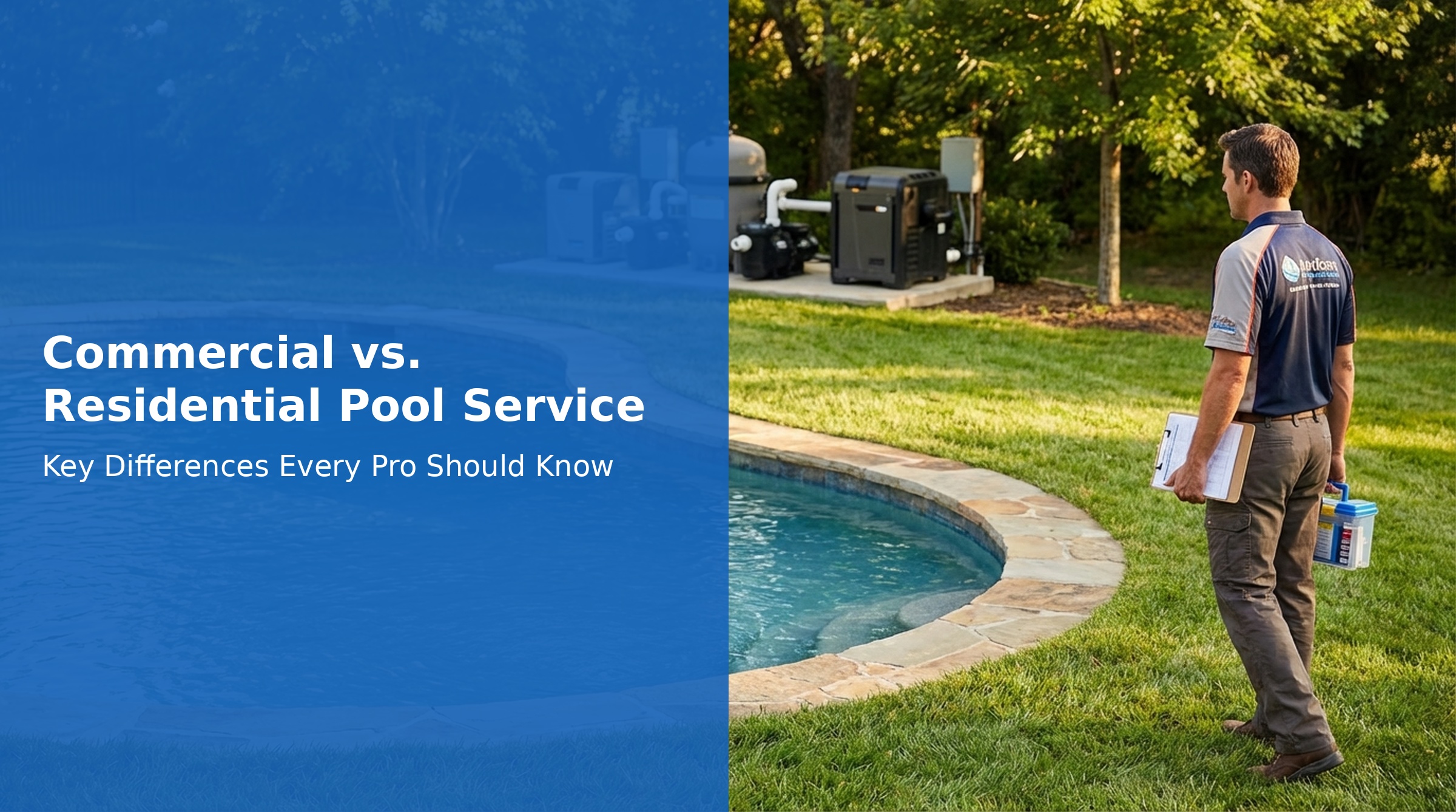
Every pool service professional eventually asks the question: should I take on commercial accounts? The money looks great on paper - a single apartment complex can pay more than 10 residential customers combined. But commercial pool service isn't just "bigger pools, bigger checks." It's a fundamentally different business with different equipment, different chemistry, different regulations, and different headaches. Here's everything that changes when you cross from backyards to commercial properties.
Key Takeaways
- Commercial pools require 2-7x weekly visits compared to the standard weekly residential stop
- Health department oversight adds compliance requirements including daily log books, specific testing protocols, and inspection readiness
- Equipment complexity jumps significantly - expect multiple pumps, commercial filters, chemical controllers, and aging infrastructure
- Revenue is 5-20x higher per account but so is the time commitment, liability, and chemical consumption
- CPO or AFO certification is often required by state law or property management companies for commercial work
The Side-by-Side Comparison
Before diving into the details, here's a high-level comparison of how residential and commercial pool service differ across every major dimension.
| Factor | Residential | Commercial |
|---|---|---|
| Pool Volume | 8,000 - 25,000 gallons | 20,000 - 500,000+ gallons |
| Visit Frequency | 1x per week (standard) | 2-7x per week |
| Monthly Revenue | $125 - $250 | $800 - $20,000+ |
| Chemical Billing | Included or billed separately | Almost always billed separately |
| Bather Load | 1-10 per day | 20-500+ per day |
| Required Certifications | Varies by state, often none | CPO or AFO typically required |
| Health Department | No oversight | Regular inspections, log books required |
| Insurance | General liability ($1-2M) | Commercial liability, higher limits |
| Decision-Maker | Homeowner (immediate) | Property manager, HOA board, GM (slow) |
| Payment Speed | Immediate or net 15 | Net 30-60 typical |
| Contract Length | Month-to-month common | 12-month minimum typical |
| Emergency Calls | Rare, can wait | Frequent, same-day response expected |
Pool Size and Volume
The most obvious difference is scale. A typical residential pool holds 10,000-20,000 gallons. A community HOA pool might hold 40,000-80,000 gallons. A hotel resort with a lazy river? You could be looking at 300,000+ gallons of water to manage.
This isn't just a "use more chemicals" situation. Larger volumes mean longer turnover rates, which affects how quickly your chemical adjustments take effect. A residential pool might turn over in 6-8 hours. A large commercial pool could take 12-24 hours for a full turnover. That lag time changes your entire approach to water chemistry management.
Use a pool volume calculator to get precise gallon counts before you bid any commercial job. Guessing on volume means guessing on chemical costs, and that's how you lose money.
Equipment Complexity
A residential pool typically has one pump, one filter, maybe a heater and a salt cell. You can diagnose most problems in 10 minutes. Commercial equipment rooms are a different world.
What You'll Find in a Commercial Equipment Room
- Multiple pumps - circulation pumps, booster pumps, feature pumps, spare pumps. A resort might have 8-12 pumps running simultaneously.
- Commercial-grade filters - large sand filters (requiring vacuum trucks for media changes), multi-cartridge systems, or DE filters that hold 50+ pounds of media.
- Chemical controllers - ORP and pH controllers with peristaltic or diaphragm feed pumps that dose chemicals automatically. These need regular calibration and probe replacement.
- Commercial heaters - boilers rated at 500,000+ BTU, heat exchangers, or chiller systems. Some facilities have both heating and cooling.
- UV or ozone systems - secondary disinfection systems required by some health departments for high-bather-load facilities.
- VFD drives - variable frequency drives on pumps for energy savings and flow control.
- Automation systems - commercial-grade controllers that manage flow rates, water levels, chemical dosing, and equipment scheduling.
The Hidden Problem: One of the biggest shocks for residential-to-commercial transitions is the state of existing equipment. Commercial equipment rooms are frequently neglected - aging pumps held together with creative plumbing, electrical panels that haven't been updated in decades, and underground piping that's corroding from the inside. One operator described a $30,000 equipment room overhaul on a pool he thought would be a straightforward maintenance account. Always do a thorough equipment assessment before you commit to a contract.
Water Chemistry
The chemistry is the same - chlorine, pH, alkalinity, calcium hardness. But the stakes are higher, the variables are more extreme, and the documentation requirements are stricter.
Bather Load Changes Everything
A residential pool might see 2-4 swimmers on a busy day. A community pool on a Saturday afternoon might have 100+ people in the water. Each bather introduces sweat, sunscreen, body oils, and biological material that consumes chlorine and shifts pH. The chlorine demand of a busy commercial pool on a hot weekend can be 10-20x that of a residential pool of the same volume.
This is why most commercial pools use automated chemical feeders rather than manual dosing. The chemistry can shift dramatically within hours, and you can't be there every hour to adjust it.
Testing Requirements
Residential testing is typically weekly with a standard test kit - free chlorine, pH, maybe alkalinity and CYA. Commercial testing is daily or multiple times per day, with documentation required for every test.
| Parameter | Residential | Commercial |
|---|---|---|
| Free Chlorine | Weekly, 2-4 ppm | Daily or 2x daily, 1-10 ppm (varies by code) |
| Combined Chlorine | Rarely tested | Every visit, must be < 0.2 ppm in many jurisdictions |
| pH | Weekly, 7.2-7.6 | Daily, 7.2-7.8 (strict enforcement) |
| Temperature | Rarely documented | Recorded at every test |
| Cyanuric Acid | Monthly or seasonal | Weekly, some jurisdictions limit to 40-100 ppm or ban entirely for indoor pools |
| ORP | Not tested | Continuous monitoring, 650-750 mV minimum |
| Bacteriological | Never | Monthly or quarterly lab testing at some facilities |
Most commercial operators use the Taylor K-2006C test kit because it matches what health inspectors use. Some keep a photometer (LaMotte SpinLab or Palintest Lumiso) as a backup for fast readings during busy season.
CYA Restrictions
This trips up a lot of residential-to-commercial operators. Many states cap cyanuric acid at 40-100 ppm in commercial pools, and some ban it entirely in indoor facilities. If you're used to using trichlor tabs on residential pools (which add CYA with every dose), you'll need to switch to liquid chlorine or cal-hypo for commercial work. Check your local health code before you start.
Regulations and Compliance
Residential pools are largely unregulated. Your customer's backyard pool doesn't get health department inspections. Commercial pools are a different story entirely.
Health Department Inspections
Commercial pools are subject to unannounced health department inspections. Inspectors check water chemistry, safety equipment, signage, fencing, drain covers (VGB compliance), log book documentation, and overall pool condition. Failing an inspection can result in the pool being closed until violations are corrected - which means your client is furious and tenants can't swim.
Daily Log Books
Every commercial pool needs a daily log book recording water chemistry readings, chemical additions, equipment operation, and any incidents. These log books must be available on-site for inspection at any time. You need to determine upfront who maintains the log book - you on service days, and the property staff on your off days.
Certifications
Most states require a CPO (Certified Pool Operator) or AFO (Aquatic Facility Operator) certification to service commercial pools. Even in states where it's not legally required, property management companies increasingly require it as a condition of the contract. Budget $400-$600 and two days for the CPO course.
VGB Act Compliance
The Virginia Graeme Baker Pool and Spa Safety Act requires specific anti-entrapment drain covers and suction outlet configurations on all public pools. If you take over a commercial account with non-compliant drains, that's a safety hazard and a liability nightmare. Check drain covers on your first walkthrough.
Pricing and Revenue
Commercial accounts pay dramatically more than residential, but the pricing model is completely different.
How Commercial Pricing Works
While residential is typically a flat monthly rate ($125-$250/month for weekly service), commercial pricing is built on labor hours. You calculate hours per visit, multiply by visit frequency, multiply by your sell rate per hour, and multiply by 4.33 weeks per month. Chemicals are billed separately as an additional line item.
Most commercial operators charge between $75-$170 per labor hour per person, with the rate depending on market, complexity, and competition. For a detailed walkthrough of the bidding formula, see our commercial pool bidding guide or use our commercial bid calculator.
Chemical Billing
On residential routes, there's a real debate about chemicals included vs. plus chemicals. On commercial, the answer is nearly universal: bill chemicals separately. The volume is too high and too variable to absorb in a flat rate. Most operators give a 20% discount off retail on chemical costs due to the volume, but it's always an additional line item.
Payment Terms
Residential customers typically pay immediately or within 15 days. Commercial clients - especially property management companies - often operate on net 30 or net 60 terms. That means you could be 2 months into a contract before you see your first check. Make sure your cash flow can handle the delay, and build clear payment terms into your service agreement.
Service Frequency and Scheduling
Residential pool service is beautifully predictable: same day, same time, every week. Commercial service is a different rhythm entirely.
- Apartment complexes - 2-3 visits per week minimum during swim season, often dropping to 1-2 in winter
- HOA community pools - 3-5 visits per week during swim season, may close for winter
- Hotels and resorts - 7 days a week, 365 days a year, often with twice-daily chemical checks
- Gyms and fitness centers - 5-7 visits per week, year-round (indoor pools don't close)
Weekend service is expected for most commercial accounts during swim season. You can't skip Saturday and Sunday when 200 residents are swimming. This means you either work weekends yourself, hire someone for weekend coverage, or staff 1.5 people on the account (one full-time, one part-time for coverage).
The 7-Day Trap: If you calculate your bid based on 5 visits per week but the client expects 7, your monthly revenue is 29% lower than it should be. Always clarify exact visit frequency in your bid and make sure it's documented in the service agreement.
Liability and Insurance
The liability exposure on commercial pools is exponentially higher than residential. A backyard pool incident typically involves one family. A commercial pool incident can involve dozens of people and attract media attention.
Insurance Requirements
Most property management companies require proof of insurance with the property listed as an additional insured. Commercial policies typically require higher limits than residential - $2M or more in general liability. Call your insurance agent before you bid your first commercial account to verify coverage and get pricing.
Client Relationships
On a residential route, you deal directly with the homeowner. Decisions are fast, payment is immediate, and the relationship is personal. Commercial is an entirely different dynamic.
Decision-Making
In residential, if the pump needs replacing, you call the homeowner, they say yes or no, and you do the work. In commercial, the maintenance supervisor recommends the repair to the property manager, who requests a bid, which goes to the regional manager or HOA board for approval, which might take 2-4 weeks. Meanwhile, the pool is running on a failing pump.
Who You're Really Working For
The property manager signs the contract, but the facilities manager is your day-to-day contact. The HOA board controls the budget, but individual residents will email you complaints. The hotel GM cares about guest satisfaction scores, not your chemical readings. Understanding who has authority, who has influence, and who you need to keep happy is critical for keeping commercial accounts long-term.
Tenant Interaction
Residential customers generally leave you alone while you work. At commercial properties, you're working around residents, hotel guests, gym members, and lifeguards. People will walk up and tell you the pool is too cold, too hot, too green, or too cloudy. Kids will splash you while you test. Someone will complain that you're there during "their" swim time. Patience and professionalism are non-negotiable.
Physical Demands
Commercial pool service is more physically demanding than residential. The pools are larger, the equipment is heavier, and the cleaning takes longer.
- Tile scrubbing - high-use commercial pools develop calcium and body oil deposits on tile lines faster than residential. Weekly tile scrubbing on 200+ linear feet of tile is a serious workout.
- Filter maintenance - a commercial sand filter change requires a vacuum truck, pallets of sand bags (50 lbs each), and sometimes crawling inside the filter through a narrow manhole.
- Chemical handling - you're moving 50-gallon drums of liquid chlorine and 5-gallon jugs of acid instead of residential-sized containers.
- Cleaning time - brushing and vacuuming a 40,000-gallon pool takes significantly longer than a 12,000-gallon backyard pool. Expect 2-4 hours per cleaning visit on larger commercial accounts.
This is why experienced operators strongly recommend sending two people for cleaning days on large commercial pools. One person on a resort-sized pool is a recipe for burnout, injuries, and poor service quality. See our injury prevention guide for protecting your crew on physically demanding accounts.
Should You Make the Jump?
There's no universal answer. Some operators love commercial and find residential boring by comparison. Others try commercial, get burned, and go back to backyards. Here's a framework for deciding.
Commercial Might Be Right If:
- You have or can get CPO/AFO certification
- Your insurance covers commercial properties
- You have reliable employees who can handle weekend coverage
- You're comfortable with net 30-60 payment terms
- You enjoy complex equipment and problem-solving
- You want higher revenue density (fewer stops, more revenue)
Stick With Residential If:
- You're a solo operator who values weekends off
- You prefer the simplicity and predictability of backyard pools
- Your insurance doesn't cover commercial or the premium increase isn't worth it
- You don't want to deal with property management companies and slow payment
- You're building a route you plan to sell (residential routes are easier to value and sell)
The Middle Ground: Many successful operators run a hybrid model. They maintain a residential route for steady, predictable income and take on 2-5 commercial accounts for the revenue boost. This limits your commercial exposure while still benefiting from the higher per-account revenue. Start with one manageable account (a small apartment complex or gym) before scaling up.
Getting Started
If you've decided to pursue commercial work, here's the order of operations:
- Get certified - complete your CPO certification if you haven't already
- Verify insurance - call your carrier and confirm commercial coverage and limits
- Shadow someone - spend a week or two with an experienced commercial operator to see the reality before committing
- Start small - bid on a small apartment complex or gym, not a 340,000-gallon resort
- Build your bid properly - use our commercial bidding guide and bid calculator to price the job correctly
- Get everything in writing - a proper service agreement protects both you and the client
The leap from residential to commercial isn't for everyone, but for the right operator, it can transform a good business into a great one. Just go in with your eyes open, your certifications current, and your numbers right.
Manage residential and commercial accounts in one platform
PoolDial handles the complexity of multi-visit commercial routes alongside your residential stops. Chemical tracking, log books, and route management built for pros.
Start Your Free Trial