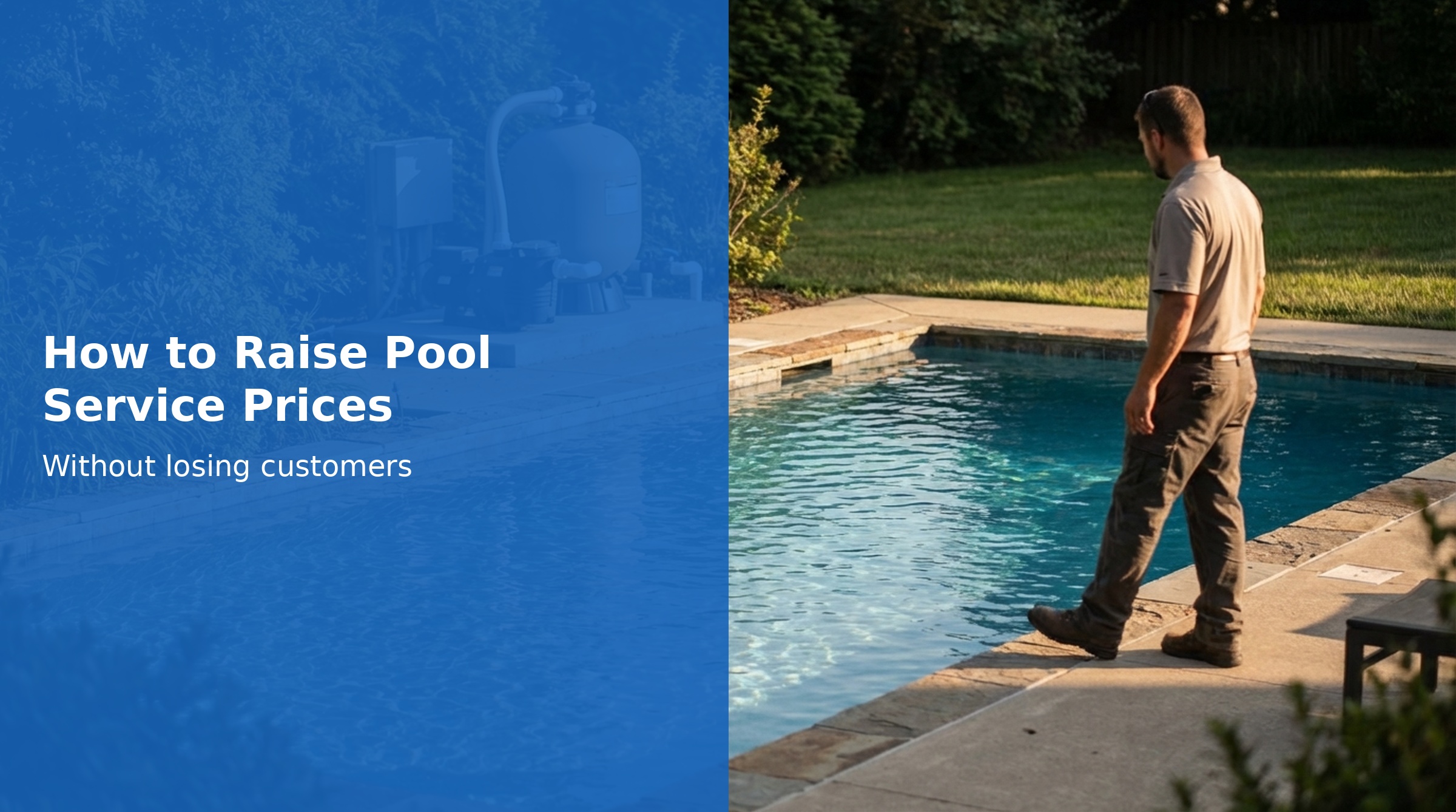
How to Raise Pool Service Prices Without Losing Customers


You know you need to raise your prices. Your chemicals cost more, your insurance went up, and you haven't adjusted rates in two or three years. But every time you sit down to write that email, a knot forms in your stomach.
You're not alone. A pool pro on r/PoolPros recently posted about being "on the verge" of sending a price increase email to 50 clients and feeling nervous about it. The response was overwhelmingly reassuring—29 comments from pros who've done it, most saying it went better than expected.
Here's what they shared about the math, the psychology, and what actually happens when you hit send.
Key Takeaways
- 8–10% annual increases are standard in pool service
- Most pros report losing 0–5 customers after a price increase, even with 50–100+ accounts
- The customers you lose are almost always the ones you wanted to drop anyway
- You can lose up to 9% of customers on a 10% increase and still make more money
- Waiting too long between increases makes the jump more shocking to customers
The Break-Even Math
This is the single most important thing to understand before raising prices. A 10% increase doesn't mean you need to keep all your customers to come out ahead. You can lose several and still make more money than before.
Example: 50 Customers at $100/month → 10% Increase
Put another way: if you lose 4 of 50 customers after a 10% increase, you're making $60 more per month while servicing 4 fewer pools. That's less drive time, less chemical expense, and more room to take on new accounts at your higher rate.
Use our price increase calculator to model this for your specific situation—plug in your customer count, current rate, and proposed increase to see your break-even number.
What Actually Happens When You Raise Prices
The thread was full of first-hand accounts. The pattern is remarkably consistent: most customers don't even respond to the notice. A few say thanks for the heads-up. And the small number who leave tend to be the most difficult accounts.
"Raised mine from $95/hr to $125/hr year before last. Lost 2 and gained 5."
Net gain: +3 customers at a higher rate"Implemented mine effective January 1st and lost 3 of 18 I increased." Brought the stragglers up to par with everyone else. Stand firm and be confident in yourself.
Lost 3, kept 15 at new rate"I've gone up three times after 2021 by a lot. Did not lose one customer." Will be doing 10% increases every 2 years from now on.
Zero customer loss across 3 increases"Had to raise prices twice in one year during Covid. Only one person quit out of 65." Of course he was a multi-millionaire, nagging customer, so it was a blessing.
Lost 1 difficult customer out of 65"Once had a client fire me when I raised her rate from $165 to $185." Three years and five other pool services later, she hired me back at $300.
Customer returned at nearly 2x the original rateThat last story came up repeatedly in different forms: customers who leave over a $15–$20 increase cycle through cheaper alternatives, deal with no-shows and splash-and-dashers, then come back willing to pay significantly more.
Why the Customers You Lose Are the Ones You Don't Miss
This was the most repeated point in the entire thread. The customers most sensitive to a $10–$20 monthly increase are almost always the most demanding, lowest-paying, hardest-to-please accounts on your route.
One pro shared a detailed example: a customer with an old pool with rough plaster left after a rate increase and hired their neighbor's cheaper pool guy. A year later, the pool was full of yellow and black algae. The customer came back—at the new rate plus cleanup fees. "If they kept me before it would've been a cheaper rate than the new rate."
Another put it bluntly: "10 percent is nothing. If you lose any, I bet they are ones you don't miss."
Some pros take this logic a step further and use annual pricing reviews as a deliberate culling mechanism—not just raising prices, but shedding their worst accounts in the process:
How to Communicate the Increase
Two things come up in almost every account from pros who've done this successfully: give notice, and be straightforward about it.
- 1 Give advance notice. Send the email 30 days before the new rate takes effect. This shows professionalism and gives customers time to process it.
- 2 Keep it short and confident. You don't need to write a three-paragraph apology. A brief, professional note is all that's needed. Don't over-explain or sound apologetic—you're running a business.
- 3 Reference real costs. One pro attaches screenshots of chemical and equipment price increase letters from HASA and equipment manufacturers. "Feel free to quote the government on its inflation numbers. Total inflation since 2022 is up 10.75%. So raising prices 10% is still giving them a better deal than 3 years ago."
- 4 Don't ask for permission. The increase is happening. You're informing them, not negotiating. "You don't need to explain yourself. Spotify raises prices all the time and nobody blinks."
- 5 Use email, not a phone call. Email gives the customer time to process without putting you in an uncomfortable live conversation. It also creates a paper trail.
One pro described sending a detailed, honest email to all customers (BCC'd) explaining the situation—and being surprised by the response:
If you use broadcast messaging, you can send price increase notifications to all affected customers at once with individual personalization.
When and How Often to Raise Prices
The consensus from pool pros is clear: raise prices regularly and don't let years pass between increases.
Annual increases (most recommended)
Multiple pros recommended raising prices every year. One approach: add $10/month on each customer's account anniversary. "So almost every month, some accounts are being raised. New account at $160/month in January 2025 would be $170/month in January 2026. No issues."
This rolling approach avoids the stress of one big annual email blast and keeps your pricing current with inflation. Some pros formalize this with new service agreements each year:
Every 2 years at 8–10%
If annual feels too frequent, every 2 years at 8–10% is the next best approach. This roughly tracks with cumulative inflation and keeps the jump manageable for customers.
What to avoid: waiting 3+ years
The original poster hadn't raised prices in 2–3 years, which is common but creates a bigger problem. The longer you wait, the larger the increase needs to be, and the more shocking it feels to customers. Several pros in the thread admitted to the same mistake and said they lost money because of it.
The Underprice-Then-Raise Pattern
Many pool service businesses—especially newer ones—follow the same pricing arc: start low to win customers, build a reputation, then raise prices once you've proven your value. It works, but it requires intentional execution.
The problem comes when the "raise prices" step never happens. One pro described starting his business by undercutting everyone to get accounts, then realizing his rates weren't sustainable:
If you're in this position, a correction isn't a price increase—it's a recalibration. As one veteran pro put it: "I never tried to beat anyone else's rates. Ever. I knew what I had to make in order to pay my bills and provide for my family." Knowing your number first, then setting prices accordingly, avoids the need for a painful correction later.
The Smart Transition Strategy
One pro shared a clever approach for making the transition less painful: start adding new customers at your higher rate before sending the increase notice to existing clients. "Currently adding newer clients on the higher rate so when informing my older clients about the increase, if I lose 20% of my clients I won't feel the drop as much."
This creates a safety net. Even in the worst-case scenario where you lose more customers than expected, your new accounts are already at the higher rate and cushioning the revenue impact.
Know Your Market Rate
Before you set your new rate, make sure you know what other pros in your area are charging. If you've been below market rate, a "price increase" might just be catching up to the going rate.
Our service price calculator can help you determine competitive rates for your area, and the 2026 pricing guide has state-by-state data from 30,000+ pool pros.
As one commenter pointed out: "Everyone I talk to, even some clients I've mentioned it to, are shocked I haven't raised my prices yet." If your customers are surprised you haven't raised prices, you've waited too long.
The Bottom Line
Raising prices is one of the most stressful things a pool service owner does, but the data from pros who've done it is overwhelmingly positive. You'll lose fewer customers than you think. The ones you do lose will often be your worst accounts. And you'll almost certainly come out ahead financially.
The math is simple: a 10% increase means you can lose up to 9% of your customers and still make more money while doing less work. In practice, most pool pros report losing 0–5% of accounts—well below the break-even threshold.
Don't sell yourself short. You've earned this increase, and your customers know it.