
Pool Service Seasonality: Revenue Patterns by Quarter and Region


The pool service industry is highly seasonal—but less so than many assume. While Q2 generates 33% of annual wholesale revenue compared to just 19% in Q4, the business is anchored by a 64% maintenance base that ensures recurring demand regardless of weather's impact on new construction.
Key Statistics
Quarterly Revenue Distribution
Pool Corporation's wholesale sales data reveals clear seasonal patterns. The second quarter (April–June) dominates, while Q4 (October–December) represents the annual low point.[1]Pool Corporation 10-KFiscal year ended December 31, 2024SEC Filing
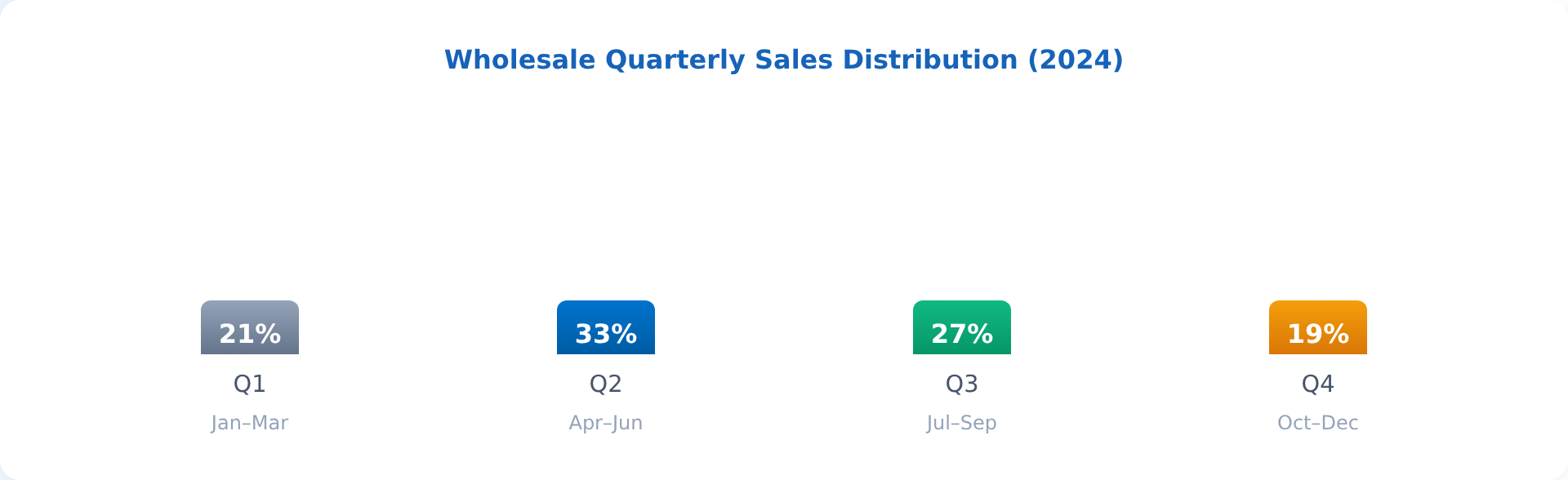
The chart above shows that Q2 trade activity is 1.7× higher than Q4 (33% vs. 19%). This reflects the seasonal pool opening rush in spring and the corresponding slowdown as pools close for winter in northern markets.
| Quarter | Months | Share of Annual Sales | Primary Activity |
|---|---|---|---|
| Q1 | Jan–Mar | 21% | Early Buy programs, pre-season prep |
| Q2 | Apr–Jun | 33% | Pool openings, peak chemical demand |
| Q3 | Jul–Sep | 27% | Summer maintenance, equipment repairs |
| Q4 | Oct–Dec | 19% | Pool closings, winter prep, Early Buy |
Source: Pool Corp 10-K
The 64% Maintenance Buffer
While seasonal swings are real, the pool service business benefits from a significant non-discretionary base. Maintenance and minor repair products represent roughly 64% of total pool product sales.[3]Pool Corp Q4 2025 Earnings CallFebruary 2026Transcript
This means only 36% of industry revenue is highly sensitive to construction seasonality and discretionary upgrades. The maintenance base provides a revenue floor that cushions seasonal volatility.

Key Insight
While the industry is highly seasonal—with Q2 representing 33% of all wholesale activity—the business is anchored by a 64% maintenance base that ensures recurring demand regardless of weather's impact on new construction. Q2 is 1.7× larger than Q4.
Retail vs. Wholesale Timing
Retail and wholesale operations experience seasonality differently. Leslie's reports that sales and earnings are highest during April–September, which corresponds to their fiscal Q3 and Q4.[2]Leslie's 10-KFiscal year ended September 28, 2024SEC Filing
Wholesale distributors like Pool Corp see their peak slightly earlier, as they must supply retailers and service companies before consumer demand hits.
The Early Buy Program
"Early Buy" programs are a key mechanism for managing seasonality. These programs incentivize trade customers to stock up on inventory during Q4 and Q1, with payments typically due in Q2.[1]Pool Corporation 10-KFiscal year ended December 31, 2024SEC Filing[4]Hayward Holdings 10-KFiscal year ended December 31, 2024SEC Filing
For pool service businesses, Early Buy programs offer:
- Discounted pricing on chemicals and equipment purchased off-season
- Extended payment terms that align with peak revenue periods
- Guaranteed inventory before the spring rush
Weather's Impact on Season Length
Unseasonably early warming in Northern U.S. and Canada can extend the pool season and positively impact sales.[1]Pool Corporation 10-KFiscal year ended December 31, 2024SEC Filing Conversely, a late spring can delay pool openings and compress the peak season.
For service businesses, weather patterns affect:
- Season start date: Earlier openings mean more weeks of service revenue
- Chemical consumption: Longer seasons require more treatments
- Labor planning: Unpredictable weather makes staffing challenging
The "Winter Strategy" Season
Industry operators are increasingly treating winter as a "strategic season" for cross-training service technicians and conducting leadership workshops.[5]Pool and Spa NewsDecember 2025Pool and Spa News
Rather than viewing Q4 as a slow period, forward-thinking companies use it for:
- Staff training: Cross-training techs on equipment repair and sales
- System upgrades: Implementing new software and processes
- Customer outreach: Selling maintenance contracts for the upcoming season
- Equipment prep: Maintaining trucks and inventory systems
Use Slow Weeks as Planned Time Off
Seasonality is not only about sales volume. It also decides when a pool business can take time off without creating service problems. In most markets, the cleanest answer is to protect the high-use months and schedule vacation weeks during slower windows.
"I do my best to not miss days during the time of the year when people are actually using their pool. If I take a couple weeks off during the off season and someone gets bent out of shape, I don't know if I'm the right pool guy for them."
— Pool pro via Reddit
That is the practical side of the 48/52 billing model. The business keeps a stable monthly invoice, but the owner uses the 4 non-service weeks when customer risk is lower. Thanksgiving, Christmas, March, and October are common choices because pool usage is lighter and many customers are already expecting holiday schedule changes.
"We bill on a 48 week year as well. Allowing for vacation, sick time, etc. Taking the time off during Christmas and thanksgiving is a good plan, not just because of much needed family time. But also because a lot of gated communities won’t allow service personnel in."
— Pool pro via Reddit
Regional conditions still matter. In warm southern markets with leaf fall, storms, or 80-degree holiday weeks, a compressed schedule may be safer than a full skipped week. The point is to make downtime intentional instead of letting slow season become random missed service.
Regional Seasonality Differences
Seasonality varies dramatically by region. Sunbelt markets like Florida, Arizona, and Southern California operate year-round, while northern states may have only 5-6 months of active pool season.
| Region | Typical Season | Seasonality Impact |
|---|---|---|
| South Florida / Arizona | Year-round | Minimal seasonal variation |
| Southern California / Texas | 10-11 months | Slight winter slowdown |
| Mid-Atlantic / Southeast | 7-8 months | Moderate seasonality |
| Northeast / Midwest | 5-6 months | High seasonality |
Northern Routes Need a Winter Income Plan
High weekly rates do not automatically make a cold-climate route safer. A New Jersey startup question focused on retention and the difficulty of operating through a short season. Another northern technician described the personal cash-flow version of the same problem:
"Talking with buddies one night, they said what do you do in the winter? I usually find a second job to pay rent and groceries, but usually it’s college kids working this job."
— Pool pro via Reddit
Build the annual plan before setting the monthly price. Forecast opening and closing labor, active maintenance weeks, winter monitoring, repair work, storage, payroll, insurance, and owner pay by month. Decide whether the company will sell winter services, reserve summer cash, maintain annual contracts, or intentionally operate as a seasonal business. The answer can vary, but hoping that a busy May will fund February is not a cash-flow system.
Do Not Let One Customer Set the Closing Calendar
A customer with an empty property may want to close early to stop a large weekly bill. One operator described that request on an 80,000-gallon pool. Set a regional closing window and quote exceptions separately. If an unusually early closing raises the expected spring cleanup or return-visit risk, explain that in writing and price the extra work rather than promising a normal opening under abnormal conditions.
Managing Seasonal Cash Flow
For pool service businesses, understanding seasonality is essential for financial planning. Key strategies include:
- Annual billing: Collect full-year fees upfront to smooth cash flow
- Winter services: Offer pool covers, equipment winterization, and off-season repairs
- Diversification: Add spa service, equipment sales, or commercial accounts
- Reserve building: Save Q2-Q3 profits to cover Q4-Q1 expenses
For more on pricing strategies that account for seasonality, see our complete pricing guide.
Sources
- [1] Pool Corporation Annual Report (Form 10-K) — Fiscal year ended December 31, 2024. SEC Filing
- [2] Leslie's, Inc. Annual Report (Form 10-K) — Fiscal year ended September 28, 2024. SEC Filing
- [3] Pool Corporation Q4 2025 Earnings Call — February 2026. Transcript
- [4] Hayward Holdings Annual Report (Form 10-K) — Fiscal year ended December 31, 2024. SEC Filing
- [5] Pool and Spa News — Q3 Pool Industry Results Show Moderate Growth, December 2025. Pool and Spa News