
Pool Drowning Statistics 2026: Deaths, Injuries, and Trends


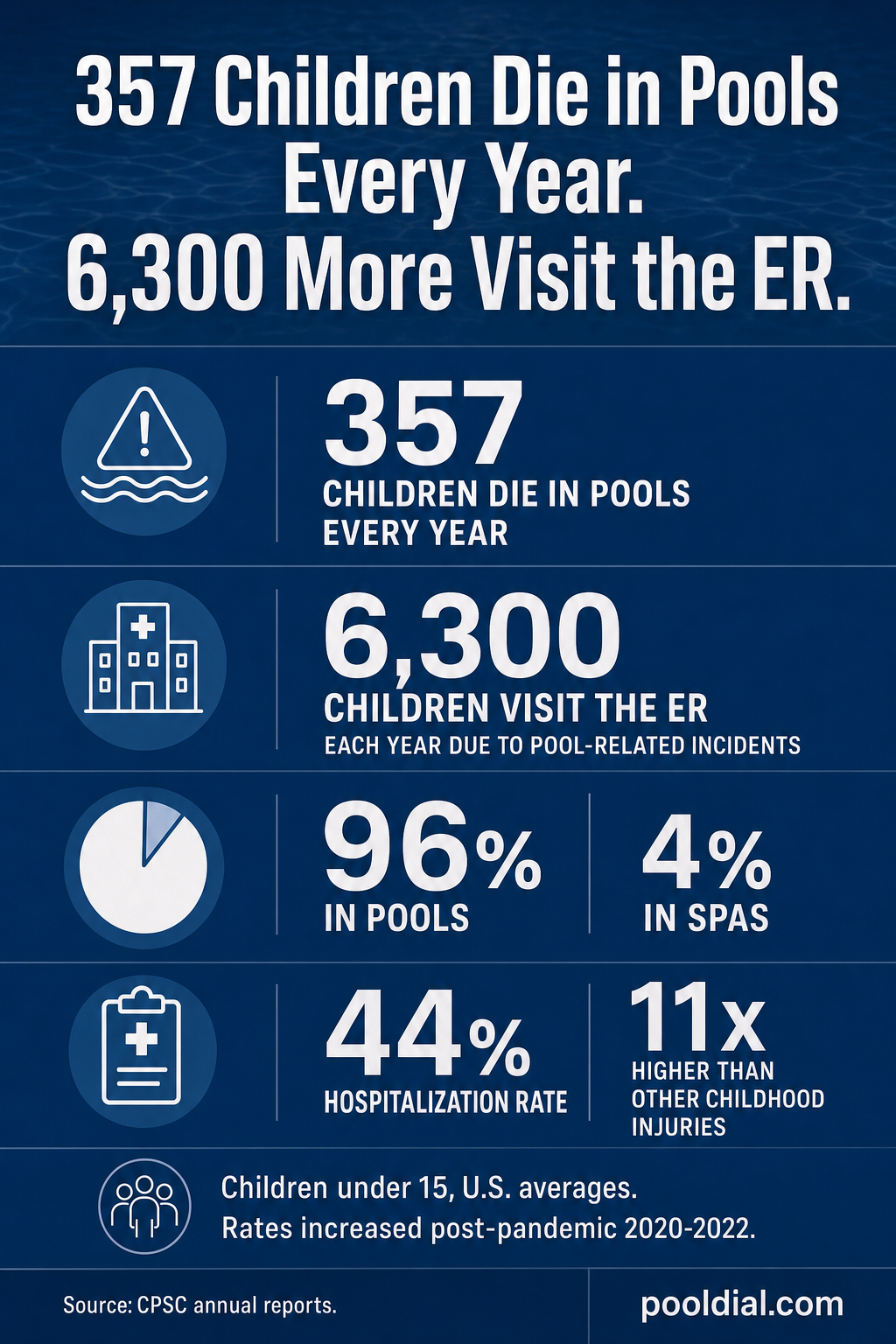
An average of 357 children under 15 die from pool and spa drownings each year in the United States.[1]U.S. Consumer Product Safety Commission2025 Submersion Report, Pool or Spa Submersions: Estimated Nonfatal and Reported Fatal Drowningscpsc.gov Another 6,300 children are treated in emergency departments annually for nonfatal submersion injuries.[1]U.S. Consumer Product Safety Commission2025 Submersion Report, Pool or Spa Submersions: Estimated Nonfatal and Reported Fatal Drowningscpsc.gov
These numbers represent preventable tragedies. For pool service professionals, understanding drowning statistics is essential for educating homeowners about safety barriers, supervision protocols, and the risks that exist in every residential pool.
Key Statistics at a Glance
- 357 — Average annual pool/spa fatalities for children under 15 (2020-2022) [1]CPSC 2025 Submersion Report3-year average 2020-2022cpsc.gov
- 6,300 — Average annual ED-treated nonfatal injuries (2022-2024) [1]CPSC 2025 Submersion Report3-year average 2022-2024cpsc.gov
- 96% — Drowning fatalities that occur in pools (vs. 4% in spas) [1]CPSC 2025 Submersion ReportProduct type breakdowncpsc.gov
- 44% — Hospitalization rate for drowning victims vs. 4% for all injuries [1]CPSC 2025 Submersion ReportHospitalization datacpsc.gov
- 17.6:1 — Nonfatal injuries for every fatal drowning (derived ratio)
Current Pool Drowning Deaths and Injuries
According to the latest CPSC data, the three-year average (2020-2022) shows 357 fatal drownings per year among children younger than 15 involving pools and spas.[1]U.S. Consumer Product Safety Commission2025 Submersion Report, 3-year average 2020-2022cpsc.gov This represents only a fraction of total U.S. drowning deaths—over 4,000 people of all ages drown annually across all water settings.[3]Centers for Disease Control and PreventionDrowning Facts, 2024cdc.gov
(Children Under 15)
(Children Under 15)
(Latest Estimate)
Source: CPSC 2025 Submersion Report
The 6,200 nonfatal injuries estimated for 2024 is not statistically different from 2023 (6,200) or 2022 (6,400), indicating a relatively stable trend in recent years.[2]U.S. Consumer Product Safety Commission2024 Submersion Report, year-over-year comparisoncpsc.gov
Year-Over-Year Fatality and Injury Trends
Looking at the most recent complete data, drowning fatalities fluctuated between 341 and 386 deaths per year from 2020 to 2022.[1]U.S. Consumer Product Safety Commission2025 Submersion Report, annual data 2020-2022cpsc.gov
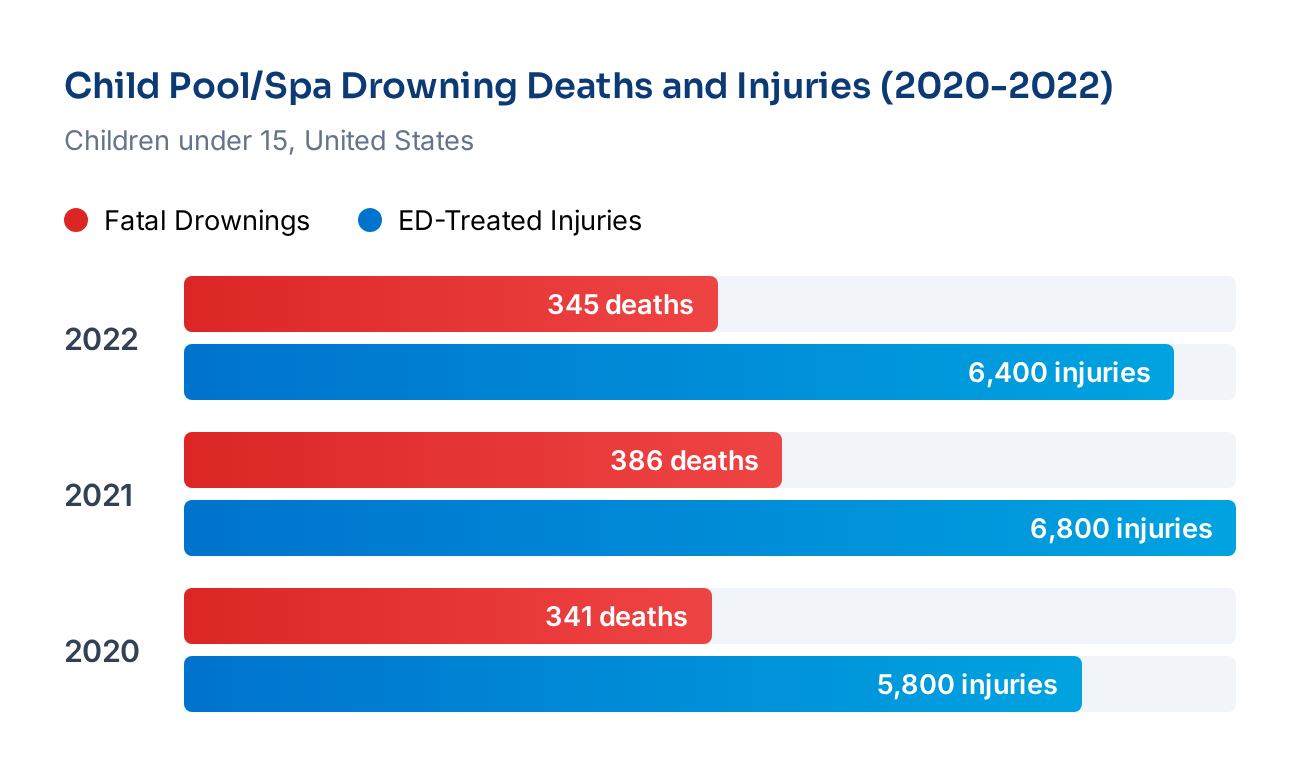
The year 2021 saw the highest fatality count at 386 deaths, which aligns with broader CDC findings showing drowning rates increased significantly in 2020, 2021, and 2022 compared to 2019.[4]CDC Morbidity and Mortality Weekly ReportVital Signs: Drowning — United States, 1999–2022cdc.gov The 2022 figure (345 deaths) shows a decline but remains above the 2020 baseline.[1]U.S. Consumer Product Safety Commission2025 Submersion Reportcpsc.gov
Why 2023-2026 data is missing: Fatal drowning data relies on death certificates and media reports, which have significant reporting delays. The CPSC typically publishes "reported" (not final) fatality counts 2-3 years after the incident year.
Pools vs. Spas: Where Do Drownings Occur?
The vast majority of child drowning fatalities happen in swimming pools, not hot tubs or spas. Pools account for 96% of fatal drownings while spas account for just 4%.[1]U.S. Consumer Product Safety Commission2025 Submersion Report, product type breakdowncpsc.gov
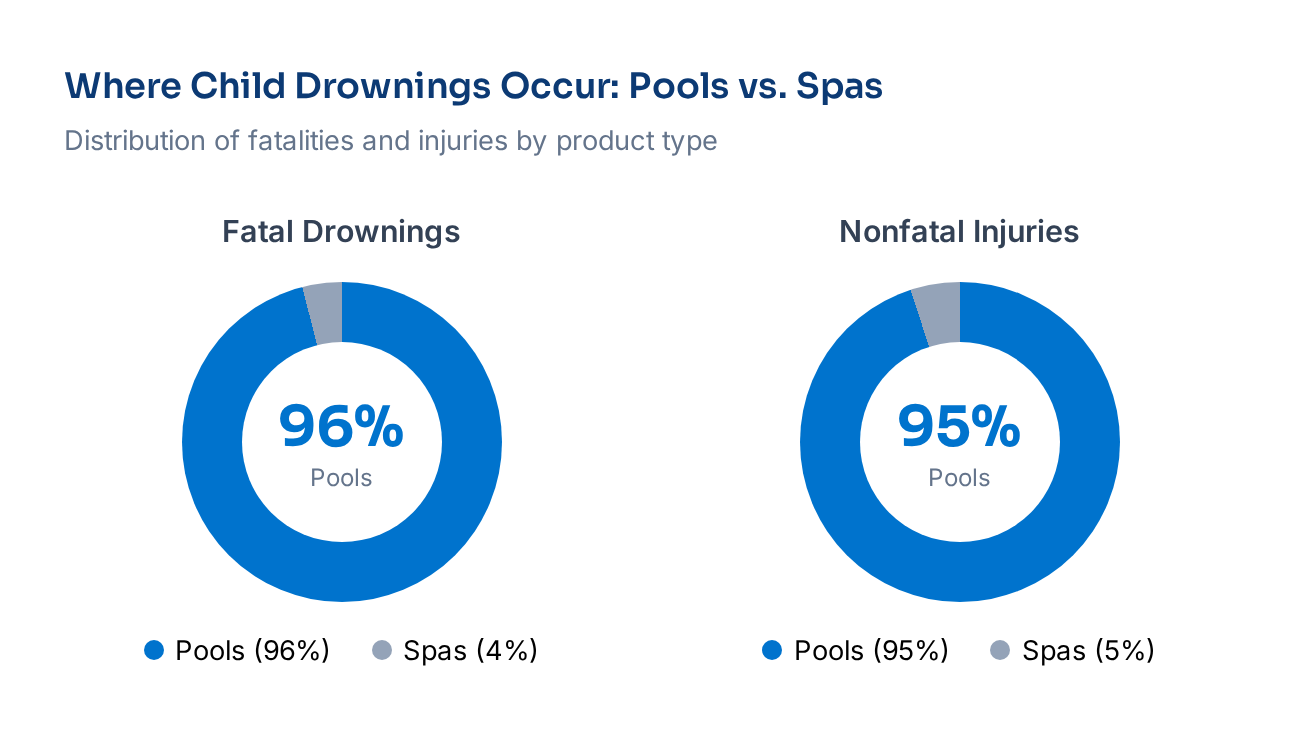
For nonfatal injuries, the distribution is nearly identical: 95% pools, 5% spas.[1]U.S. Consumer Product Safety Commission2025 Submersion Reportcpsc.gov This concentration in pools—not spas—reflects the fundamental risk factor: water deep enough for a child to submerge.
Hospitalization Rates: The Severity of Pool Drownings
Pool submersions are uniquely severe compared to other childhood injuries. 44% of children treated in emergency departments for nonfatal drowning injuries are hospitalized or transferred to another facility.[1]U.S. Consumer Product Safety Commission2025 Submersion Report, hospitalization datacpsc.gov
By comparison, only 4% of all consumer-product-related injuries among children under 15 result in hospitalization.[1]U.S. Consumer Product Safety Commission2025 Submersion Report, comparative injury datacpsc.gov
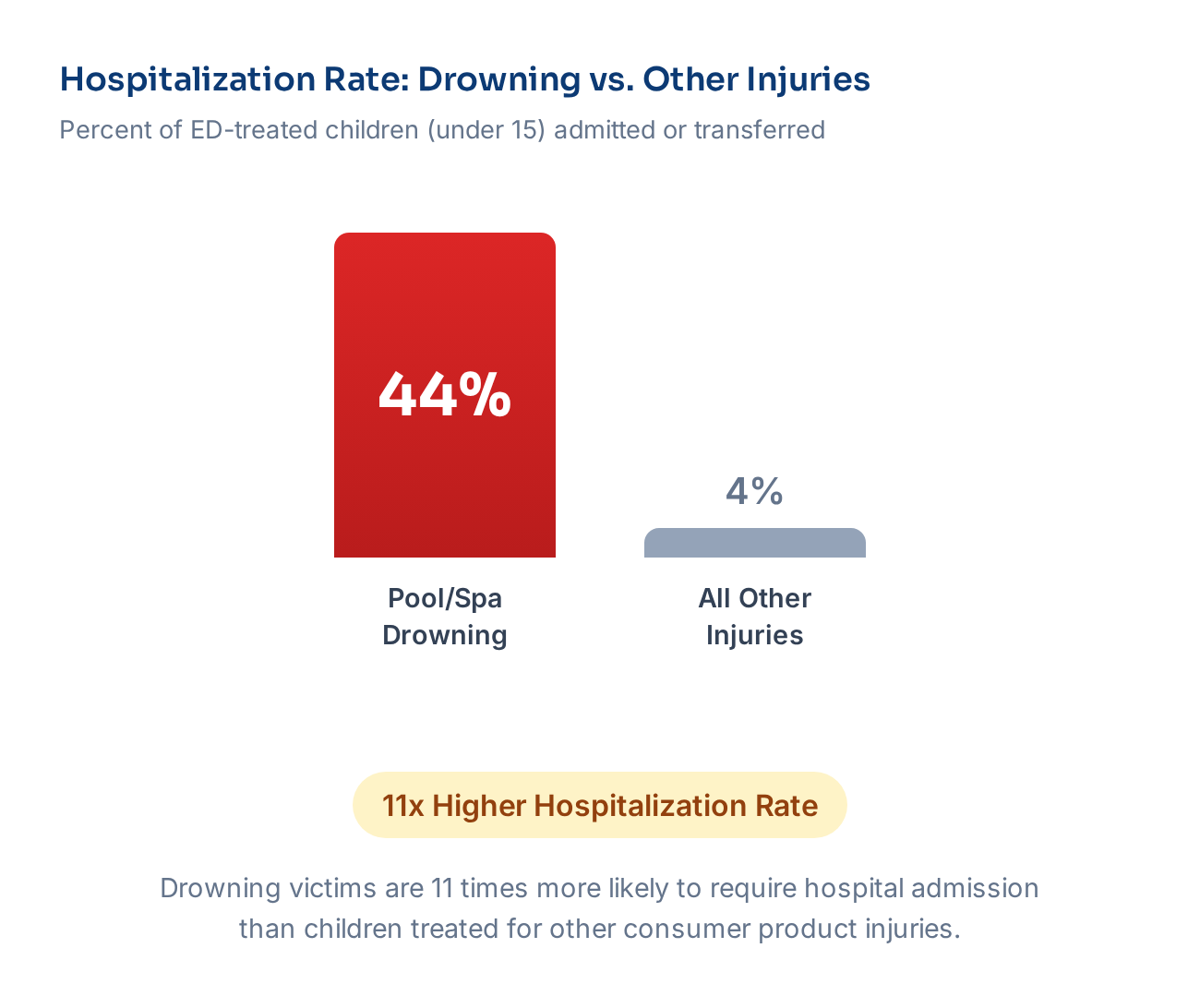
This means drowning victims are 11 times more likely to require hospital admission than children treated for other types of injuries. The high hospitalization rate reflects the severity of submersion events—even survivors often face long recovery periods and potential neurological complications.
Long-Term Trends: 1999-2022
Despite the concerning recent numbers, there has been meaningful progress over the past two decades. Childhood drowning rates (ages 0-17) declined 38% between 1999 and 2019, falling from 1.6 to 1.0 deaths per 100,000 population.[5]CDC National Center for Health StatisticsData Brief No. 413: Drowning Death Rates, 1999-2019cdc.gov
However, this two-decade decline was interrupted during the COVID-19 pandemic. CDC data shows drowning rates increased significantly in 2020, 2021, and 2022 compared to 2019.[4]CDC Morbidity and Mortality Weekly ReportVital Signs: Drowning — United States, 1999–2022cdc.gov Researchers attribute this partly to reduced access to supervised swimming settings and lifeguards during pandemic restrictions.
What the Data Means for Pool Professionals
For pool service companies, these statistics underscore the critical importance of safety conversations with customers. Every residential pool without proper barriers represents an ongoing risk—and every homeowner educated about supervision and fencing is a potential tragedy prevented.
Key takeaways for the industry:
- Residential focus: The vast majority of child drownings occur in residential pools, not public facilities. Your customers' backyards are where the risk lives.
- Barrier effectiveness: Research shows that barriers and fencing can substantially reduce childhood residential drownings.[6]Pool Safely Act (P.L. 110-140)Virginia Graeme Baker Pool and Spa Safety Act, Section 1407poolsafely.gov
- Severity matters: With an 11x higher hospitalization rate, even "near misses" can result in life-altering injuries.
- Seasonal awareness: Drowning incidents peak in May, June, July, and August—precisely when pool service activity is highest.[7]U.S. Consumer Product Safety Commission2022 Submersion Report, seasonal patternscpsc.gov
Data Limitations and Missing Information
While the CPSC provides the most comprehensive pool-specific drowning data available, there are important limitations:
- Fatality reporting delays: Final fatality counts for 2023-2026 are not yet available due to death certificate processing timelines
- Race/ethnicity gaps: 42-55% of emergency department records are missing race/ethnicity data, limiting demographic analysis[1]U.S. Consumer Product Safety Commission2025 Submersion Report, data limitations sectioncpsc.gov
- Age scope: CPSC data focuses on children under 15; adult drowning statistics require separate CDC sources
Sources
- [1] U.S. Consumer Product Safety Commission, "Pool or Spa Submersions: Estimated Nonfatal and Reported Fatal Drownings, 2025 Report." cpsc.gov
- [2] U.S. Consumer Product Safety Commission, "Pool and Spa Submersion Report, 2024." cpsc.gov
- [3] Centers for Disease Control and Prevention, "Drowning Facts," 2024. cdc.gov
- [4] CDC Morbidity and Mortality Weekly Report, "Vital Signs: Drowning — United States, 1999–2022," MMWR 2024;73(29). cdc.gov
- [5] CDC National Center for Health Statistics, "Data Brief No. 413: Drowning Death Rates in the United States, 1999-2019." cdc.gov
- [6] Pool Safely Act (P.L. 110-140), Virginia Graeme Baker Pool and Spa Safety Act, Section 1407. poolsafely.gov
- [7] U.S. Consumer Product Safety Commission, "Pool or Spa Submersions: Estimated Nonfatal and Reported Fatal Drownings, 2022 Report," seasonal data analysis. cpsc.gov