
Biodesign Pool Keeps Turning Green: Pro Checklist


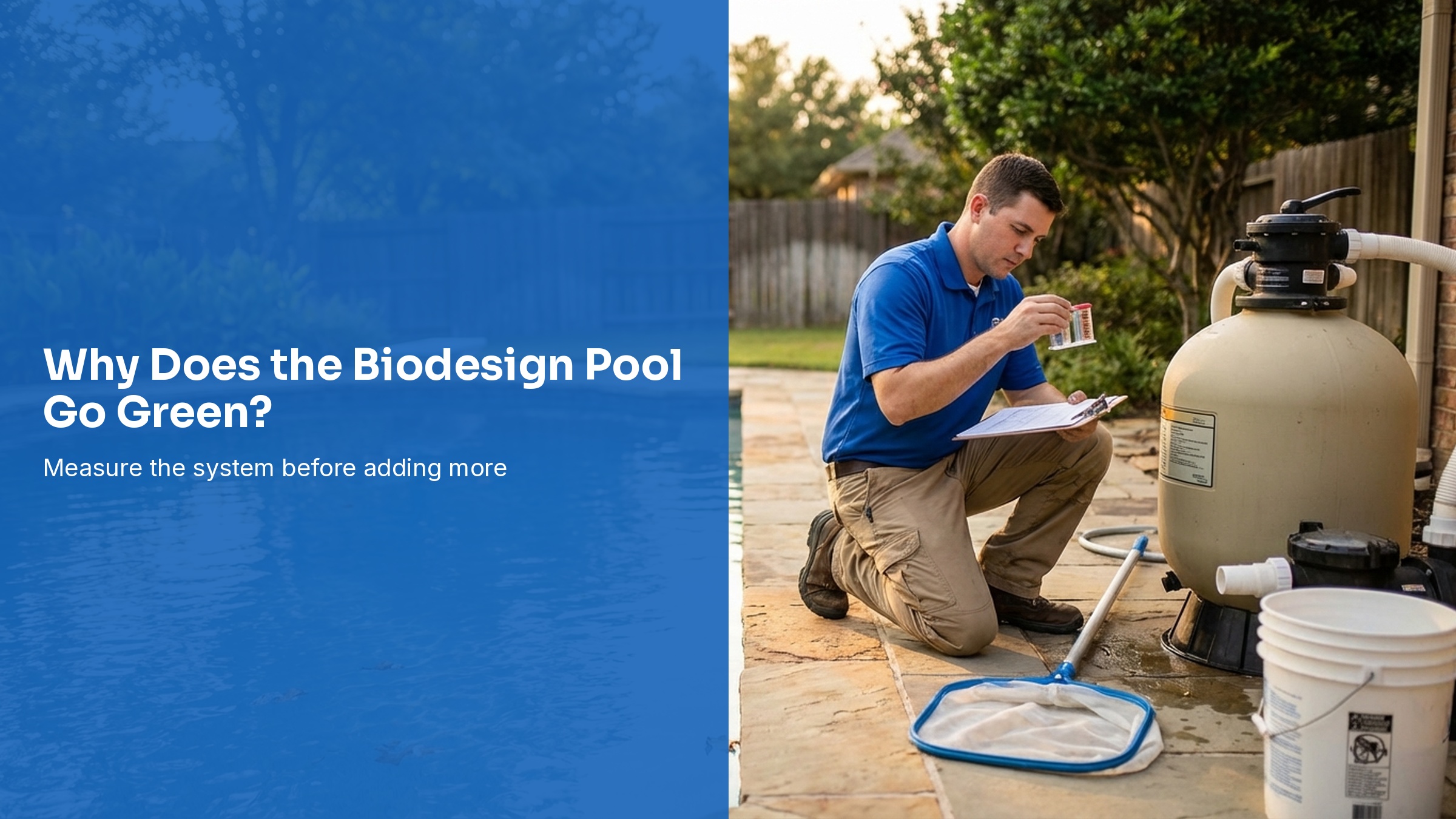
A Biodesign pool that repeatedly turns green needs a measured system diagnosis, not bigger unrecorded chlorine doses. Confirm the pool volume, sanitizer loss, cyanuric acid, pH, circulation, filter performance, cleaning method, and condition of the resin-quartz surface. Then involve the authorized builder or dealer before using an aggressive treatment that could affect the finish or warranty.
The Biodesign brand is a construction system, not a water diagnosis. The manufacturer describes an EPDM waterproof membrane beneath reinforced quartz-sand and resin coating layers. That differs from plaster and from an ordinary exposed liner, so the service plan must follow the installed system's current care instructions.
Key Takeaways
- Verify volume before dosing. Organic shapes, shelves, and sloped entries make visual gallon estimates unreliable.
- Measure chlorine demand over time. A single weekly reading cannot show when sanitizer disappears or why.
- Measure flow, not pump RPM alone. Plumbing, filter condition, valves, and features determine delivered circulation.
- Use the manufacturer's surface-care method. Biodesign currently calls for standard PVC brushes and warns against excessive aggressive chemical treatment.
- Treat biofilm as a hypothesis until supported. Recurring algae can also come from underdosing, poor coverage, filter problems, contamination, or a surface defect.
Start With the Installed Biodesign System
Obtain the build file before changing treatment. Record the installer, date, plans, calculated water volume, pump, filter, sanitizer, inlets, drains, water features, coating specification, maintenance history, and warranty. Ask whether the authorized biennial surface treatment described in Biodesign's current maintenance guidance has been performed.
Do not call the surface "epoxy sand" and assume all repairs or brushes are interchangeable. Biodesign's current technology page describes quartz sand and purpose-made resin over reinforcement and an EPDM membrane. The maintenance page calls for routine debris removal, filter inspection, water monitoring, and a standard PVC brush rather than sponge tile brushes.
That is the right opening question. Water features can affect aeration and pH behavior, and the system layout determines where sanitizer and filtered water reach. Photograph the equipment and map every suction and return point before selecting a chemical remedy.
Establish Whether Chlorine Is Truly Disappearing
Use a current FAS-DPD method that can measure free and combined chlorine precisely across both routine and elevated ranges. Taylor's K-2006 documentation lists free chlorine, combined chlorine, pH, alkalinity, hardness, and CYA tests. Verify reagent dates, sample depth, volume, and test method.
| Measurement | What to learn |
|---|---|
| Free and combined chlorine | Whether the sanitizer residual is present and whether combined chlorine is accumulating. |
| Cyanuric acid | Whether the sanitizer plan accounts for stabilizer rather than using a fixed chlorine number. |
| pH, alkalinity, hardness, and temperature | Whether water balance, aeration, or heat is changing sanitizer performance and surface risk. |
| Evening and early-morning free chlorine | How much chlorine is lost without sunlight or a new chemical dose during the observed interval. |
| Multiple pool locations | Whether shelves, beach entries, coves, or distant areas receive different circulation and sanitizer. |
| Makeup water and recent use | Whether source water, parties, rain, landscaping, animals, or debris add unusual demand. |
CDC's residential guidance recommends routinely checking chlorine and pH and lists at least 2 ppm chlorine when CYA is used. That is a health-oriented minimum, not a universal algae-remediation target. The treatment level must follow the sanitizer label, pool conditions, CYA, material limits, and any applicable local rules.
Use our free chlorine guide to explain the measurement, but do not rely on a color-comparator result that has bleached out at a high sanitizer level. Record the method and any dilution.
Verify the Volume Before Any Recovery Dose
Biodesign pools often have irregular perimeters, shallow beach entries, and sloped floors. Length times width times an assumed average depth can produce a large error. Obtain design volume from the builder, compare it with fill records or meter data where available, and create a section-based calculation when plans are missing.
An underestimated volume creates chronic underdosing. An overestimated volume can create surface damage, unsafe water, unnecessary cost, and misleading test results. Put the verified gallons in the customer record and use the chemical dosage calculator only after the target comes from a compatible, documented treatment plan.
Map Circulation Instead of Reading RPM
Ten hours at one pool and 24 hours at another do not establish effective circulation. Record flow where possible, clean-filter pressure, dirty pressure, valve position, skimmer action, sanitizer flow switch, and return strength. Confirm that water from shallow shelves and beach entries reaches the treatment loop.
Hydraulics
Measure flow, inspect suction and returns, verify valves, and compare distribution across the organic shape.
Filtration
Confirm model, size, media or cartridges, pressure history, cleaning quality, bypass condition, and backwash performance.
Sanitizer
Verify feeder or salt-cell output, flow interlocks, schedule, production capacity, and residual between visits.
Surface
Inspect for loose aggregate, soft areas, discoloration, coating loss, rough zones, and growth that returns in the same location.
Biodesign's maintenance page lists cartridge, sand, and glass-powder filters and says filter inspection is essential. It expresses a preference for cartridge filtration on sustainability and fine-particle grounds, but that manufacturer statement does not prove that every sand filter is causing algae. Evaluate the installed filter on its actual condition and performance.
The pump run-time calculator can organize volume and flow assumptions. Verify those assumptions in the field before extending runtime. Running a poorly distributed or bypassing system longer may increase cost without reaching the problem area.
Do Not Declare Biofilm From a Photo
That is a plausible field hypothesis, not a verified Biodesign failure mechanism. The manufacturer describes the coating as resin-fixed quartz over a membrane system. A technician cannot conclude from recurring green water that organisms are beneath the coating, that the surface is permeable in a specific way, or that the manufacturer intended biological filtration.
Look for repeatable evidence. Does growth return in exactly the same zones? Does brushing release material? Are those zones rough, loose, cracked, soft, or poorly circulated? Does the filter rapidly load after brushing? Share the photos and service history with the authorized dealer. If a coating defect is suspected, stop trying to cure it with progressively stronger chemistry.
This comment is valuable because it reports mixed outcomes, not because its explanation is confirmed. Similar-looking pools performing differently point toward comparing construction dates, installers, surface maintenance, hydraulic plans, sanitizer systems, environment, and service history before blaming the product category.
When surface-associated contamination is supported, mechanical disruption can be part of remediation, but use the approved brush. See our biofilm overview for the general concept and the green algae guide for differential diagnosis. Product-specific surface instructions still control.
A Controlled Recovery Sequence
- Close or restrict swimming as conditions require. Follow local rules, the sanitizer label, and professional judgment for unsafe clarity or sanitizer.
- Capture baseline data. Full water panel, multiple locations, flow, pressure, equipment state, photos, and verified volume.
- Contact the installer or authorized dealer. Confirm brush, treatment limits, surface status, warranty, and required periodic care.
- Correct equipment faults first. Restore sanitizer production, flow, filtration, and schedule before adding a large oxidizer dose.
- Brush and clean with approved tools. Remove debris, clean the filter as needed, and record what leaves the surface.
- Follow one labeled treatment plan. Calculate from verified volume and measure the residual at planned intervals.
- Prove recovery. Track chlorine demand, water clarity, filter load, and whether the same locations regrow.
- Build prevention from the findings. Adjust service frequency, testing, circulation, cleaning, or authorized surface work.
Do Not Add a Second System Before Fixing the First
Mineral cartridges, silver systems, borates, algaecides, enzymes, and secondary treatment may have legitimate labeled uses. They are not substitutes for an effective primary sanitizer residual, measured circulation, functioning filtration, or correct surface care. Some products introduce metals or create chemical and warranty conflicts.
Before adding one, obtain its current EPA label where applicable, confirm compatibility with the Biodesign surface and existing chemicals, define how success will be measured, and tell the customer the ongoing replacement and testing cost. Do not stack products until no one can tell which change worked.
Common Questions
Are all Biodesign pools hard to maintain?
No conclusion like that is supported by one thread. The discussion itself reports both recurring-problem pools and others that perform normally. Diagnose each installation and compare the differences.
Should a Biodesign pool run 24 hours per day?
Not as a blanket rule. Required runtime depends on verified volume, measured flow, filter performance, sanitizer production, use, and circulation coverage. A correct system may run longer at lower flow, but the field measurements should drive the schedule.
Can you use a stainless brush?
Do not assume so. Biodesign's current public maintenance page says to use standard PVC brushes and not sponge tile brushes. Obtain written dealer guidance for any more aggressive tool.
What if algae appears to come through the coating?
Photograph it before and after approved cleaning, document repeated locations, and request an authorized surface inspection. Do not diagnose growth beneath the coating without evidence or keep escalating chemicals against a possible construction issue.
The Bottom Line
Recurring green water in a Biodesign pool is a reason to measure more, not dose harder. Verify gallons, sanitizer demand, CYA, pH, flow, filtration, coverage, cleaning method, and surface condition in a single documented investigation.
Follow the current Biodesign care instructions and involve an authorized dealer when the surface is implicated. A repeatable diagnosis protects swimmers, the finish, the service company, and the owner's warranty.
Turn a Recurring Green Pool Into a Case File
PoolDial keeps water tests, flow checks, photos, filter work, treatments, and dealer guidance together for every visit.
Start Your Free Trial