
Virginia Graeme Baker Act: Pool Drain Safety Requirements Explained


The Virginia Graeme Baker Pool and Spa Safety Act (VGB Act) is federal law requiring anti-entrapment drain covers on all public pools and spas. Named after the 7-year-old granddaughter of former Secretary of State James Baker, who died in 2002 after being trapped by a pool drain, the law has saved countless lives since taking effect in 2008.[1]CPSCVGB Act implementation and requirementscpsc.gov
This guide explains VGB Act requirements, compliance standards, and what pool service professionals need to know about drain safety.
VGB Act Key Requirements
- Effective December 19, 2008 — All public pools must have compliant drain covers [1]CPSCVGB Act effective datecpsc.gov
- ASME/ANSI A112.19.8 — Required standard for drain covers (now APSP-16) [1]CPSCDrain cover standard requirementscpsc.gov
- Single-drain pools need backup systems — SVRS, suction vents, or gravity drainage required [2]Pool Safely (CPSC)VGB Act compliance informationpoolsafely.gov
- 3-foot minimum drain spacing — Multiple drains must be at least 3 feet apart [3]CPSC Drain Cover GuidanceDrain spacing requirementscpsc.gov
Background: Why the VGB Act Exists
Pool drain entrapment occurs when a swimmer's body, hair, or clothing becomes trapped against a drain by powerful suction. The force can be so strong that victims cannot escape without help—and drowning can occur in minutes.
Virginia Graeme Baker's death in 2002 brought national attention to this hazard. Despite being surrounded by adults, the 7-year-old became trapped by a hot tub drain and could not be freed. Her grandfather, former Secretary of State James Baker, championed federal legislation that was signed into law in 2007 and took effect in December 2008.
took effect
between drains
became effective
Source: CPSC
Core VGB Act Requirements
The VGB Act applies to all public pools, spas, and hot tubs. This includes pools at hotels, apartments, condominiums, community centers, water parks, and any other facility open to the public or shared by multiple households.[2]Pool Safely (CPSC)VGB Act scope and applicabilitypoolsafely.gov
Drain Cover Requirements
All pool and spa drain covers must comply with the ASME/ANSI A112.19.8 standard (or its successor, APSP-16, which became effective November 24, 2020). Compliant covers are designed to:
- Prevent body entrapment (torso, limbs)
- Prevent hair entanglement
- Allow water flow while blocking suction hazards
- Include visible markings showing compliance certification
How to identify compliant covers: Look for markings showing the drain cover meets ASME/ANSI A112.19.8, APSP-16 2011, or APSP-16 2017. The cover should also display the manufacturer name, flow rating (GPM), and maximum lifespan date.
Single-Drain Pool Requirements
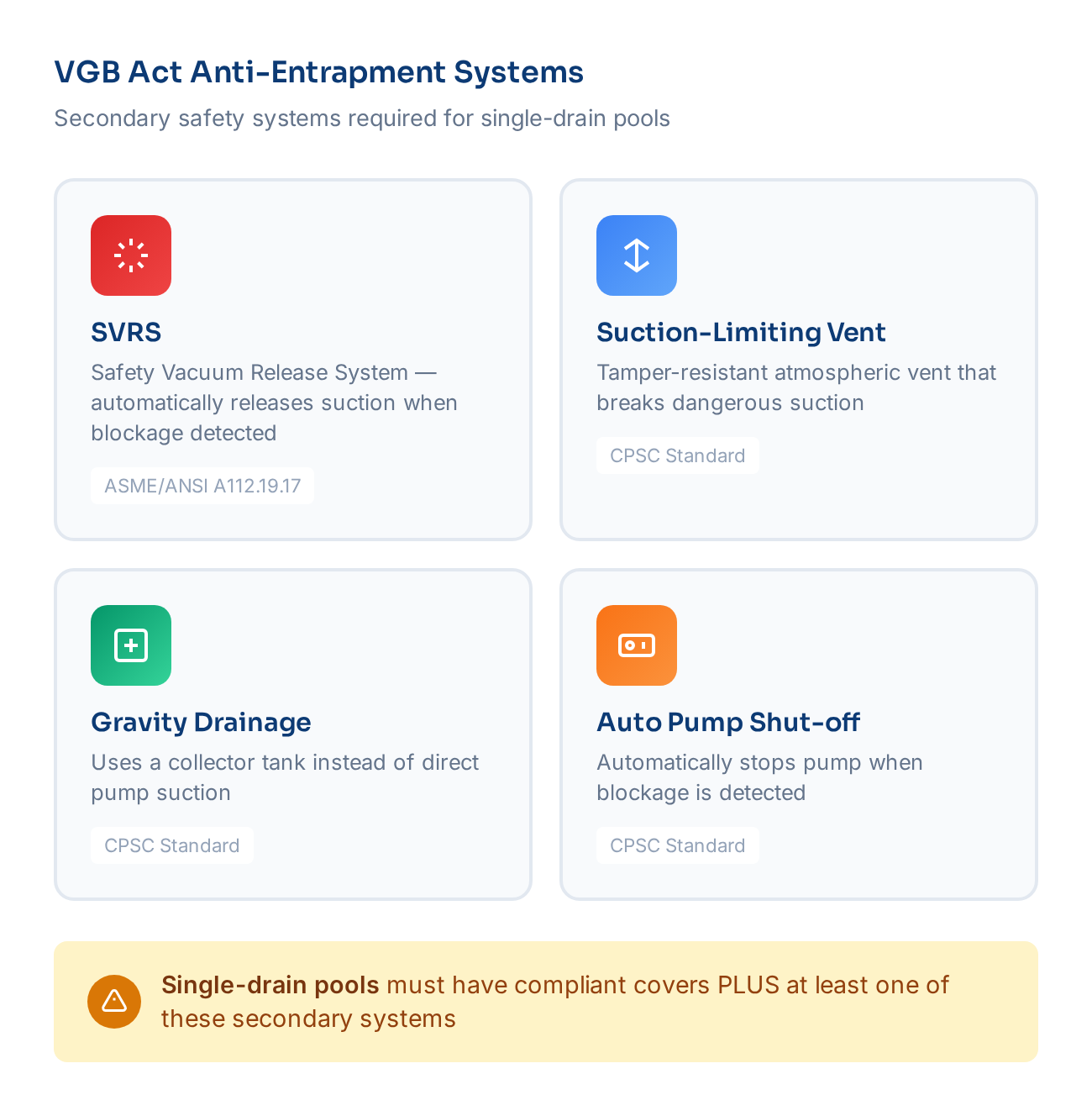
Pools with a single main drain (or multiple drains that can be blocked by a single body) must have at least one additional anti-entrapment system:[2]Pool Safely (CPSC)Secondary system requirementspoolsafely.gov
| System | Description | Standard |
|---|---|---|
| SVRS | Safety Vacuum Release System — automatically releases suction when blockage detected | ASME/ANSI A112.19.17 |
| Suction-Limiting Vent | Tamper-resistant atmospheric vent that breaks suction | CPSC Standard |
| Gravity Drainage | Uses a collector tank instead of direct suction | CPSC Standard |
| Auto Pump Shut-off | Automatically stops pump when blockage detected | CPSC Standard |
| Drain Disablement | No main drain (pool skims only) | N/A |
| Unblockable Drains | Multiple drains spaced 3+ feet apart | CPSC Guidance |
The 3-Foot Drain Spacing Rule
Multiple drains on the same suction line are considered "unblockable" only if they are at least 3 feet apart. This ensures that a single body cannot block all drains simultaneously, maintaining water flow and preventing dangerous suction buildup.[3]CPSC Drain Cover GuidanceDrain spacing requirementscpsc.gov
If drains are closer than 3 feet, they are treated as a single drain and require a secondary anti-entrapment system.
Residential Pool Applicability
Important: The federal VGB Act does not require residential (single-family home) pools to install compliant drain covers or secondary systems. However, the CPSC strongly recommends that homeowners voluntarily comply, and many states have enacted their own residential requirements.
Even without federal requirements, pool service professionals should:
- Inspect drain covers during routine service visits
- Recommend VGB-compliant covers to residential customers
- Document drain cover condition and any recommendations made
- Know your state's residential drain safety requirements
VGB Act Timeline
Enforcement and Penalties
The CPSC enforces the VGB Act at the point of manufacture and distribution. This means every drain cover entering commerce must meet entrapment standards before it can be sold.[1]CPSCCPSC enforcement authoritycpsc.gov
Pool operators (hotels, apartments, etc.) can face:
- State and local health department citations
- Pool closure orders until compliance is achieved
- Civil liability for injuries occurring at non-compliant pools
- Potential federal penalties for willful non-compliance
What Pool Service Pros Should Know
For pool service professionals, understanding VGB Act requirements is essential—especially when servicing commercial accounts.
During routine service:
- Check drain covers for damage, cracks, or missing screws
- Verify covers display VGB-compliant markings
- Check expiration dates (covers have maximum lifespans)
- Document condition and report issues to pool operator
- Never service a pool with a missing or damaged drain cover
If you encounter a non-compliant drain cover:
- Document the issue with photos
- Notify the pool operator in writing
- Recommend immediate replacement with a compliant cover
- Consider whether the pool should be closed until repaired
Sources
- [1] U.S. Consumer Product Safety Commission, "Pool and Spa Drain Covers" — Business guidance on VGB Act compliance, drain cover standards, and enforcement. cpsc.gov
- [2] Pool Safely (CPSC), "Frequently Asked Questions" — Official CPSC resource on VGB Act compliance, secondary system requirements, and public pool obligations. poolsafely.gov
- [3] U.S. Consumer Product Safety Commission, "Pool and Spa Drain Covers FAQ" — Drain spacing requirements, cover standards, and compliance guidance. cpsc.gov