
Why pH Keeps Rising
Add acid, then move or splash the water. See why pH can
rise again even though the acid already did its job.
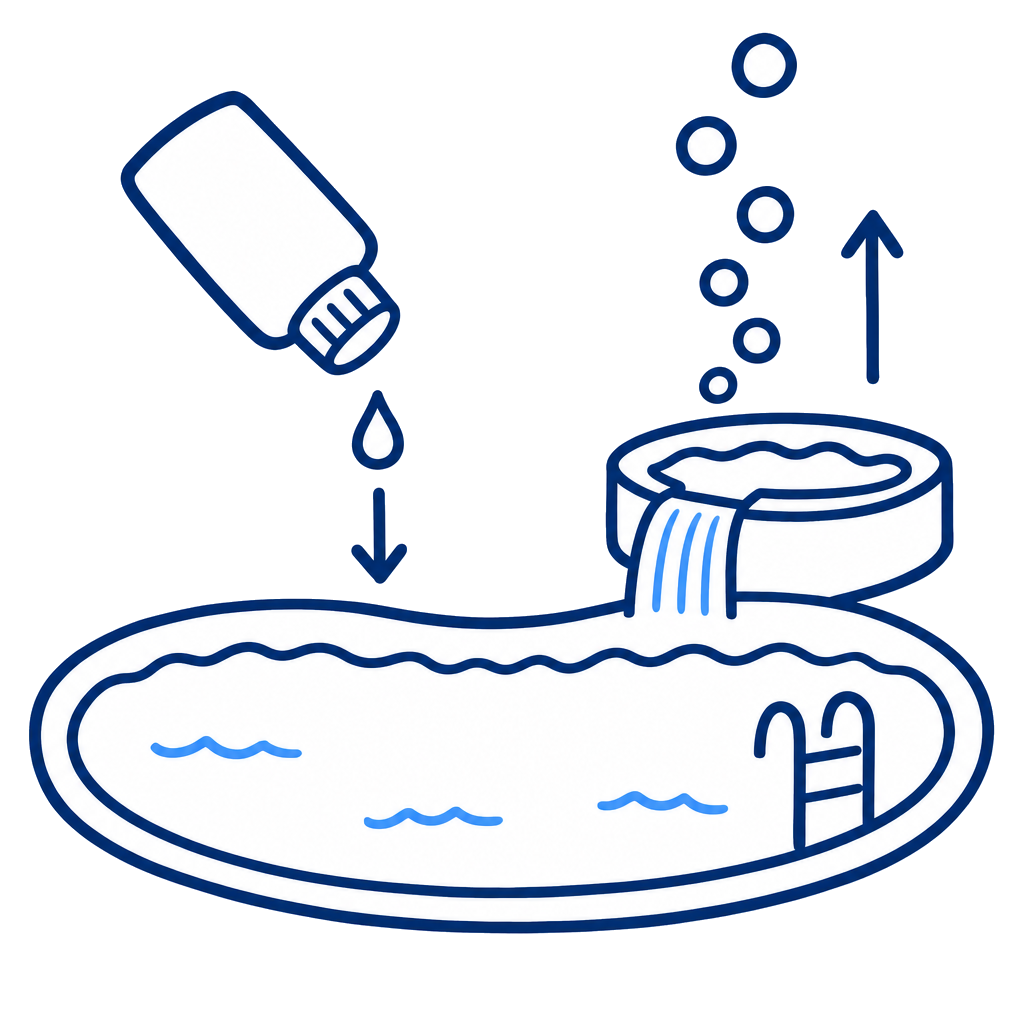
Educational model only—not an acid dose. Test the water, follow the product label, and never mix acid with chlorine.
Why pool pH rises again after acid
Pool water contains dissolved carbon dioxide as part of its carbonate system. Adding acid neutralizes some alkalinity and shifts more of that system toward dissolved CO₂, so pH falls. When CO₂ later escapes into the air, the acidic influence decreases and pH can climb again.
Acid changes pH and total alkalinity
pH describes hydrogen-ion activity at that moment. Total alkalinity describes the water’s acid-neutralizing capacity, supplied mostly by bicarbonate in an ordinary pool. Acid lowers pH and reacts with bicarbonate, so total alkalinity also decreases.
Moving water can raise pH without restoring alkalinity
Returns aimed at the surface, spa spillovers, waterfalls, jets, and vigorous splashing increase contact between water and air. That can speed up CO₂ loss. In the carbonate system shown here, the pH rises during that loss while total alkalinity stays at the lower level created by the acid.
What higher alkalinity changes
Higher total alkalinity gives the water more acid-neutralizing capacity. That means the same modeled acid effect produces a smaller immediate pH change. It also leaves more carbonate alkalinity available after the correction. This explorable lets you change TA so that buffering behavior is visible instead of treating pH as an isolated number.
How to use this pH rebound model
Set the starting pH and total alkalinity, then choose how many ppm of TA the illustrative acid treatment neutralizes. Choose what happens to the water afterward and press Play the rebound. Watch pH and TA fall together during the acid step. When the water moves and CO₂ escapes, the pH number rises while the TA value stays put.
The playback shows direction and relative behavior, not a clock. Real CO₂ loss depends on pool geometry, water features, pump schedules, temperature, wind, and other chemistry that a short form cannot measure.
Calculate an actual acid treatment separately
This explorable intentionally does not convert the acid effect into ounces. Use the pool chemical dosage calculator with a measured pool volume and current test results. Use the LSI calculator to see how pH and alkalinity combine with calcium, temperature, and dissolved solids.
Sources and model scope: The CDC Model Aquatic Health Code Annex describes total alkalinity as water’s acid-neutralizing capacity, identifies CO₂ outgassing as a source of rising pH, and notes that acid reduces total alkalinity. The model uses carbonate equilibrium constants at 25°C and an illustrative fraction of movement toward atmospheric CO₂ equilibrium. Chemical-safety language follows the CDC’s pool chemical safety recommendations.