


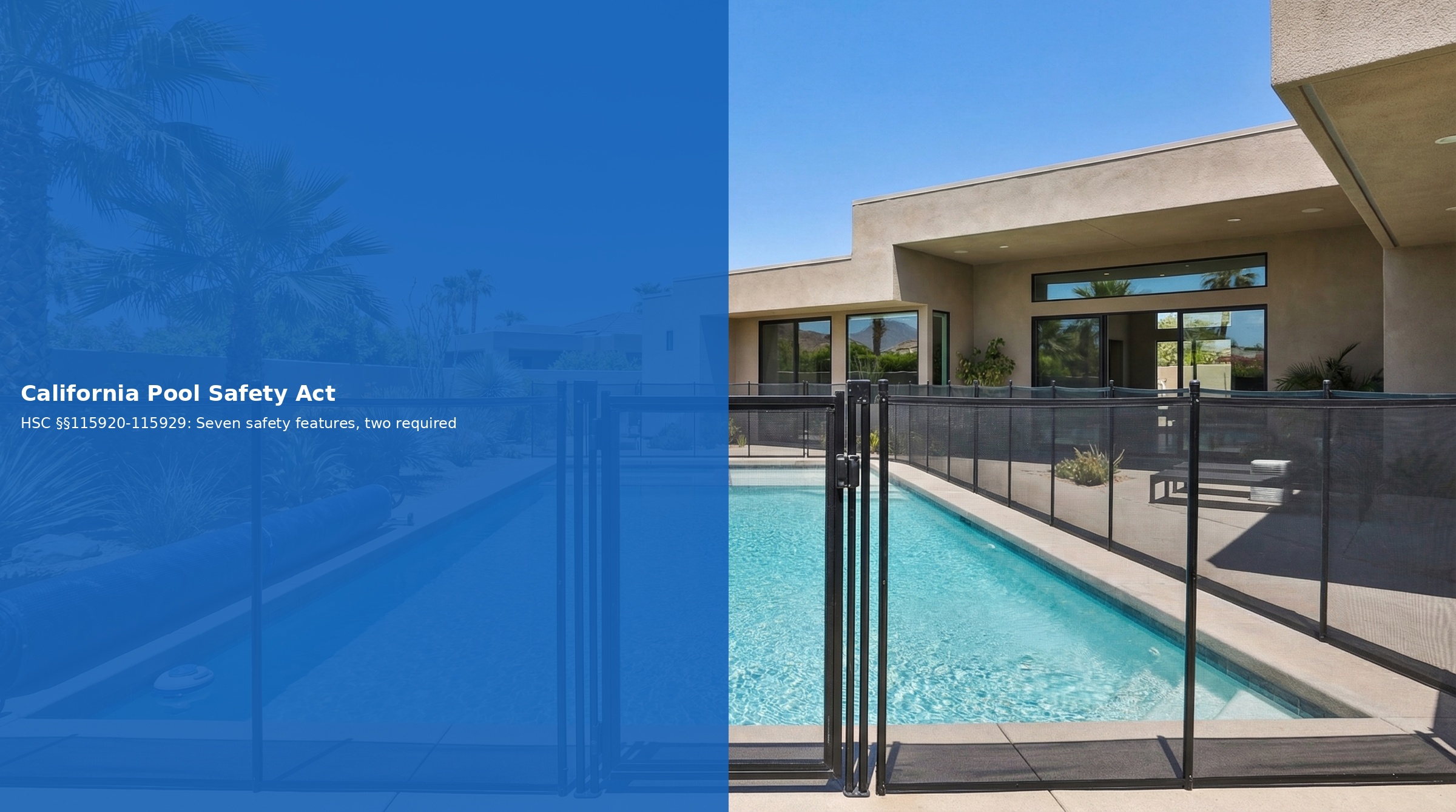
The Swimming Pool Safety Act is a vital piece of California legislation aimed at preventing childhood drowning, the leading cause of unintentional death for children ages one to four in the state. Codified in California Health and Safety Code sections 115920 through 115929, this act establishes mandatory safety requirements for residential swimming pools and spas.[1]HSC Section 115922Swimming Pool Safety Act Requirementsleginfo.legislature.ca.gov
Key Takeaways
- Two Safety Features Required — New and remodeled pools must have at least two of seven approved drowning prevention features[1]HSC Section 115922Swimming Pool Safety Act Requirementsleginfo.legislature.ca.gov
- Seven Approved Features — Options include enclosures, mesh fencing, safety covers, exit alarms, self-closing doors, pool alarms, and other approved devices[1]HSC Section 115922Swimming Pool Safety Act Requirementsleginfo.legislature.ca.gov
- 60-Inch Fence Height — Permanent enclosures must be at least 60 inches tall[2]HSC Article 2.5Swimming Pool Safety Enclosure Standardsleginfo.legislature.ca.gov
- Self-Latching Gates — Gate latches must be at least 60 inches above the ground[2]HSC Article 2.5Swimming Pool Safety Enclosure Standardsleginfo.legislature.ca.gov
- ASTM Standards Required — Mesh fencing (F2286), covers (F1346), and alarms (F2208) must meet specific ASTM standards[1]HSC Section 115922Swimming Pool Safety Act Requirementsleginfo.legislature.ca.gov
- No Duplicate Features — The two features must be different types operating independently[1]HSC Section 115922Swimming Pool Safety Act Requirementsleginfo.legislature.ca.gov
The Seven Approved Safety Features
The Act specifies seven drowning prevention safety features, and homeowners must choose at least two from the following list. Each feature serves as a layer of protection designed to prevent unsupervised access to the pool area by young children.[1]HSC Section 115922Swimming Pool Safety Act Requirementsleginfo.legislature.ca.gov
Approved Safety Features
- An enclosure that meets the requirements of Section 115923 and isolates the swimming pool or spa from the private single-family home.
- Removable mesh fencing that meets ASTM F2286 standards in conjunction with a gate that is self-closing and self-latching and can accommodate a key lockable device.
- An approved safety pool cover that meets ASTM F1346 standards.
- Exit alarms on the private single-family home's doors that provide direct access to the swimming pool or spa.
- A self-closing, self-latching device with a release mechanism placed no lower than 54 inches above the floor on the home's doors providing direct access to the pool.
- A pool alarm that, when placed in the pool, will sound upon detection of accidental or unauthorized entrance into the water, meeting ASTM F2208 standards.
- Other means of protection that provides equivalent drowning prevention as approved by the local building official.
Critical Compliance Limitations
The law is specific about what combinations are not allowed. The goal is to ensure two different layers of protection that operate independently of one another. Simply installing two devices on the same point of entry does not satisfy the requirement.[1]HSC Section 115922Swimming Pool Safety Act Requirementsleginfo.legislature.ca.gov
"The requirements of subdivision (a) are not satisfied by any of the following: (1) An exit alarm and a self-closing, self-latching device on the same door..." — Cal. Health & Safety Code Section 115922(b)
For example, an owner cannot satisfy the law by placing both an exit alarm and a self-closing device on the same door. Similarly, a safety pool cover cannot be paired with a pool alarm to meet the requirement. This provision ensures that homeowners implement genuinely redundant safety systems rather than superficially doubling up on a single access point.
Standards for Enclosures
When a permanent enclosure (fence) is used as one of the safety features, it must meet several strict structural criteria under Section 115923. These requirements ensure that the barrier effectively prevents young children from accessing the pool area.[2]HSC Article 2.5Swimming Pool Safety Enclosure Standardsleginfo.legislature.ca.gov
| Enclosure Requirement | Standard |
|---|---|
| Height | Minimum 60 inches |
| Ground Clearance | Maximum 2-inch vertical clearance between ground and bottom of enclosure |
| Gaps | Openings must not allow a 4-inch diameter sphere to pass through |
| Gate Direction | Must open away from the pool |
| Gate Mechanism | Must be self-closing with self-latching device at least 60 inches above ground |
| Climbability | Outside surface must be free of protrusions or handholds enabling a child under five to climb |
The California Building Code (CBC) Chapter 31 incorporates and reinforces these Health and Safety Code requirements, ensuring that building inspectors verify compliance during both new construction and remodel projects.[3]CBC Chapter 31California Building Code Swimming Pool Requirementsup.codes
Contractor and Official Responsibilities
Pool contractors and building officials share responsibility for ensuring compliance with the Swimming Pool Safety Act. Before issuing a final approval for pool construction or remodeling, local building officials must verify that at least two of the seven approved safety features have been properly installed and meet all applicable standards.
For pool service professionals, understanding these requirements is essential when advising clients on upgrades or when working with homeowners who are buying or selling properties with pools. Real estate transactions involving pools trigger disclosure requirements, and sellers must demonstrate compliance with current safety standards.
Summary Table
| Feature | Standard/Requirement | Citation |
|---|---|---|
| Enclosure (Fence) | 60" min height; self-latching gate | HSC Section 115923 |
| Mesh Fencing | ASTM F2286 compliant | HSC Section 115922(a)(2) |
| Safety Cover | ASTM F1346 compliant | HSC Section 115922(a)(3) |
| Exit Alarms | UL 2017 compliant; on all doors/windows | HSC Section 115922(a)(4) |
| Self-Closing Device | Release mechanism at least 54" above floor | HSC Section 115922(a)(5) |
| Pool Alarm | ASTM F2208 compliant; no wearables | HSC Section 115922(a)(6) |
| Features Required | Minimum of two different types | HSC Section 115922(a) |
Sources
- [1] California Health and Safety Code Section 115922, Swimming Pool Safety Act. leginfo.legislature.ca.gov
- [2] California Health and Safety Code Article 2.5, Swimming Pool Safety. leginfo.legislature.ca.gov
- [3] California Building Code Chapter 31, Special Construction - Swimming Pool Requirements. up.codes