


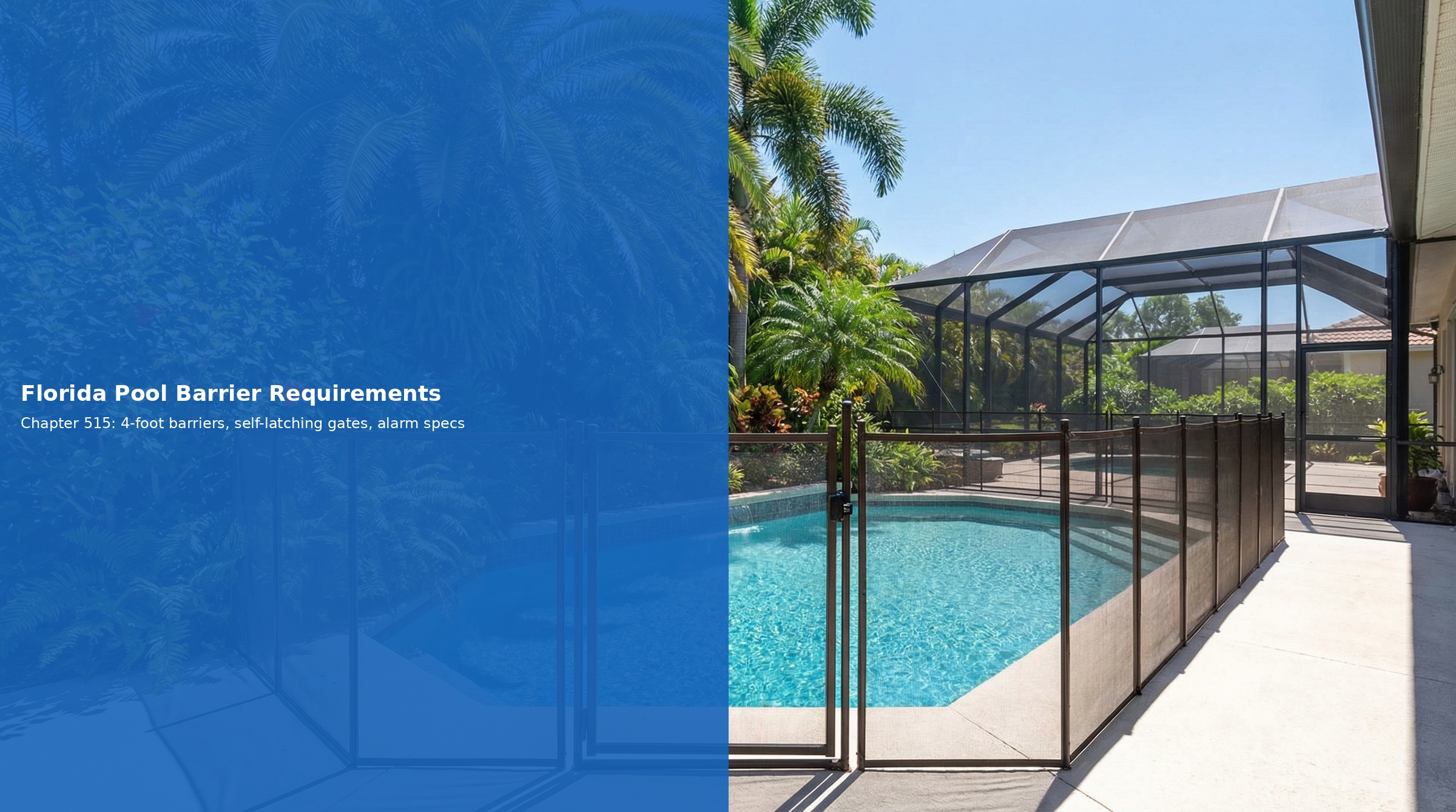
The Residential Swimming Pool Safety Act was enacted to reduce the number of accidental drownings in Florida, particularly among young children.[1]FAC 64E-9.018Pool Service Technician Certificationflrules.org By requiring physical barriers and electronic monitoring for all new residential pools, the state has created a multi-layered defense system.[2]§515.27, Florida StatutesSafety Feature Options & Penaltiesflsenate.gov These regulations apply to all pools built after the law's inception in October 2000, setting a high standard for residential safety compliance.
Key Takeaways
- Minimum Barrier Height — Barriers must be at least 4 feet tall measured from the outside[3]§515.29, Florida StatutesBarrier Requirementsflsenate.gov
- Multiple Safety Options — Homeowners must choose at least one of five approved safety features, including fences or alarms[2]§515.27, Florida StatutesSafety Feature Options & Penaltiesflsenate.gov
- Outward Opening Gates — All access gates must open outward, away from the pool, and be self-closing[3]§515.29, Florida StatutesBarrier Requirementsflsenate.gov
- High-Decibel Alarms — Door and window exit alarms must reach at least 85 dB A at 10 feet[2]§515.27, Florida StatutesSafety Feature Options & Penaltiesflsenate.gov
- ASTM Certification — Pool alarms must be independently certified to ASTM Standard F2208[2]§515.27, Florida StatutesSafety Feature Options & Penaltiesflsenate.gov
- Criminal Penalties — Failing to equip a new pool with required safety features is a second-degree misdemeanor[2]§515.27, Florida StatutesSafety Feature Options & Penaltiesflsenate.gov
Residential Barrier Specifications
Florida Statute 515.29 provides the technical blueprint for what constitutes a legal pool barrier.[3]§515.29, Florida StatutesBarrier Requirementsflsenate.gov The primary requirement is that the barrier must be at least 4 feet high on the outside and free of any gaps, openings, or protrusions that would allow a child to crawl under or climb over it. This physical separation is intended to isolate the pool from the home, ensuring that the pool area is not accidentally accessible.
The placement of the barrier is just as critical as its height. It must be positioned sufficiently far from the water's edge to prevent someone who manages to penetrate the barrier from immediately falling into the pool. Furthermore, the barrier cannot be located near any permanent structures or equipment that could be used as a ladder for climbing. While a wall of a dwelling can serve as part of the barrier, it is only compliant if it contains no doors or windows that provide direct access to the water.[3]§515.29, Florida StatutesBarrier Requirementsflsenate.gov
"A residential swimming pool barrier must have all of the following characteristics: (a) The barrier must be at least 4 feet high on the outside. (b) The barrier may not have any gaps, openings, indentations, protrusions, or structural components that could allow a young child to crawl under, squeeze through, or climb over the barrier." — §515.29(1), Florida Statutes
Access Gates and Self-Latching Mechanisms
Gates are often the weakest point in a pool safety system, which is why Florida law mandates specific mechanical standards for them.[3]§515.29, Florida StatutesBarrier Requirementsflsenate.gov Every gate providing access to a residential pool must open outward—away from the water. They must also be self-closing and equipped with a self-latching locking device. The release mechanism for this latch must be located on the pool side of the gate and placed so that a small child cannot reach it over the top or through any gaps.
For aboveground pools, the structure of the pool itself can sometimes serve as the barrier, but the access points remain strictly regulated. Any ladder or steps used to enter an aboveground pool must be capable of being secured, locked, or removed when not in use. Alternatively, the ladder must be surrounded by a separate barrier that meets the same 4-foot height and self-latching gate requirements as a standard inground pool fence.[3]§515.29, Florida StatutesBarrier Requirementsflsenate.gov
Electronic Safety Options and Alarms
If a physical enclosure is not the chosen primary safety feature, homeowners may opt for electronic monitoring or specialized covers.[2]§515.27, Florida StatutesSafety Feature Options & Penaltiesflsenate.gov One popular option is the installation of exit alarms on all doors and windows that provide direct access to the pool area. These alarms must produce a minimum sound pressure rating of 85 dB A at 10 feet to ensure they are audible throughout the home. Another option is a self-closing, self-latching device on all doors, with a release mechanism at least 54 inches above the floor.
Pool alarms that float in the water are also an acceptable safety feature, provided they meet ASTM Standard F2208.[2]§515.27, Florida StatutesSafety Feature Options & Penaltiesflsenate.gov These devices must be able to detect an unauthorized entrance into the water through surface motion, pressure, or sonar. However, the law explicitly states that personal "wearable" alarms attached to a child do not satisfy the legal requirement for a pool alarm.
"A person who fails to equip a new residential swimming pool with at least one pool safety feature as required in subsection (1) commits a misdemeanor of the second degree... except that no penalty shall be imposed if the person, within 45 days... has equipped the pool with at least one safety feature." — §515.27(2), Florida Statutes
Summary Table
| Safety Feature | Legal Specification | Citation |
|---|---|---|
| Enclosure | 4ft height, separate from yard fence | §515.29(1) F.S. |
| Exit Alarm | 85 dB A at 10 feet | §515.27(1)(c) F.S. |
| Gate Latch | Pool-side, child-unreachable | §515.29(3) F.S. |
| Door Latch | 54 inches minimum height | §515.27(1)(d) F.S. |
| Pool Alarm | ASTM F2208 certified | §515.27(1)(e) F.S. |
Sources
- [1] Florida Administrative Code Rule 64E-9.018, Public Pool Service Technician Certification. flrules.org
- [2] §515.27, Florida Statutes, Residential Pool Safety Features. flsenate.gov
- [3] §515.29, Florida Statutes, Barrier Requirements. flsenate.gov