


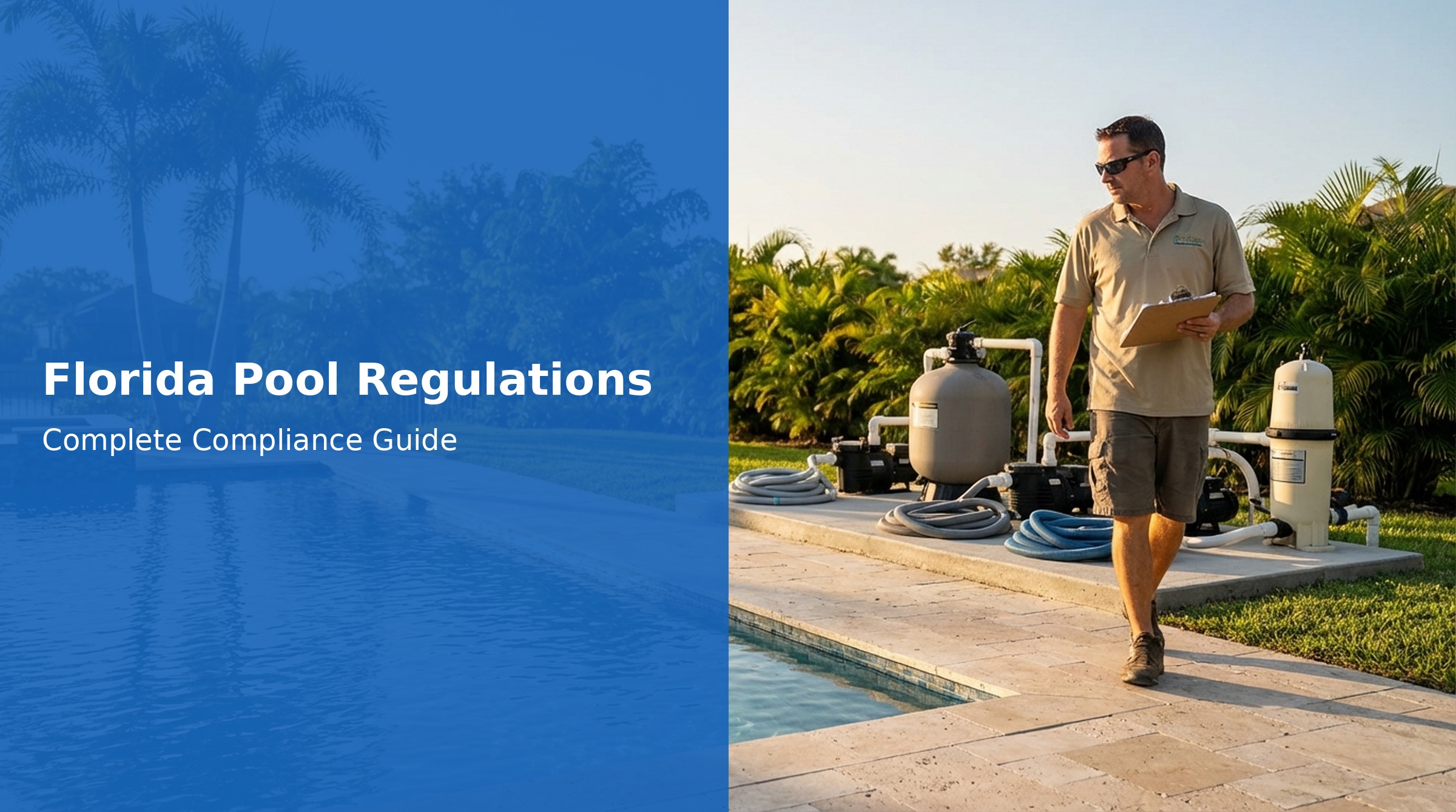
Florida is home to the largest swimming pool market in the United States, with over 1.5 million residential pools currently in operation. To manage this massive infrastructure, the state has established a rigorous regulatory framework primarily through Chapters 514 and 515 of the Florida Statutes and Rule Chapter 64E-9 of the Florida Administrative Code. These laws ensure that both public and private swimming environments maintain high standards of sanitation, safety, and professional oversight.[1]Florida Statutes Chapter 514Public Swimming and Bathing Facilitiesflsenate.gov
Key Takeaways
- Massive Market Scale — Florida contains more than 1.5 million residential pools, necessitating a year-round service industry
- Public vs. Private Distinction — Public pools serve cooperative housing of five or more units, while private pools serve individual families or smaller living units[2]§514.011, Florida StatutesDefinitionsflsenate.gov
- Certification Mandatory — Technicians servicing public pools must hold specific certifications under Florida law[3]FAC 64E-9.018Public Pool Service Technician Certificationflrules.org
- Barrier Compliance — All residential pools built after October 2000 must adhere to strict safety barrier requirements[4]§515.27, Florida StatutesSafety Feature Options & Penaltiesflsenate.gov
- Entrapment Prevention — Every public pool and spa must be equipped with anti-entrapment systems or devices[5]§514.0315, Florida StatutesRequired Safety Featuresflsenate.gov
- Department Oversight — The Florida Department of Health (DOH) is the primary agency responsible for the sanitation and safety of public pools
Defining Public vs. Private Facilities
Under Florida law, the distinction between a "public" and "private" pool determines which set of regulations a service professional must follow. A public swimming pool is defined as a watertight structure used for bathing or swimming by humans, which is filled with filtered and disinfected water. This definition extends beyond municipal pools to include facilities serving cities, counties, day care centers, schools, and health spas.[2]§514.011, Florida StatutesDefinitionsflsenate.gov
Crucially for property managers and service pros, the "public" designation also covers cooperative living projects of five or more units. This includes apartments, hotels, motels, mobile home parks, and townhouses. In contrast, a private pool is strictly for the use of an individual family or a living unit and their guests, specifically excluding any cooperative housing or joint tenancy of five or more units.[2]§514.011, Florida StatutesDefinitionsflsenate.gov
"Public swimming pool or public pool... includes, but is not limited to, pools operated by or serving... cooperative living-type projects of five or more living units, such as apartments, boardinghouses, hotels, mobile home parks, motels, recreational vehicle parks, and townhouses." — §514.011(2), Florida Statutes
Professional Certification and Licensing
The state of Florida requires that individuals performing service and maintenance on public pools be properly certified. According to Chapter 514, public pool service technicians must complete a department-approved training course to ensure they understand the technical requirements of water chemistry and system maintenance. This certification is not just a best practice but a legal prerequisite for working on commercial or multi-family properties.[3]FAC 64E-9.018Public Pool Service Technician Certificationflrules.org
For more extensive work, such as pool construction or the installation of specific safety features, Florida requires a licensed contractor. For example, the installation of anti-entrapment features on pools built before 1993 must be performed by a licensed contractor as described in Section 489.105(3). This ensures that complex mechanical safety systems are installed according to engineering standards like ASME or ANSI.[6]§489.105, Florida StatutesContractor Definitionsflsenate.gov
Residential Safety and Barrier Laws
For the 1.5 million residential pools in Florida, the Residential Swimming Pool Safety Act (Chapter 515) mandates specific safety features to prevent unauthorized access by children. New residential pools must meet at least one of several safety requirements before they can pass a final inspection and receive a certificate of completion. These options include enclosures, safety covers, exit alarms on doors and windows, or specialized pool alarms.[4]§515.27, Florida StatutesSafety Feature Options & Penaltiesflsenate.gov
The law is particularly strict regarding the physical characteristics of barriers. A barrier must be at least 4 feet high and constructed in a way that prevents a young child from crawling under or squeezing through the structure. These requirements are designed to provide a critical delay, preventing children or medically frail elderly persons from immediately falling into the water if they penetrate the outer yard enclosure.[7]§515.29, Florida StatutesBarrier Requirementsflsenate.gov
"In order to pass final inspection and receive a certificate of completion, a residential swimming pool must meet at least one of the following requirements relating to pool safety features..." — §515.27(1), Florida Statutes
Summary Table
| Requirement | Details | Citation |
|---|---|---|
| Public Pool Definition | Serves 5+ units (apartments, hotels, etc.) | §514.011(2) F.S. |
| Service Certification | Required for all public pool technicians | §514.075 F.S. |
| Barrier Height | Minimum 4 feet high on the outside | §515.29(1)(a) F.S. |
| Entrapment Safety | Must comply with ASME/ANSI A112.19.8 | §514.0315(1) F.S. |
| Misdemeanor Penalty | Failure to equip safety features on new pools | §515.27(2) F.S. |
Sources
- [1] Florida Statutes Chapter 514, Public Swimming and Bathing Facilities. flsenate.gov
- [2] §514.011, Florida Statutes, Definitions. flsenate.gov
- [3] Florida Administrative Code Rule 64E-9.018, Public Pool Service Technician Certification. flrules.org
- [4] §515.27, Florida Statutes, Residential Pool Safety Features. flsenate.gov
- [5] §514.0315, Florida Statutes, Required Safety Features for Public Pools. flsenate.gov
- [6] §489.105, Florida Statutes, Contractor Definitions. flsenate.gov
- [7] §515.29, Florida Statutes, Barrier Requirements. flsenate.gov