


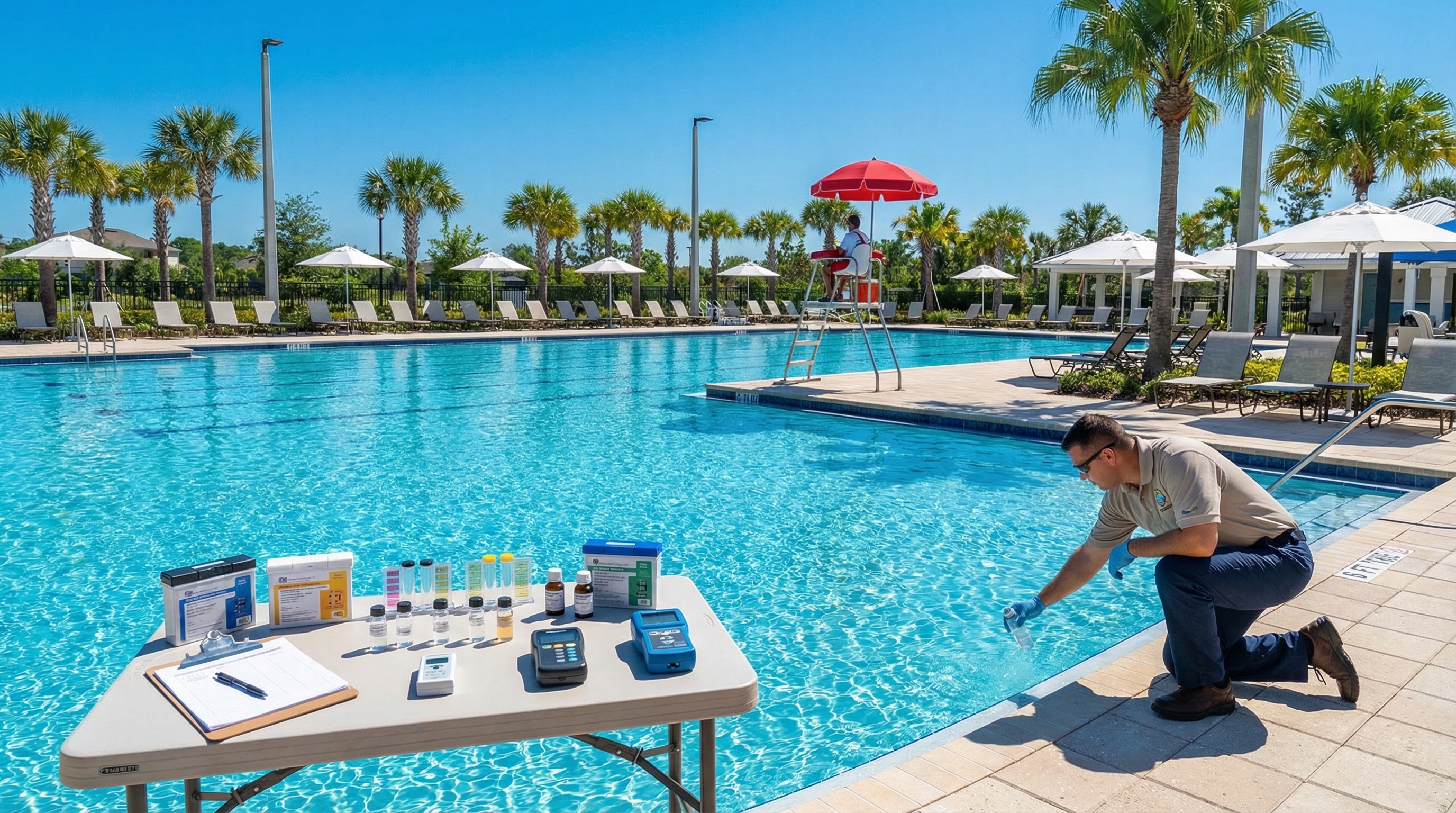
Water quality in public swimming pools is a critical public health concern, especially in a state with a year-round swimming season like Florida.[1]Chapter 64E-9, FACPublic Swimming Pools and Bathing Placesflrules.org To address this, the Florida Department of Health has established Rule 64E-9.004, which outlines the operational requirements for all public bathing facilities.[2]§514.011, Florida StatutesDefinitionsflsenate.gov These regulations are designed to ensure that pools remain sanitary, safe, and free from contaminants that could cause illness.
Key Takeaways
- Operational Rule — Rule 64E-9.004 is the primary regulation for public pool maintenance and water quality[3]FAC 64E-9.004Operational Requirementsflrules.org
- Daily Log Books — Operators must maintain a daily record of information using Department Form DH 921[2]§514.011, Florida StatutesDefinitionsflsenate.gov
- Sanitation Criteria — The rule provides the specific sanitation and safety criteria that all public pools must meet[2]§514.011, Florida StatutesDefinitionsflsenate.gov
- Fecal Incident Response — New versions of the rule adopt CDC Fecal Incident Response Guidelines by reference[2]§514.011, Florida StatutesDefinitionsflsenate.gov
- Hydration Rules — Recent updates allow for commercially bottled water in plastic bottles on the wet deck for patron hydration[2]§514.011, Florida StatutesDefinitionsflsenate.gov
Operational Requirements and Sanitation
Rule 64E-9.004 sets the baseline for the "sanitation and safety criteria" that every public pool operator must follow.[2]§514.011, Florida StatutesDefinitionsflsenate.gov These requirements cover everything from chemical balance to the physical condition of the pool deck. The Department of Health frequently updates these standards to incorporate new national guidelines and technological developments in the field of water treatment.
A significant part of the rule involves keeping the pool free from prohibited items that could compromise safety or water clarity. For instance, while older versions of the rule were more restrictive, recent amendments have allowed for plastic-bottled water on the "wet deck" to ensure patron hydration.[2]§514.011, Florida StatutesDefinitionsflsenate.gov These common-sense updates reflect the Department's goal of balancing strict safety standards with the practical needs of pool users in Florida's hot climate.
"The rule amendments will update standards adopted by reference and provides for the sanitation and safety criteria in public swimming pools in Florida." — Rule 64E-9.004, Rule Development Notice
Mandatory Record Keeping (Form DH 921)
One of the most important administrative requirements for a public pool operator is the maintenance of a daily log.[2]§514.011, Florida StatutesDefinitionsflsenate.gov The state requires a record of water chemistry and operational data to be recorded on Form DH 921. This daily log provides a paper trail that health inspectors can review to ensure the pool has been consistently maintained in a safe condition.[4]FAC 64E-9.008Supervision and Safetyflrules.org
The importance of this record-keeping cannot be overstated. Property owners and service providers have occasionally sought variances from this requirement, but the Department of Health generally maintains that daily records are essential for protecting public health.[2]§514.011, Florida StatutesDefinitionsflsenate.gov These logs must be kept on-site and be readily available for inspection at any time by Department officials.
Safety Equipment and Emergency Response
Beyond water chemistry, Rule 64E-9.004 also addresses the safety equipment and emergency protocols that must be in place.[4]FAC 64E-9.008Supervision and Safetyflrules.org This includes adopting national standards for how to respond to biological contamination. For example, the 2023 version of the rule explicitly references the CDC Fecal Incident Response Guidelines (Ref-15364), providing operators with a clear, scientifically backed protocol for handling health threats.[2]§514.011, Florida StatutesDefinitionsflsenate.gov
The Department of Health also oversees the "Supervision and Safety" of these facilities under a related rule, 64E-9.008. This ensures that not only is the water clean, but the facility is managed by individuals who understand how to handle emergencies. Together, these rules create a comprehensive safety net for anyone using a public pool in the state of Florida.[4]FAC 64E-9.008Supervision and Safetyflrules.org
Summary Table
| Requirement | Details | Citation |
|---|---|---|
| Operational Rule | FAC 64E-9.004 | FAC 64E-9.004 |
| Record Form | DH 921 (Daily Records) | §514.011 F.S. |
| Incident Response | CDC Fecal Incident Guidelines | FAC 64E-9.004 |
| Permitted Items | Plastic bottled water (hydration) | FAC 64E-9.004 |
| Effective Date | Latest version effective June 11, 2023 | FAC 64E-9.004 |
Sources
- [1] Chapter 64E-9, Florida Administrative Code, Public Swimming Pools and Bathing Places. flrules.org
- [2] §514.011, Florida Statutes, Definitions. flsenate.gov
- [3] Florida Administrative Code Rule 64E-9.004, Operational Requirements. flrules.org
- [4] Florida Administrative Code Rule 64E-9.008, Supervision and Safety. flrules.org