
How Pool Service Companies Handle Tech Callouts Without the Owner Jumping In


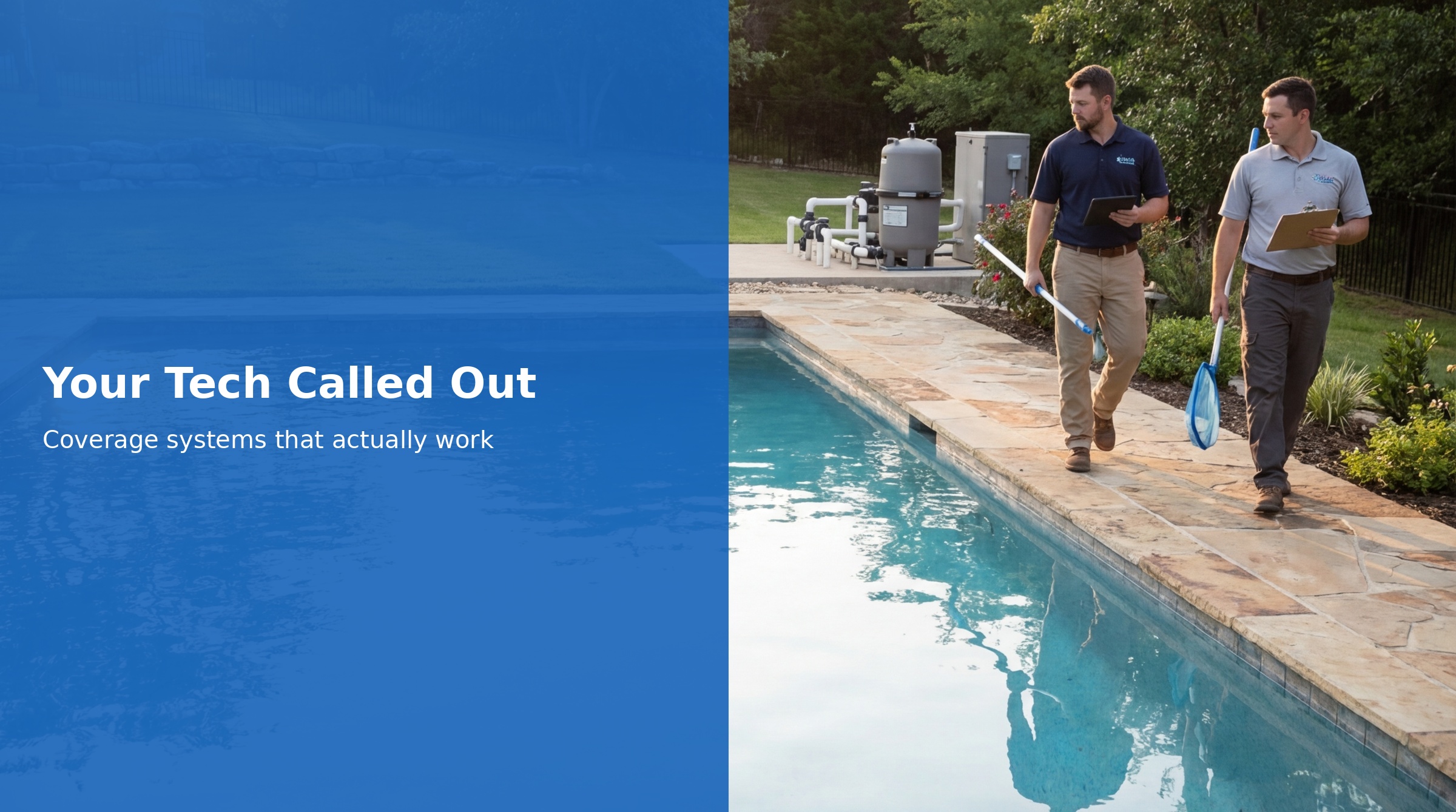
Your tech calls in sick on a Tuesday morning. He's got 18 pools on his route today. Now what?
If the answer is "the owner goes out and runs the route," you don't have a system — you have a job you can't leave. This is one of the hardest operational problems in growing pool service companies: building coverage systems that don't depend on the owner being available to jump in a truck. We asked pool company owners and managers how they handle it. Here's what actually works.
Key Takeaways
- Don't max out routes — Keep techs at ~85% capacity so they can absorb a sick day
- Cross-train on critical accounts — Every tech should know at least one other tech's HOAs and commercial pools
- A part-time floater changes everything — Even 2–3 days/week of on-call coverage eliminates most crises
- Pay techs who cover — OT or per-pool bonuses. Free "helping out" is how you lose good people
- Route documentation is what makes coverage possible — If the knowledge is in the sick tech's head, you're stuck
Strategy 1: Don't Max Out Routes
The simplest coverage strategy is also the most overlooked: don't schedule your techs to 100% capacity in the first place.
At 85% capacity, a tech with a 5-day route has enough slack to make up a missed day by adding a few extra stops to the remaining days that week. No overtime, no coverage scramble, no owner in the truck. The math works out: you "lose" 15% of potential route density, but you gain the ability to handle the 10–15 sick days per tech per year without any disruption.
One owner takes a similar approach by keeping Mondays reserved for filter cleans and non-urgent tasks. Since filter cleans can always be pushed a week, Monday becomes a natural buffer day. If a tech misses Tuesday, Monday's filter cleans slide and Tuesday's route fills the gap.
Strategy 2: The 4-Day Work Week
Several growing companies have moved to a 4-day, 10-hour schedule. The fifth day (usually Friday) becomes a built-in makeup day.
This structure does double duty: it's a coverage system and a retention tool. In an industry where finding and keeping techs is one of the biggest challenges, a 3-day weekend is a real differentiator when recruiting.
The trade-off is real though. In hot-climate markets, those extra 2 hours in the summer heat are brutal. And if your chemical suppliers close at 4:30, a 10-hour day that starts at 7 AM doesn't leave room for a mid-afternoon restock. One Southwest Florida pro noted that longer days during peak season would require stocking chemicals in bulk rather than picking up from the supplier daily — a logistics change that not every company is ready for.
4-Day Week
4 × 10-hour days with Friday as a makeup/off day. Route runs Mon–Thu, Friday only used if someone missed a day that week.
5-Day With Buffer
Standard 5-day week but routes at 85% capacity. Monday reserved for flexible tasks (filter cleans, non-urgent work).
6-Day Rotation
Schedule work for 5 days, 6th day is a makeup day for illness or weather. If not needed, day off.
Strategy 3: The Floater
Multiple owners pointed to the same solution as the single biggest improvement they made: hiring a dedicated floater.
A floater is someone on your roster — part-time or on-call — who knows multiple routes and can step in when anyone calls out. The cost is real: you're paying someone even on weeks when nobody's sick. But it's cheaper than overtime, cheaper than lost accounts, and infinitely cheaper than the owner spending 8 hours in a truck instead of running the business.
The floater role also doubles as your training pipeline. New hires start as riders/floaters, learn multiple routes, and when you're ready to expand, they already know the territory. One owner called this the only way to properly train new hires — if you're not riding them with experienced techs, you're not training them.
Strategy 4: Cross-Training
Even without a dedicated floater, cross-training your existing techs on each other's routes is essential. But you don't need to cross-train on everything — focus on the accounts that matter most.
The key insight is prioritization. When a tech is out for a day, you don't need to cover all 18 pools. You need to cover the 5–6 that will cause problems if missed: the commercial accounts with health department requirements, the HOA that will call the management company, and the residential customer who emails every time they see a leaf in the skimmer. The rest can wait a day.
This is where your customer records matter. If you've flagged which accounts are high-priority and which can flex, the covering tech knows exactly which stops to hit and which to skip. Without that documentation, they're guessing — or trying to do all 18 and failing at most of them.
Pay People Who Cover
This came up repeatedly and it's worth stating plainly: if a tech is covering someone else's route on top of their own, pay them for it.
The specific structure varies by company:
- Overtime rate if covering pushes them past 40 hours that week
- Per-pool bonus ($5–10 per extra pool) on top of their normal pay
- Salaried supervisors cover first, then techs pick up overflow at bonus rate
Trying to squeeze free labor out of techs by calling it "helping out" or "being a team player" is how you lose good people. In an industry with a chronic technician shortage, the cost of replacing a tech who quits over unpaid extra work far exceeds a few hundred dollars in coverage bonuses.
Route Documentation: The Make-or-Break Factor
Every strategy above depends on one thing: can the covering tech actually service the route without the regular tech's knowledge?
This is where most pool companies fall down. The regular tech knows that the Johnson pool has a tricky valve configuration, that the Martinez equipment pad is behind the locked side gate (code 4521), and that Mrs. Chen's dog needs to be put inside before you enter the backyard. None of that is written down anywhere. So when the covering tech shows up, they're starting from zero.
What needs to be documented for every account:
- Access information — Gate codes, key locations, dog situation, parking
- Equipment details — Make/model of pump, filter, heater, salt cell. Any quirks or known issues
- Chemical history — What's been added recently, any ongoing issues (high CYA, calcium creep, etc.)
- Customer preferences — Do they want to be notified? Do they have security cameras? Are they particular about anything?
- Priority level — Can this pool be skipped for a day, or does it need to be hit no matter what?
If this information lives in a service app that every tech can access, coverage becomes a logistics problem instead of a knowledge problem. The covering tech opens the app, sees the route, sees the notes, and goes. No phone calls to the sick tech asking for gate codes. No guessing about chemical dosages. No showing up to find a locked gate with no way in.
The Hiring Decision: Floater vs. Manager
As you grow past 4–5 techs, the coverage question often overlaps with a bigger decision: do you hire a floater or a manager?
A field manager or supervisor can do both — manage the team day-to-day and cover routes when needed. They're salaried, so there's no overtime question. They know all the routes because it's their job to. And they free the owner from being the default backup, which is the whole point.
The downside is cost. A salaried manager is a bigger commitment than a part-time floater. But if you're at the stage where callouts are a recurring operational crisis, you're probably also at the stage where you need someone managing the team full-time anyway.
Putting It All Together
There's no single solution. The companies that handle callouts smoothly use a layered approach:
- Prevention — Don't max out routes. Keep 15% slack or use a 4-day schedule with a makeup day
- Documentation — Every account's access codes, equipment, chemical history, and priority level in a system every tech can access
- Cross-training — Every tech knows the critical accounts on at least one other route
- Dedicated coverage — A part-time floater or salaried supervisor who can step in without disrupting anyone else's schedule
- Fair compensation — OT or per-pool bonuses for techs who cover. Never expect it for free
- Route saturation awareness — Know when to stop adding customers. If you can't cover an absence without the owner getting in a truck, you're past capacity
The goal isn't to eliminate callouts — people get sick, that's life. The goal is to build a system where a callout is a minor scheduling adjustment, not a five-alarm fire that pulls the owner off whatever they were supposed to be doing that day.
Route coverage starts with route documentation
PoolDial gives every tech access to customer notes, gate codes, equipment details, and chemical history — so anyone can cover any route without starting from zero.
Start Your Free Trial