


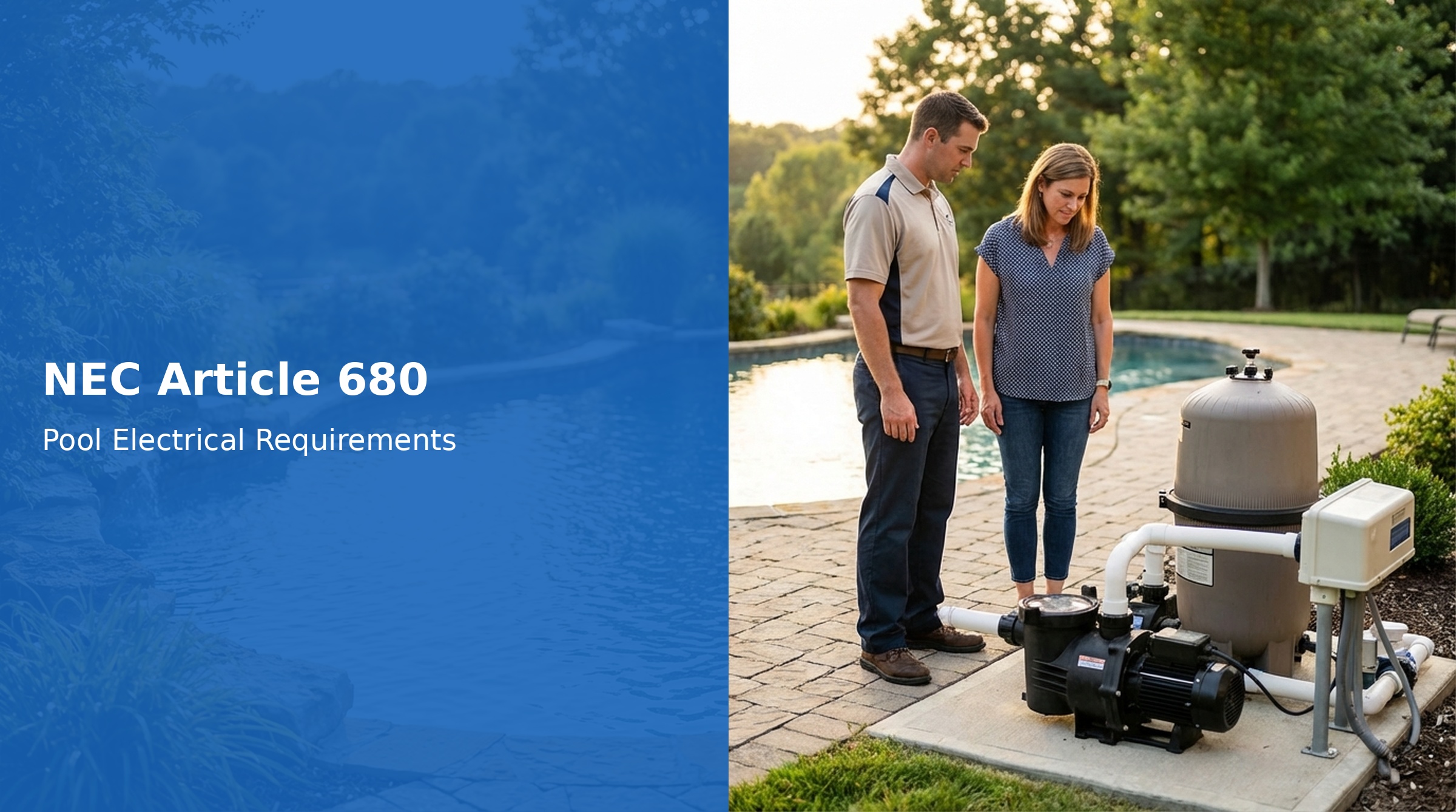
The National Electrical Code (NEC), specifically Article 680, serves as the definitive safety standard for electrical installations in and around swimming pools, spas, and hot tubs. The primary objective of these regulations is to maintain a strict separation between electricity and bather-accessible water to prevent lethal shock hazards. For pool service professionals and electricians, adherence to these wiring methods, grounding protocols, and bonding requirements is a non-negotiable safety mandate.[1]Mike Holt NEC Article 680 GuideSwimming Pool Electrical Safetypacodealliance.com
Key Takeaways
- Overriding Safety Goal — NEC Article 680 is designed to keep people and electricity separated in aquatic environments
- GFCI Mandates — Ground-Fault Circuit Interrupter (GFCI) protection is required for nearly all outlets supplying pool motors and adjacent receptacles[1]NEC 680.21(C)GFCI requirementspacodealliance.com
- Equipotential Bonding — All metal parts of the pool structure and associated equipment must be bonded to reduce voltage gradients
- Overhead Clearances — Water must be at least 22.5 feet away from overhead conductors rated at 750V or less
- Underground Wiring — Strict conduit requirements exist for wiring under or within 5 feet of the pool wall
- Maintenance Disconnects — A maintenance disconnect must be readily accessible, within sight of the equipment, and at least 5 feet from the water
GFCI and Grounding Requirements
The NEC relies heavily on Ground-Fault Circuit Interrupter (GFCI) technology to provide a high level of safety for pool-related electrical loads. GFCI protection is strictly required for all outlets—whether they are standard receptacles or direct connections—that supply pool pump motors connected to single-phase branch circuits ranging from 120V to 240V. This requirement extends to storable pools as well, where cord-connected pumps must feature integral GFCI protection in the attachment plug.[1]NEC 680.21(C)GFCI protection for pool motorspacodealliance.com
Grounding is equally critical. All electrical equipment associated with the pool must be grounded in accordance with the general rules of Article 250 and specific modifications in Article 680. For permanently installed pools, any wiring method used to supply a motor must contain an insulated copper equipment grounding conductor (EGC). This conductor must be sized based on the circuit's overcurrent protection device and cannot be smaller than 12 AWG.[1]NEC Article 680Grounding conductor requirementspacodealliance.com
"GFCI protection is required for outlets supplying pool pump motors connected to single-phase, 120V through 240V branch circuits, whether by receptacle or by direct connection." — NEC 680.21(C)
Receptacles located near the pool are subject to precise placement rules. At a dwelling unit, at least one 125V, 15A or 20A receptacle must be located between 6 and 20 feet from the pool's inside wall. All such receptacles within 20 feet of the pool walls must be GFCI protected. Furthermore, any receptacle used specifically for a pool motor or circulation system must be at least 6 feet from the pool walls and employ a grounding-type configuration.[2]NJ NEC SummaryReceptacle placement rulesnespapool.org
Equipotential Bonding and Lighting
Equipotential bonding is the process of joining all metal parts in the pool area to create a uniform electrical potential, thereby reducing dangerous voltage gradients. This bonding grid must include metal structural reinforcing steel, perimeter surfaces (extending 3 feet horizontally from the pool walls), and metal fittings 4 inches or larger, such as ladders and handrails. The bonding conductor must be a solid copper wire, not smaller than 8 AWG.[1]NEC 680.26Equipotential bonding requirementspacodealliance.com
Lighting in a pool environment requires specialized "wet-niche" or "dry-niche" luminaires. Wet-niche luminaires are installed in a "forming shell" where they are completely surrounded by water. To ensure safety, these luminaires must be installed so that the top of the lens is at least 18 inches below the normal water level. Wiring to these forming shells must be done through specific corrosion-resistant raceways, such as brass or rigid nonmetallic conduit containing an 8 AWG insulated bonding jumper.[1]NEC Article 680Pool lighting requirementspacodealliance.com
"The required equipotential bonding is intended to reduce voltage gradients in the area around a permanently installed pool." — NEC 680.26(A)
For underwater audio equipment or speakers, the rules are even more stringent. Each speaker must be mounted in an approved metal forming shell with a bonded metal screen. Just as with luminaires, any nonmetallic conduit used for speakers must include an 8 AWG insulated copper bonding jumper, and the terminations in the forming shell must be encapsulated in a listed potting compound to prevent water-induced deterioration.[1]NEC Article 680Underwater speaker requirementspacodealliance.com
Clearances, Underground Wiring, and Spas
The NEC dictates strict spatial separations to prevent accidental contact between water and high-voltage power sources. Water must be located at least 22.5 feet vertically from overhead service-drop conductors and other overhead power lines. For communication cables, such as telephone or cable lines, the required vertical clearance is 10 feet. These measurements are always taken from the "maximum water level," which is defined as the highest level the water reaches before spilling out.[1]NEC 680.8Overhead clearance requirementspacodealliance.com
Underground wiring is generally prohibited directly under the pool or within 5 feet of the inside wall, unless the wiring is necessary to supply the pool equipment itself. In cases where space is limited, the wiring must be installed in complete raceway systems using rigid metal conduit, intermediate metal conduit, or listed nonmetallic systems. The minimum burial depth for this wiring must comply with the general cover requirements of the code.[1]NEC 680.11Underground wiring requirementspacodealliance.com
"Underground pool wiring is permitted if installed in RMC, IMC, PVC, Type RTRC, or Type MC cable listed for the location (sunlight-resistant or for direct burial)." — NEC 680.11
Special considerations apply to spas and hot tubs. Outdoor installations must follow many of the same rules as permanent pools, including the 22.5-foot overhead clearance for power lines. Indoor spas, however, have unique requirements for receptacles and wall switches. At least one receptacle must be located between 6 and 10 feet from the water, and any wall switch must be at least 5 feet horizontally from the indoor spa. Crucially, an indoor spa must also have a clearly labeled emergency shutoff switch for its motors, located within sight and at least 5 feet away.[2]NEC 680.41-680.44Spa and hot tub requirementsnespapool.org
Summary Table
| Feature | NEC Requirement | Citation |
|---|---|---|
| Pump Motor GFCI | Required for 120V-240V circuits | NEC 680.21(C) |
| Bonding Conductor | Solid copper, minimum 8 AWG | NEC 680.26(B) |
| Overhead Power Line | 22.5 ft vertical clearance | NEC 680.8(A) |
| Receptacle Distance | 6 ft minimum from pool/spa wall | NEC 680.22(A)(2) |
| Bonding Perimeter | Must extend 3 ft beyond pool walls | NEC 680.26(B)(2) |
| Emergency Spa Switch | Within sight, ≥5 ft from water | NEC 680.41 |
Sources
- [1] Mike Holt, "Article 680 Swimming Pools" NEC Guide. pacodealliance.com
- [2] NEC Article 680 Summary for New Jersey. nespapool.org
- [3] 29 CFR 1910 Subpart S, OSHA Electrical Safety Standards.