
Should Pool Service Companies Use Service Agreements?


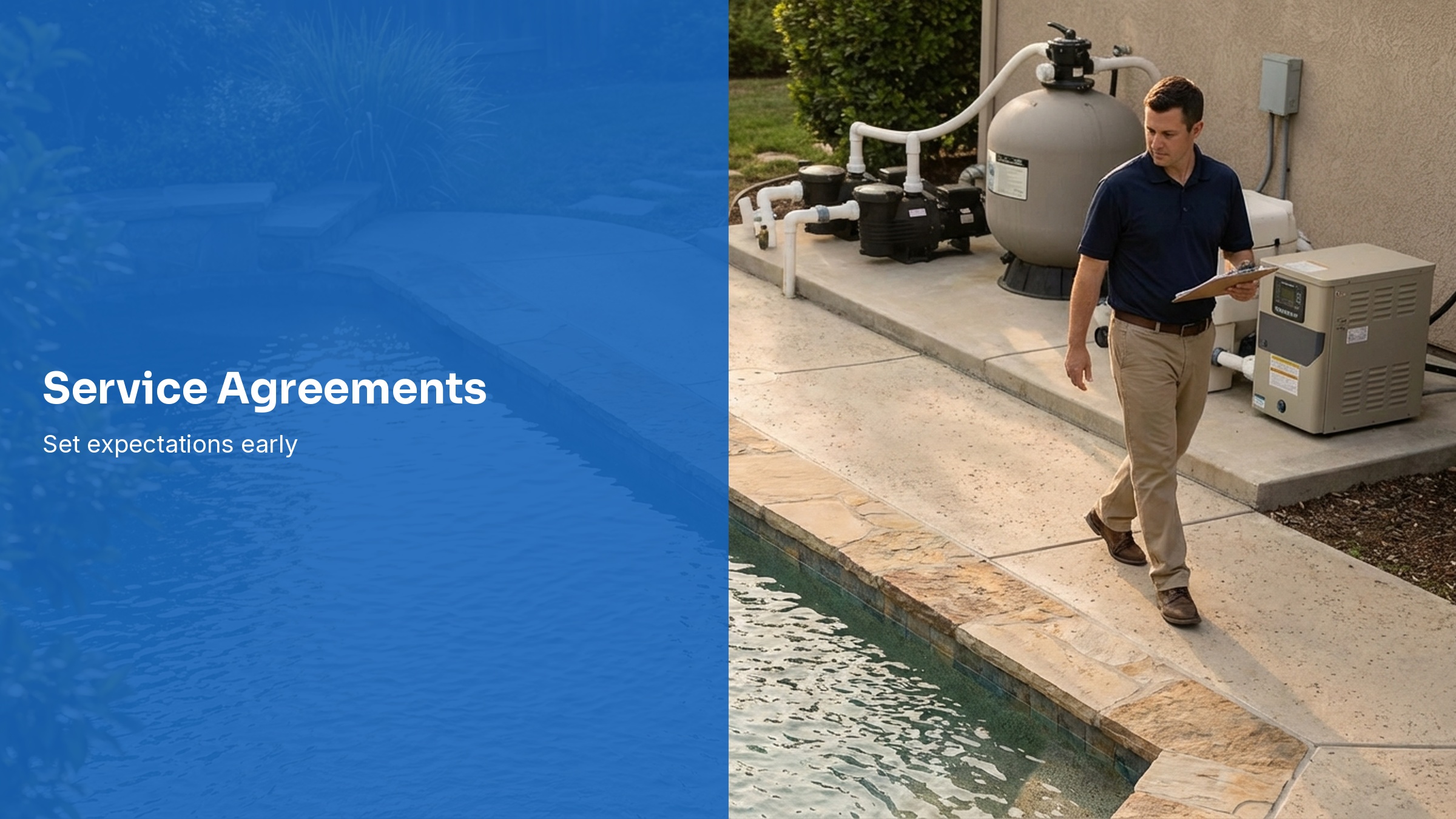
Pool service agreements can help. They can also scare off a perfectly good customer if they feel like a trap.
That is why the better question is not, "Should every customer sign a contract?" The better question is, "What expectations need to be in writing before the first visit?"
For routine weekly maintenance, many pool companies do not need a heavy long-term contract. A plain scope of work can be more useful. For repairs, add-ons, equipment work, and unusual service, written terms matter a lot more.
Key Takeaways
- Use clear written terms to set expectations, not to make customers feel stuck.
- For weekly maintenance, a scope of work may sell better than a formal contract.
- Repairs and extras should have stronger approval and payment terms than routine cleaning.
- Document pre-existing damage before service starts.
- Include storm, locked-gate, skipped-visit, and equipment-access policies up front.
Agreement vs. Scope of Work
The word "contract" carries baggage. Some customers hear it and think cancellation fees, fine print, and being locked into bad service.
Pool service owners often mean something simpler: the customer should know what is included, what is not included, how billing works, and what happens when normal service is interrupted.
That is why "scope of work," "service terms," or "terms, conditions, and procedures" can be better language for routine maintenance. The document can still be signed. It can still protect the business. But it feels like an explanation of how service works, not a legal ambush.
A good scope of work answers practical questions:
- How often will the pool be serviced?
- What does each visit include?
- What chemicals are included?
- Which chemicals, repairs, or parts cost extra?
- What happens when a gate is locked?
- What happens during storms or unsafe weather?
- How are repairs approved?
- How much notice does either side need to end service?
Routine Maintenance Is Different From Repairs
Weekly route service is usually a recurring relationship. Repairs and extras are usually separate jobs.
That distinction matters because the risk is different.
| Work Type | Written Terms Should Cover | Why It Matters |
|---|---|---|
| Weekly maintenance | Visit frequency, included tasks, chemicals, billing, access, skipped stops, and cancellation notice. | Most disputes come from mismatched expectations, not complex legal issues. |
| Repairs and extras | Estimate approval, deposit, parts, labor, payment due date, and what is excluded. | Money and responsibility are clearer when the work is approved before it starts. |
| Pre-existing conditions | Photos and notes for plaster flaws, equipment problems, leaks, staining, and prior damage. | Documentation helps prevent blame for problems that were already there. |
In the operator research behind this article, one common split was simple: monthly route service could be prepaid with lighter terms, while repairs and extras needed estimates, deposits, and clearer collection language. One example used a 35% down payment for repairs and extras.
Do not copy that number blindly. Use it as a reminder that repair work needs a different approval process than weekly brushing, testing, and cleaning.
Commercial Pools Need a Responsibility Matrix
A residential scope cannot simply be relabeled “commercial.” Public and semi-public aquatic facilities may operate under health-department rules, inspection schedules, required test frequencies, trained-operator requirements, incident plans, patron closures, and record-retention duties. Those rules vary by jurisdiction and facility type.
A recent commercial contract discussion emphasized starting with the authority that regulates the facility:
"When dealing with commercial pools you need to become familiar with the local DES or DHEC or whatever your state uses. Get a CPO license if you dont have one already. That's a good introduction to basic commercial pool rules and most classes should include some specific things about your state."
Pool pro via Reddit
The agency name and credential requirement differ by location, so verify them before bidding. CDC's current 2024 Model Aquatic Health Code is useful reference guidance, but CDC states that it is not federal law and only has legal effect where a jurisdiction adopts it. The controlling sources are the applicable state, local, tribal, or territorial code, permit, and health authority.
Build a responsibility matrix into the agreement or an attached operating exhibit. For every task, name the responsible party, required frequency, record location, response deadline, backup person, and authority to close or reopen the venue. Cover at least:
- water testing, calibration, chemical addition, and log review;
- daily opening and closing inspections;
- qualified operator coverage and staff training;
- fecal, vomit, blood, chemical-release, injury, and weather response;
- health-department notices, inspections, corrections, and record production;
- lifeguarding, patron supervision, signage, gates, drains, and safety equipment;
- preventive maintenance, repairs, parts approval, shutdowns, and after-hours calls;
- chemical purchasing, delivery, secure storage, inventory, and SDS access;
- utilities, water replacement, waste discharge, and vendor access; and
- insurance certificates, additional-insured requests, indemnity, and incident reporting.
"I’m going to disagree with you there. Commercial brings a lot more with it than any residential pool. Documentation, insurance, more regulations and laws that you are on the hook for. Anyone charging the same for residential as commercial is either severely undercutting themselves, don’t know what they are doing, or both. My commercial rate is 1.5-2x my residential rate. And I charge that for every day of the week that I touch the pool."
Pool pro via Reddit
The multiplier is one operator's experience, not a market rate. Price the actual labor, visit frequency, testing and documentation, travel, chemical responsibility, emergency availability, insurance, administrative coordination, and risk allocation. A low per-stop price can become expensive when the contract quietly includes unlimited calls, weekend responses, inspection attendance, or corrective visits.
Have a lawyer licensed in the governing jurisdiction review the final agreement, insurance provisions, waivers, indemnity, limitation-of-liability language, and termination terms. A sample shared online can provide a question list, but it cannot tell you whether the duties match the facility, insurance policy, or adopted code.
Clauses Worth Including
A pool service agreement should be short enough that a customer will read it. It should be specific enough that your team can use it later.
1. Service Scope
Define the normal visit. Do not assume the customer knows what "full service" means.
For example, list water testing, chemical balancing, brushing, skimming, basket cleaning, equipment visual checks, and service notes if those are included. If vacuuming, filter cleaning, salt, phosphate remover, stain treatment, or algae cleanup are conditional, say so.
2. Access Policy
Locked gates create disputes because the tech drove to the stop and could not work.
Your agreement should say what happens if access is blocked by a locked gate, loose animal, construction, unsafe yard condition, or missing entry code. If the account is still charged for a customer-caused access failure, state that plainly.
3. Weather and Storm Policy
Storms, lightning, flooding, and unsafe conditions need a policy before they happen.
Some companies reschedule. Some perform a limited chemical-only visit. Some skip and continue the normal route cadence. The right policy depends on your market and service promise, but it should be written down.
4. Repairs and Extra Work
Weekly service does not mean the customer pre-approved every future repair.
Set a rule for repair approvals. Small thresholds can be approved by text. Larger jobs may need a signed estimate and deposit. Parts, labor, diagnostics, and return trips should be clear before work starts.
5. Pre-Existing Damage
This is one of the most overlooked parts of a new account.
Document plaster cracks, loose tile, surface staining, damaged equipment, leaks, broken lids, cracked baskets, worn o-rings, and anything else that could later become a blame problem. Add photos to the customer record before the first normal service visit.
6. Payment Terms
Put billing dates, due dates, late fees, paused service, and collections language in writing. For any language about liens, collections, enforceability, or attorney fees, talk to a qualified professional in your state.
Known Leaks and Refused Repairs Need a Written Boundary
A PoolPros discussion raised a common service dilemma: how to maintain a pool with a known leak when the customer will not authorize the repair.
"How do you guys treath pool with known leak that customer doesn't want to fix the issue."
— Pool pro via Reddit
Do not let routine service imply that the underlying condition is accepted or controlled. Record the observed water loss, the recommended diagnostic or repair, the customer's decision, and the limits of ongoing service. Explain that water balance, chemical use, equipment operation, and finish risk may change while the leak continues. Define whether extra chemicals, refill-related treatment, return visits, and damage tied to the unresolved leak are outside the monthly price. If the condition cannot be serviced safely or lawfully, the agreement should allow the company to pause or end service.
How to Reduce Signup Friction
The biggest argument against service agreements is friction. A new customer wants the pool cleaned. The owner wants the customer signed. A long document can slow everything down.
The answer is not to skip written terms. The answer is to make the terms easier to understand.
- Call it a scope of work instead of a contract when that better matches the intent.
- Keep routine maintenance terms short.
- Use plain language.
- Separate normal service from repair approvals.
- Tell customers the document protects both sides.
- Send it before the first visit, not after the first dispute.
Good customers usually do not object to clear terms. They object to surprises.
Sample Customer-Friendly Language
Use this as a starting point, then have your own legal or business advisor review anything formal:
Our weekly pool service includes routine maintenance listed in this scope of work. Specialty chemicals, filter cleanings, repairs, parts, unusual cleanup, and equipment work are billed separately unless included in a written estimate.
If we cannot safely access the pool because of a locked gate, loose animal, unsafe condition, or missing access code, the visit may be marked as attempted and billed as scheduled.
Service days may change because of weather, route efficiency, holidays, access issues, or seasonal conditions. We will provide notice when a permanent route-day change is needed.
Those lines are not legal advice. They are examples of the kind of plain language that prevents avoidable confusion.
How Pool Dial Helps
Service agreements only work if the team can actually follow them.
Pool Dial helps pool service companies keep customer terms, service notes, skipped-stop reasons, estimates, photos, and account history in one place. That matters when a customer asks why a visit was skipped, why a filter cleaning was extra, or whether a repair was approved.
Keep Terms Connected to the Route
Pool Dial helps you manage service agreements, estimates, customer notes, skipped stops, and service history without losing context.
See Service AgreementsFAQ
Do pool service companies need contracts?
Not always. Many routine maintenance accounts can work with a clear scope of work and service terms. Repairs, extras, commercial work, and higher-risk accounts usually need stronger written approval terms.
What should a pool service agreement include?
Include service frequency, included tasks, excluded work, chemicals, billing terms, access rules, weather policy, repair approval process, cancellation notice, and pre-existing damage documentation.
Will a service agreement scare customers away?
It can if it feels heavy or one-sided. A short customer-friendly scope of work is usually easier to accept because it explains how service works instead of making the customer feel trapped.
Should repairs be covered by the monthly service agreement?
Usually no. Repairs and extras should go through estimates or written approvals so the customer understands the cost before work starts.
Bottom Line
Pool service companies should put expectations in writing. That does not always mean a long contract.
For weekly maintenance, use a clear scope of work that explains service, billing, access, weather, and extras. For repairs and add-ons, use stronger written approvals. For pre-existing damage, take photos before the first normal visit.
The goal is not to win a legal argument later. The goal is to prevent the argument in the first place.