


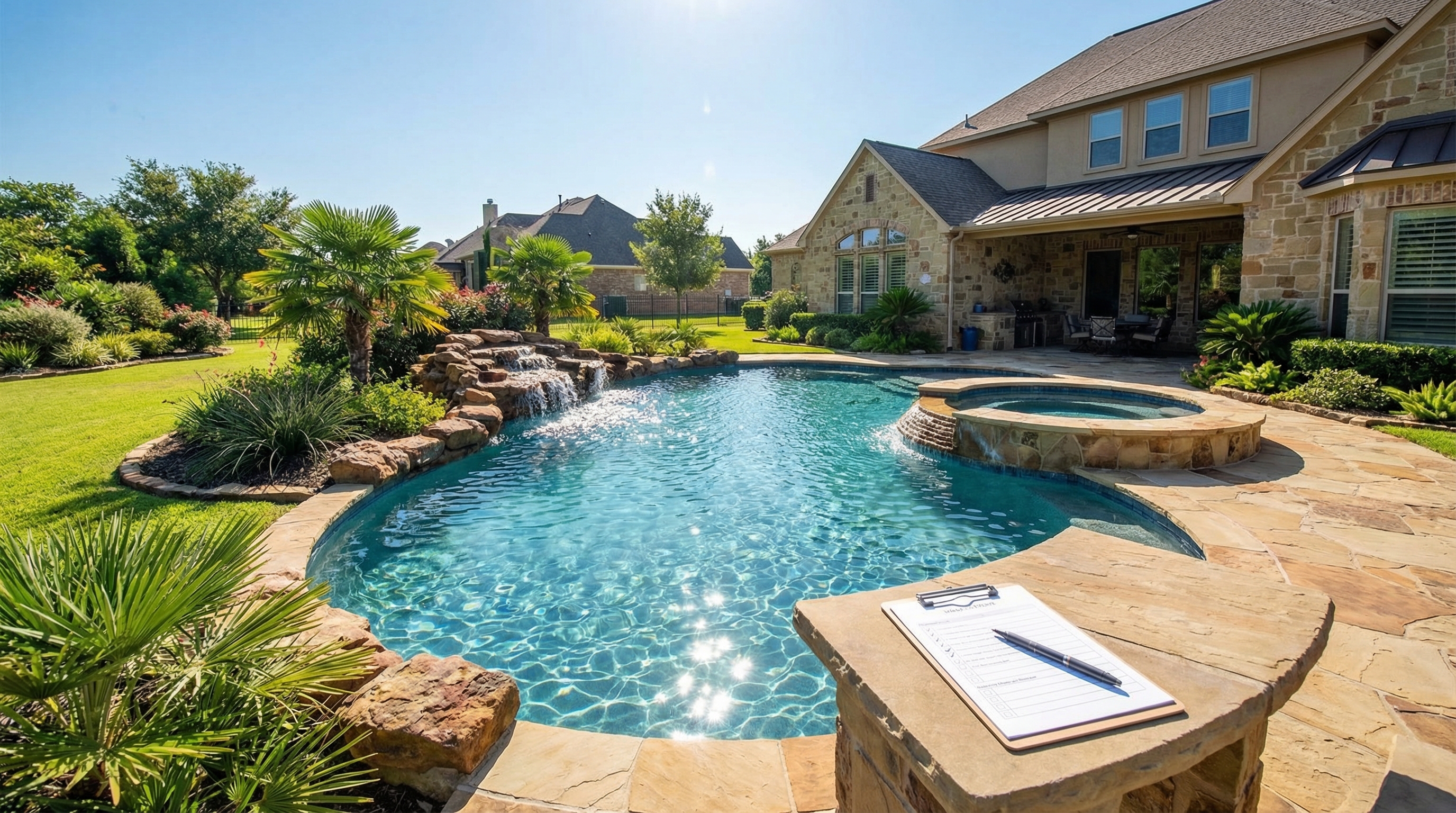
When a residential property with a swimming pool changes hands in Texas, the law requires a high degree of transparency regarding the pool's condition and safety features. This is governed primarily by the Texas Property Code Section 5.008, which mandates the use of a Seller's Disclosure Notice. This document serves as a formal record of what the seller knows about the property, ensuring the buyer is aware of both the pool's functionality and its compliance with safety standards.[1]Property Code Section 5.008Seller's Disclosure of Property Conditionstatutes.capitol.texas.gov
Key Takeaways
- Property Code Section 5.008 — The statutory basis for mandatory real estate disclosures in Texas[1]Property Code Section 5.008Seller's Disclosure of Property Conditionstatutes.capitol.texas.gov
- Safety Feature Checklist — Sellers must specifically disclose the presence of fences, covers, and alarms[1]Property Code Section 5.008Seller's Disclosure of Property Conditionstatutes.capitol.texas.gov
- Condition Disclosure — Any known defects in the pool structure or equipment must be reported[1]Property Code Section 5.008Seller's Disclosure of Property Conditionstatutes.capitol.texas.gov
- Chain-Link Status — While not explicitly on all forms, the 1994 chain-link ban is a critical factor for older homes[2]H&S Code Chapter 757Swimming Pool Enclosuresstatutes.capitol.texas.gov
- Buyer Recourse — Failure to provide a disclosure notice can allow a buyer to terminate the contract[1]Property Code Section 5.008Seller's Disclosure of Property Conditionstatutes.capitol.texas.gov
The Seller's Disclosure Notice
In Texas, most sellers of single-family residential property are required to provide the buyer with a written notice of the property's condition. This requirement applies to almost all traditional home sales. The form includes a specific section for "Swimming Pool" and "Swimming Pool Equipment," where the seller must check off which items are present and whether they are in working condition.[1]Property Code Section 5.008Seller's Disclosure of Property Conditionstatutes.capitol.texas.gov
The disclosure goes beyond just the pump and filter. It specifically asks about safety features. Sellers must indicate if the property has a pool heater, a pool cover, or a "pool/spa equipment" enclosure. Because Texas has such specific laws regarding pool yard enclosures under Health and Safety Code Chapter 757, this disclosure is a critical step in identifying whether a pool is legally compliant or represents a future liability for the buyer.[2]H&S Code Chapter 757Swimming Pool Enclosuresstatutes.capitol.texas.gov
Disclosing Safety Features and Defects
The disclosure form requires the seller to acknowledge any "known" defects. If the pool has a leak, if the heater is non-functional, or if the underwater lighting is improperly grounded, these must be disclosed. From a safety perspective, this includes the integrity of the pool fence.[1]Property Code Section 5.008Seller's Disclosure of Property Conditionstatutes.capitol.texas.gov
"A fence or wall may not be constructed of chain link for a swimming pool or spa for which a building permit was issued on or after September 1, 1994." — Tex. Health & Safety Code Section 757.005(a)
While the standard disclosure form may not ask for the date of the fence installation, a savvy seller or agent should be aware of the 1994 chain-link ban. If a home was built in 2005 and has a chain-link fence, that fence is a violation of state law. Disclosing such "nuisance conditions or hazards" is essential to avoid post-sale legal disputes.[2]H&S Code Chapter 757Swimming Pool Enclosuresstatutes.capitol.texas.gov
Consequences of Non-Disclosure
The Seller's Disclosure Notice is a powerful legal tool. Under Texas law, if the seller fails to provide the notice on or before the effective date of the contract, the buyer may terminate the contract for any reason within seven days after receiving the notice.[1]Property Code Section 5.008Seller's Disclosure of Property Conditionstatutes.capitol.texas.gov
More importantly, if a seller knowingly withholds information about a pool's safety defects—such as a non-functioning self-latching gate or a missing suction outlet cover—they could be held liable under the Deceptive Trade Practices Act (DTPA). In the second-largest pool market in the country, where drowning prevention is a high legislative priority, the accurate disclosure of pool safety features is a fundamental part of the real estate transaction.
Summary Table
| Disclosure Item | Requirement | Legal Basis |
|---|---|---|
| Disclosure Notice | Mandatory for most residential sales | Property Code Section 5.008 |
| Pool Equipment | Must disclose presence and condition | Property Code Section 5.008 |
| Safety Barriers | Must disclose fences, covers, and alarms | Property Code Section 5.008 |
| Known Defects | Mandatory disclosure of leaks or equipment failure | Property Code Section 5.008 |
| Chain-Link Ban | Relevant for pools permitted after 9/1/1994 | H&S Code Section 757.005 |
Sources
- [1] Texas Property Code Section 5.008, Seller's Disclosure of Property Condition. statutes.capitol.texas.gov
- [2] Texas Health and Safety Code Chapter 757, Swimming Pool Enclosures. statutes.capitol.texas.gov