
Why Pool Builders Need Service Experience


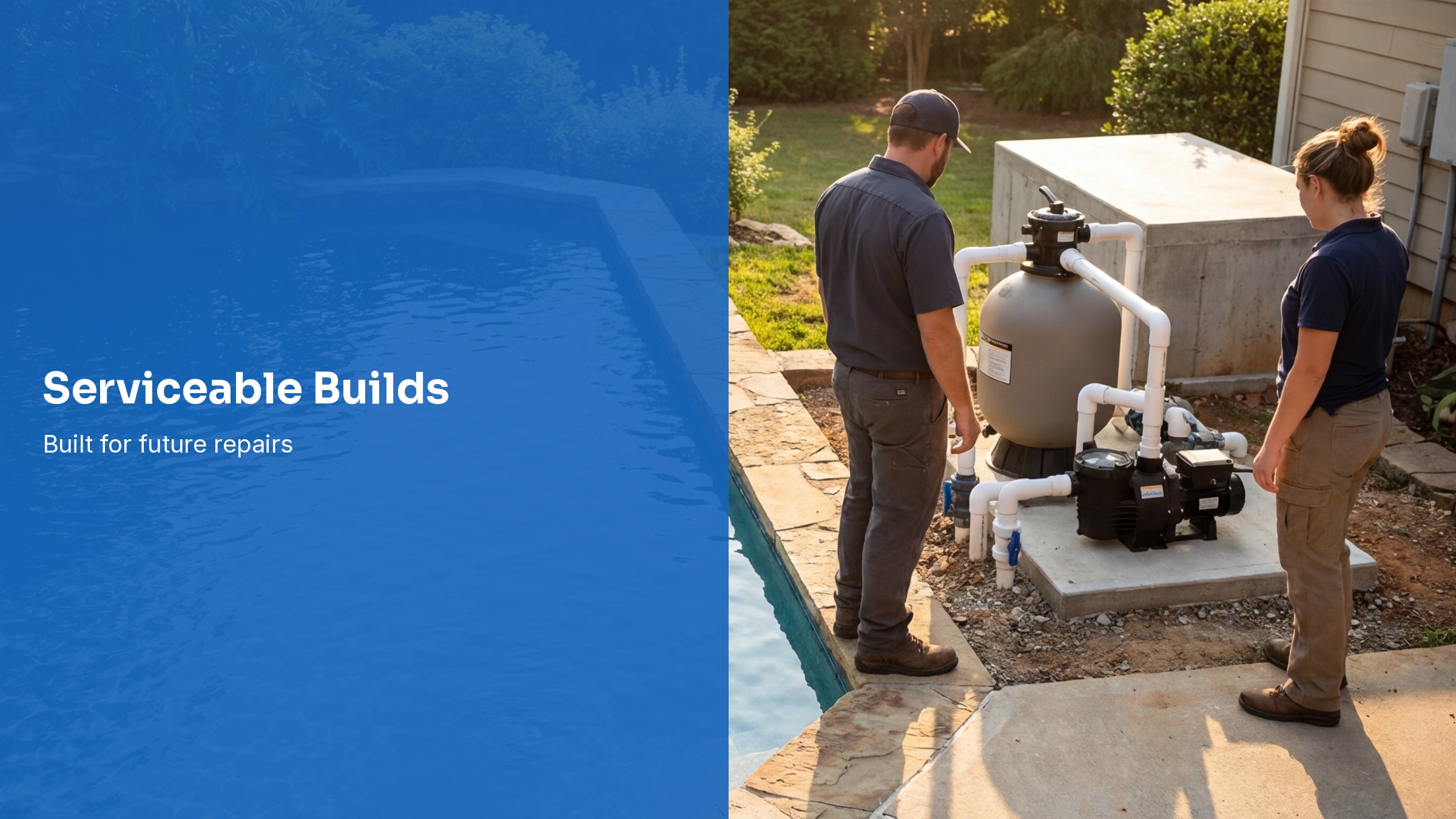
Pool builders and pool service techs look at the same equipment pad in completely different ways. The builder sees a finished job. The service tech sees the next 10 years of filter cleanings, salt-cell replacements, heater repairs, automation upgrades, warranty calls, and emergency leaks.
That difference matters. A pool can look beautiful on startup day and still be miserable to maintain. Tight equipment clearances, glued unions, blocked filter clamps, crowded salt cells, and mystery plumbing all create future labor that someone else has to explain to the homeowner.
Key Takeaways
- Serviceability is part of build quality. If a filter, pump, valve, or salt cell cannot be removed cleanly, the pad is not finished.
- Unions save future labor. They cost little during construction and prevent repeated cut-and-couple repairs later.
- Clearance is not optional. Filters, heaters, automation panels, and salt cells need room for hands, tools, lids, clamps, and replacement parts.
- Builders with service experience design better systems. They understand flow, cleaners, plumbing access, and how the pool will actually be maintained.
The Reddit Thread That Hit a Nerve
A PoolPros discussion titled "Pool Builders should start as Pool Techs" turned into a blunt field audit of construction decisions that make service harder.
The original complaint was not about fancy design. It was about basic access:
That is the whole argument in one example. One union during construction can prevent several future service calls from turning into pipe surgery. The part is cheap. The future labor is not.
Another builder in the thread agreed from the other side of the trade:
That is the better standard. A builder does not need to run a weekly route forever. But spending time in service teaches what drawings and bid sheets miss: where techs stand, where water goes, how cleaners behave, how filters open, and how customers react when a simple repair becomes a replumb.
Serviceability Is Not a Nice-to-Have
Serviceability is the difference between a 20-minute repair and a two-hour repair. It is also the difference between a customer trusting the original builder and blaming every future contractor who touches the pool.
A serviceable pool lets a technician do normal work without cutting apart good plumbing. That includes:
Filter access
There is room to remove lids, cartridges, clamps, grids, laterals, and media without moving other equipment.
Unions in the right places
Pumps, filters, heaters, salt cells, and valves can be removed without cutting pipe every time.
Clear plumbing logic
Suction, return, cleaner, spa, water feature, bypass, and waste lines are understandable at a glance.
Replacement room
Future equipment can fit without turning every upgrade into a full pad rebuild.
Pool pros notice when a pad was built by someone who has serviced pools. Valves are reachable. Salt cells have room. Heaters are not jammed into corners. Automation panels open fully. Filters can be cleaned without scraped knuckles and angry phone calls.
The Expensive Mistake: No Unions
Unions are one of the cheapest ways to respect the next technician. They also protect the homeowner. When a pump fails, a filter head cracks, or a salt cell needs replacement, a union lets the repair stay focused on the failed part.
Without unions, a simple replacement can turn into extra labor, extra fittings, and extra blame. The customer does not usually understand that the real problem was the original pad layout. They just hear that the repair costs more than expected.
This is especially true around filters. A sand filter may need a multiport valve, lateral repair, sand change, or full tank replacement years later. A cartridge filter may need enough room for the lid and cartridges to lift out. A DE filter may need grids pulled and cleaned. Every one of those jobs becomes slower when the builder only designs for day-one installation.
For service pricing, this is why direct swaps and "simple" filter work are rarely simple. We covered the labor side in our equipment install labor rates guide, but the hidden cause is often construction access.
Clearance Problems Become Warranty Problems
One comment in the thread described a system where the filter housing was pushed so tight against walls that clamps could not be removed. The proposed fix was to disconnect other plumbing and slide the filter forward each time it needed service.
That is not a service plan. That is a warranty complaint waiting to happen.
Bad clearance usually shows up in four places:
- Filters: lids, bands, clamps, cartridges, and grids need vertical and side clearance.
- Salt cells: cells need hand clearance, tool clearance, and room to remove the cell without fighting the deck or wall.
- Heaters: panels, gas access, bypass plumbing, bonding, and venting need room for inspection and repair.
- Automation: panels should open fully and leave enough working room for wiring, relays, breakers, and future expansion.
If the only way to service a component is to disassemble unrelated plumbing, the layout is wrong. It may pass a quick visual inspection, but it will fail the first time a tech has to work on it in July.
Cheap, Fast, and Good Does Not Work on an Equipment Pad
Another comment from the thread put the economic pressure plainly:
That line applies to both builders and service companies. A builder under pressure to keep a bid low may save a little money on fittings, space, or layout time. But the customer still pays for that choice later. The cost just moves from construction to service.
For service companies, this creates an opportunity and a boundary. If you inherit a bad pad, document it. Take photos. Explain which future repairs will cost more because of the layout. If the customer asks why a salt-cell replacement or filter repair is expensive, show the access issue instead of absorbing the labor.
If you routinely fix customer-supplied or poorly installed equipment, read our guide on whether to install customer-supplied parts. The same principle applies: you need a policy before you inherit someone else's shortcuts.
A Serviceability Checklist for Builders
Builders do not need to overcomplicate this. Before startup, someone should look at the pad like a service tech and ask whether each component can be reached, opened, removed, replaced, and explained.
Equipment pad serviceability check
- Can the pump be removed without cutting the suction and return lines?
- Can the filter lid, clamp, cartridges, grids, or laterals be removed with normal tools?
- Can the salt cell be removed without hitting a wall, deck, valve, or heater?
- Can the heater panels open fully with safe access to gas, electrical, and plumbing connections?
- Are valves labeled or arranged in a way a new tech can understand?
- Is there space for a future automation upgrade, heater replacement, or filter upgrade?
- Are unions installed where future replacements are likely?
- Can a tech stand safely while working, or is everything jammed against a wall?
This checklist also helps service companies during inspections and new account onboarding. A clean pool with a bad pad is still a risk. If the pad is built in a way that makes normal maintenance expensive, note it before the customer assumes every future issue is your fault.
How Service Companies Can Use This
Most PoolDial readers are service operators, not builders. But this topic still matters because service companies are the ones who inherit the work.
Use bad equipment-pad design as a documentation and pricing trigger:
- During estimates: call out missing unions, tight filters, blocked salt cells, and unsafe access before quoting repairs.
- During onboarding: add photos and notes to the customer record so future techs know what they are walking into.
- During repairs: charge for access work separately from the part replacement.
- During builder relationships: refer work to builders who make your life easier, not just builders who send leads.
PoolDial makes that easier by keeping equipment notes, photos, service history, and repair work in one place. If a customer asks why a repair needs extra labor, you can show the history instead of rebuilding the story from memory.
For larger repairs, use work orders to separate diagnosis, access work, materials, and replacement labor. For recurring accounts, note pad issues in the customer profile so your team does not get surprised every time the filter needs service.
The Better Standard
The best builders think beyond startup day. They ask what the pool will be like to maintain in year three, year six, and year ten. They make room for service. They install unions where future work is likely. They understand that the equipment pad is not just a construction endpoint. It is a workspace.
That is why service experience matters. It teaches builders that every shortcut becomes someone's labor later. Sometimes that person is the builder's own warranty tech. Sometimes it is the homeowner's service company. Either way, the pool remembers the design.
Track the details that make service profitable
PoolDial keeps equipment notes, photos, service history, quotes, and work orders connected so your team can price repairs from the facts.
Start Your Free Trial