
How a D.E. Pool Filter Works: Grids and Filter Powder


Key Takeaways
- The fabric-covered grids or elements support the D.E. powder. The powder is the working filtration layer.
- After startup or backwash, the filter must receive the exact recharge amount and method in its manual.
- Backwash removes dirty D.E. and debris, but periodic teardown, cleaning, and inspection are still required.
- D.E. returning to the pool can point to a damaged element or another leak in the internal collection path.
A D.E. filter combines a support element with a replaceable powder coating. The element may look like a set of curved vertical grids or a cartridge-shaped assembly. In both cases, the diatomaceous earth powder coats the fabric and performs the fine filtration.
The Grid Is the Support, Not the Filter Cake
When the pump starts after a proper recharge, water carries D.E. powder into the tank. The powder spreads over the fabric surfaces and forms a porous coating. Pool water crosses that coating, then the fabric and internal collection path, before returning to the pool.
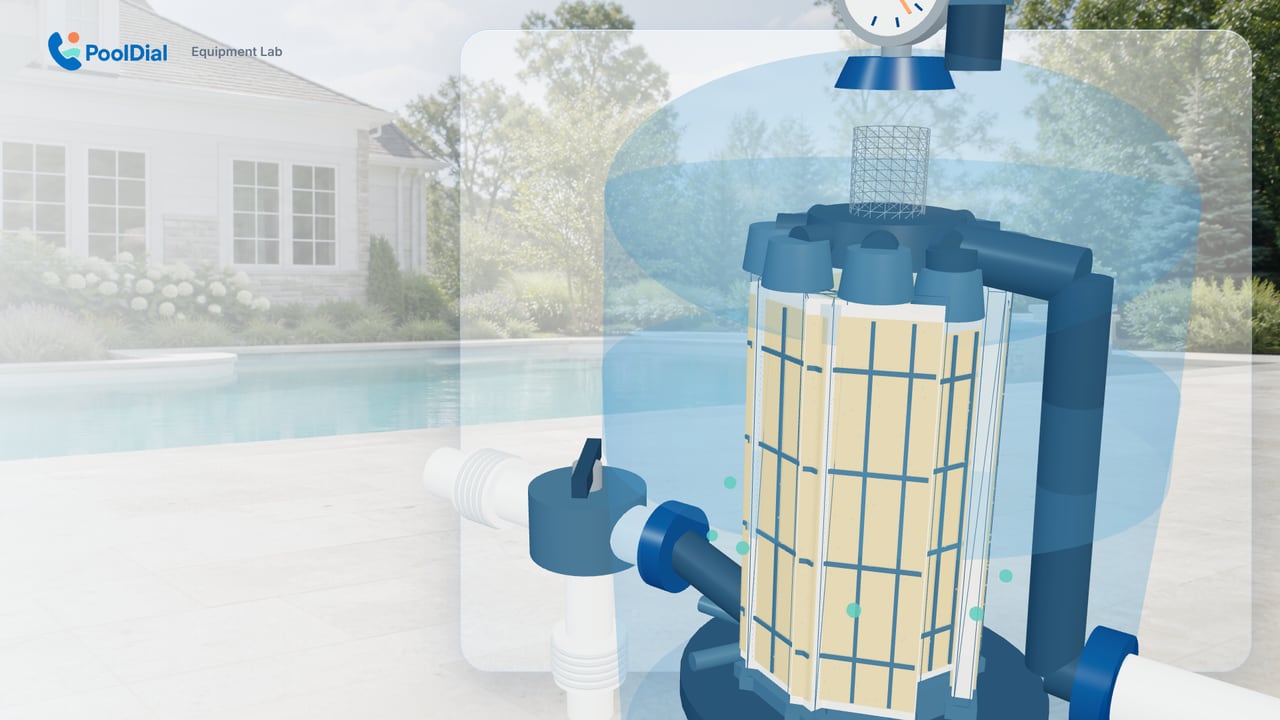
Without the correct powder charge, dirt can load the fabric directly and the filter may not perform or clean as designed. Too much powder can also create excess resistance. Use the model's stated type and quantity rather than estimating by tank size or memory.
Pressure Rises as the Cake Loads
Captured material builds in the D.E. layer and increases resistance. Record the clean pressure after a complete service and recharge, using a known pump speed and normal valve setup. Follow the installed manual's pressure-rise threshold and cleaning instructions.
What Backwash Does
Backwash reverses the cleaning flow and sends used D.E. and debris to Waste. The multiport or backwash valve routing depends on the installed system. Always shut the pump off before moving the valve.
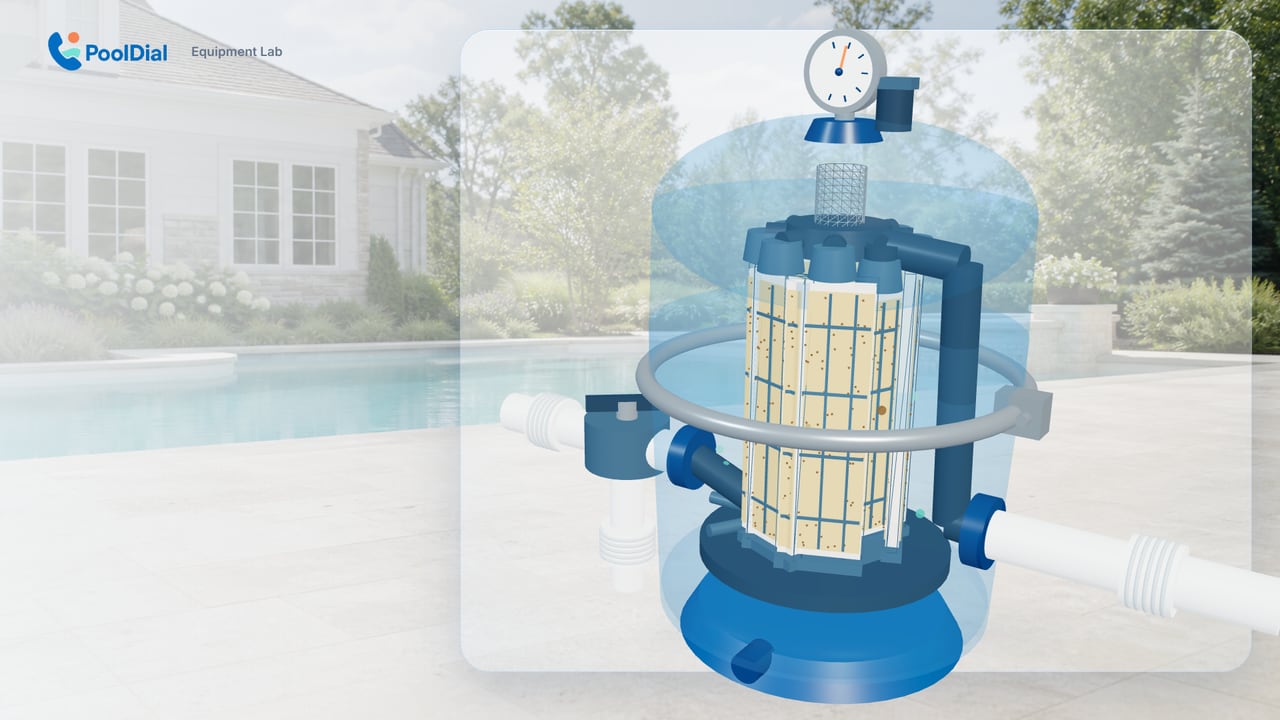
After backwash, the filter no longer has its proper working coating. Recharge it immediately with the exact amount and method in the filter manual. Backwash also does not replace periodic teardown, grid cleaning, and inspection.
Why D.E. Can Return to the Pool
Filtered water is supposed to reach the return path only after crossing the coated elements. A torn grid, cracked element, manifold problem, standpipe seal, air-relief screen issue, or assembly leak can create another route.
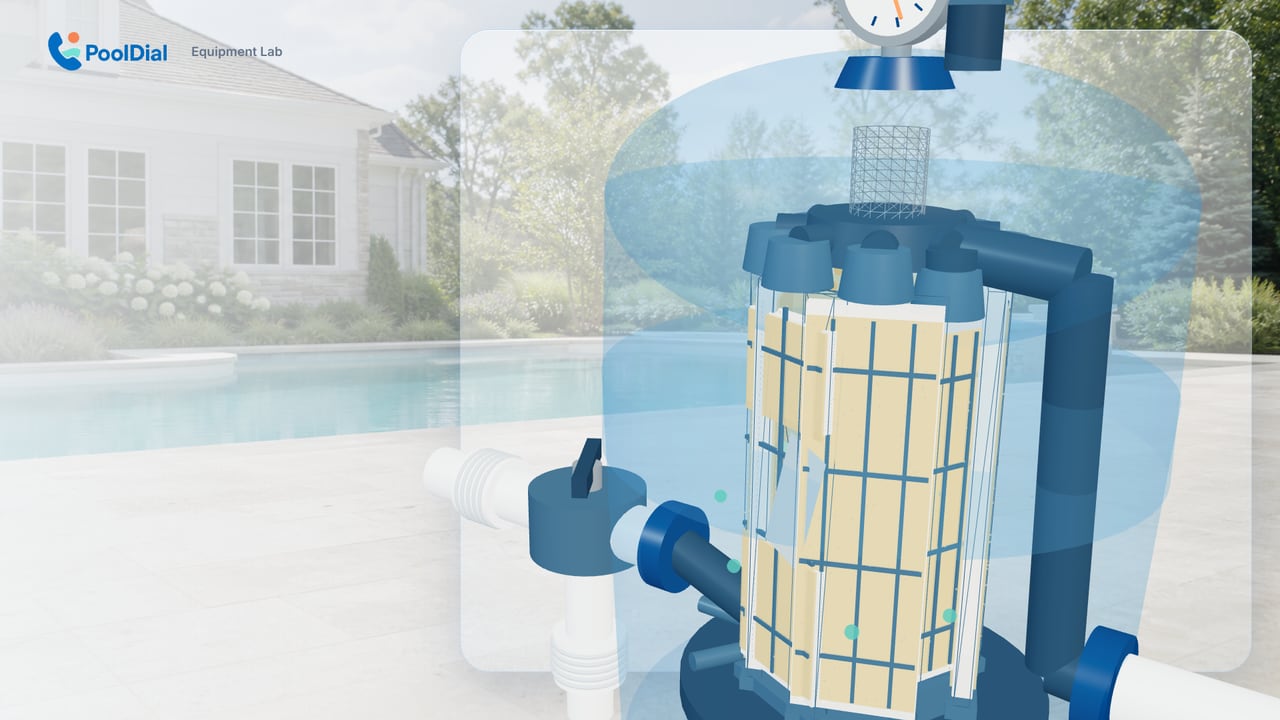
Note when the powder appears. A brief cloud after recharge, a continuous stream, or a problem that began after teardown are different clues. Confirm that the material is D.E. before ordering parts, since plaster dust, dead algae, and other fine material can look similar in the pool.
Mechanics-Based Symptom Map
| Pattern | Mechanics clue | Next documentation |
|---|---|---|
| Pressure rises quickly after a full cleaning | Heavy loading, water-quality issue, wrong charge, or restricted path | Water condition, exact D.E. amount, pump speed, clean pressure |
| Pressure stays high after backwash | Backwash may not have fully cleaned the elements or another restriction remains | Valve route, waste flow, teardown history, return strength |
| D.E. appears at returns | The coated-element collection path may have a leak | Timing, recent service, grid/manifold condition, assembly seals |
| Pressure low and flow low | The filter may not be receiving enough water | Suction path, baskets, pump prime, speed, and impeller clues |
These are inspection zones, not proof of one failed part. Use the exact filter parts diagram and service procedure before opening the tank.
Related Filter Resources
Use the filter sizing calculator for initial area comparisons. For model-specific symptoms, see the Pentair Quad D.E. filter guide and record pressure baselines in PoolDial equipment history.
Frequently Asked Questions
What actually filters the water in a D.E. filter?
The fabric-covered elements support a coating of D.E. powder. That powder layer performs the fine filtration while the grid or element provides structure and a clean-water collection path.
Do you add D.E. after every backwash?
Yes, a backwashed D.E. filter must be recharged as its manual directs because the used powder leaves through Waste. The required amount can differ from a full teardown charge.
Why is D.E. coming back into the pool?
A damaged element or leak in the manifold, standpipe, seal, or internal collection path can let powder bypass the intended route. Confirm the material and inspect by the model manual.
This guide is an original, generic teaching explanation based on manufacturer documentation. Visuals are simplified and not to scale. The installed equipment manual controls service and safety procedures.
- Pentair, FNS Plus D.E. Filter Installation and User’s Guide, operation, cleaning, recharge, and safety sections.
- Pentair, Quad D.E. Filter Installation and User’s Guide, backwash, recharge, and pressure guidance.
- Hayward, ProGrid D.E. Filter Owner’s Manual, startup, cleaning, troubleshooting, and component-separation warnings.