


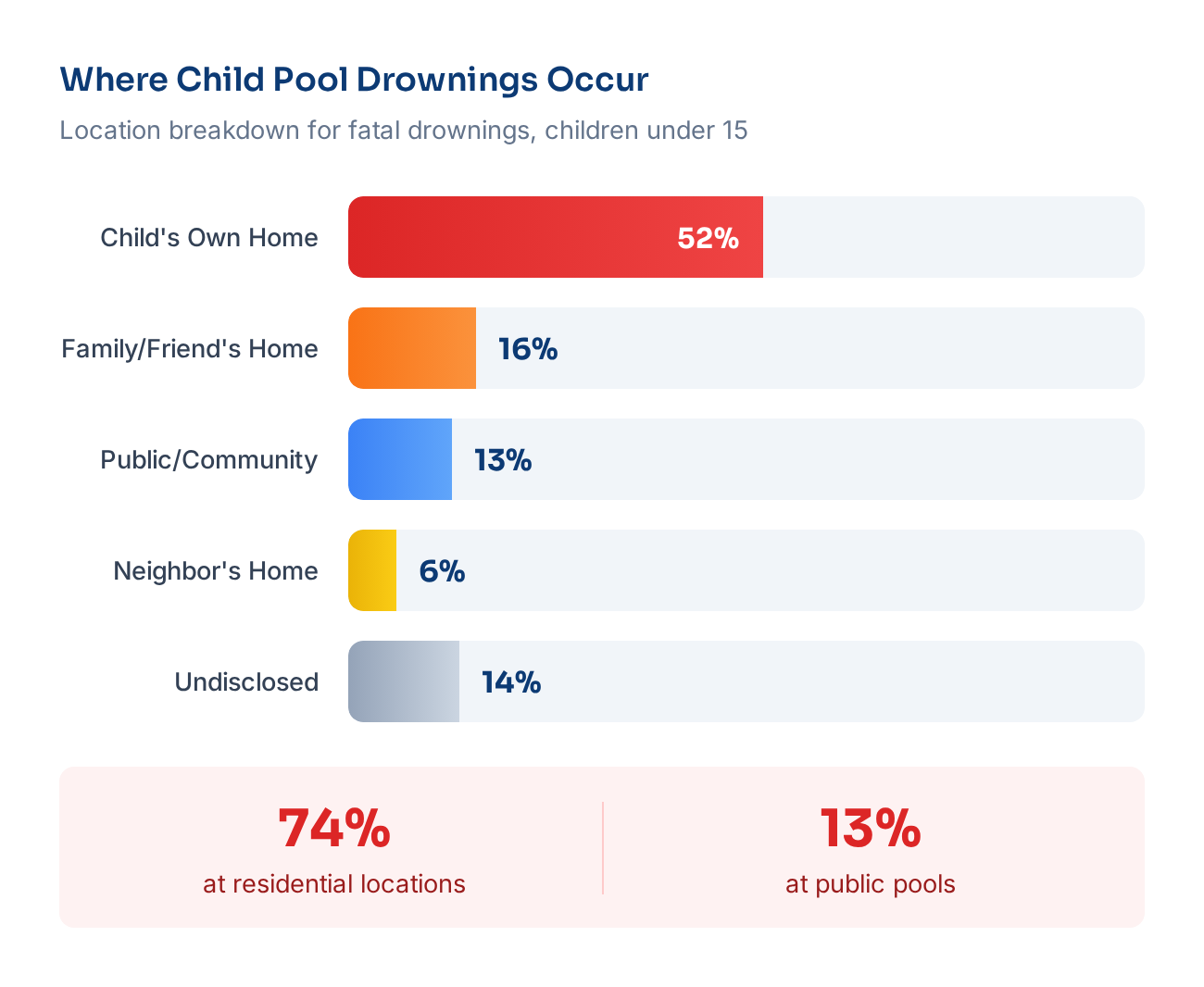
74% of fatal child drownings occur at residential locations—not public pools, water parks, or community facilities.[1]CPSC 2025 Submersion ReportLocation breakdown of fatalitiescpsc.gov This statistic challenges common assumptions about where pool dangers lie.
For pool service professionals, understanding where drownings actually happen helps frame safety conversations with homeowners—and underscores why residential pool barriers matter more than many realize.
Key Statistics at a Glance
- 74% — Fatal drownings at residential locations [1]CPSC 2025 Submersion ReportResidential location datacpsc.gov
- 52% — Drownings at the child's own home [1]CPSC 2025 Submersion ReportOwn home fatality ratecpsc.gov
- 13% — Drownings at public/community locations [1]CPSC 2025 Submersion ReportPublic location datacpsc.gov
- 86% — Toddler drownings at residential settings (own home + family/friend/neighbor) [1]CPSC 2025 Submersion ReportCombined residential rate for under-5cpsc.gov
- 10x — How much more dangerous home pools are vs. public pools for children under 5 [1]CPSC 2025 Submersion Report86% residential vs 7% publiccpsc.gov
The Location Breakdown
The CPSC tracks where fatal pool and spa drownings occur across several location categories. The data reveals a clear pattern: the closer to home, the greater the risk.[1]CPSC 2025 Submersion ReportLocation breakdown of fatalitiescpsc.gov
Source: CPSC 2025 Submersion Report
When combined, these three categories—the child's own home, family/friend's home, and neighbor's home—account for 74% of all fatal pool drownings among children. Only 13% occur at public, community, or business locations (including apartment and condo pools).
Why Residential Pools Are More Dangerous
The disparity between residential and public pool drowning rates isn't about pool design or water conditions—it's about supervision and barriers.
The supervision gap: Public pools typically have lifeguards, fencing requirements, and multiple adults present. Residential pools often have none of these. A child can slip away from a distracted caregiver and reach a backyard pool in seconds.
Consider the difference in safety infrastructure:
- Public pools: Required lifeguards, mandatory fencing, regulated depth markings, safety equipment, multiple witnesses
- Residential pools: No lifeguard, fencing varies by state/age of pool, often single-caregiver supervision, barriers may be absent or compromised
The CPSC notes that 14% of fatalities occur at "undisclosed locations," and 32% of nonfatal injuries have undisclosed location data, limiting complete analysis.
How Location Risk Changes with Age
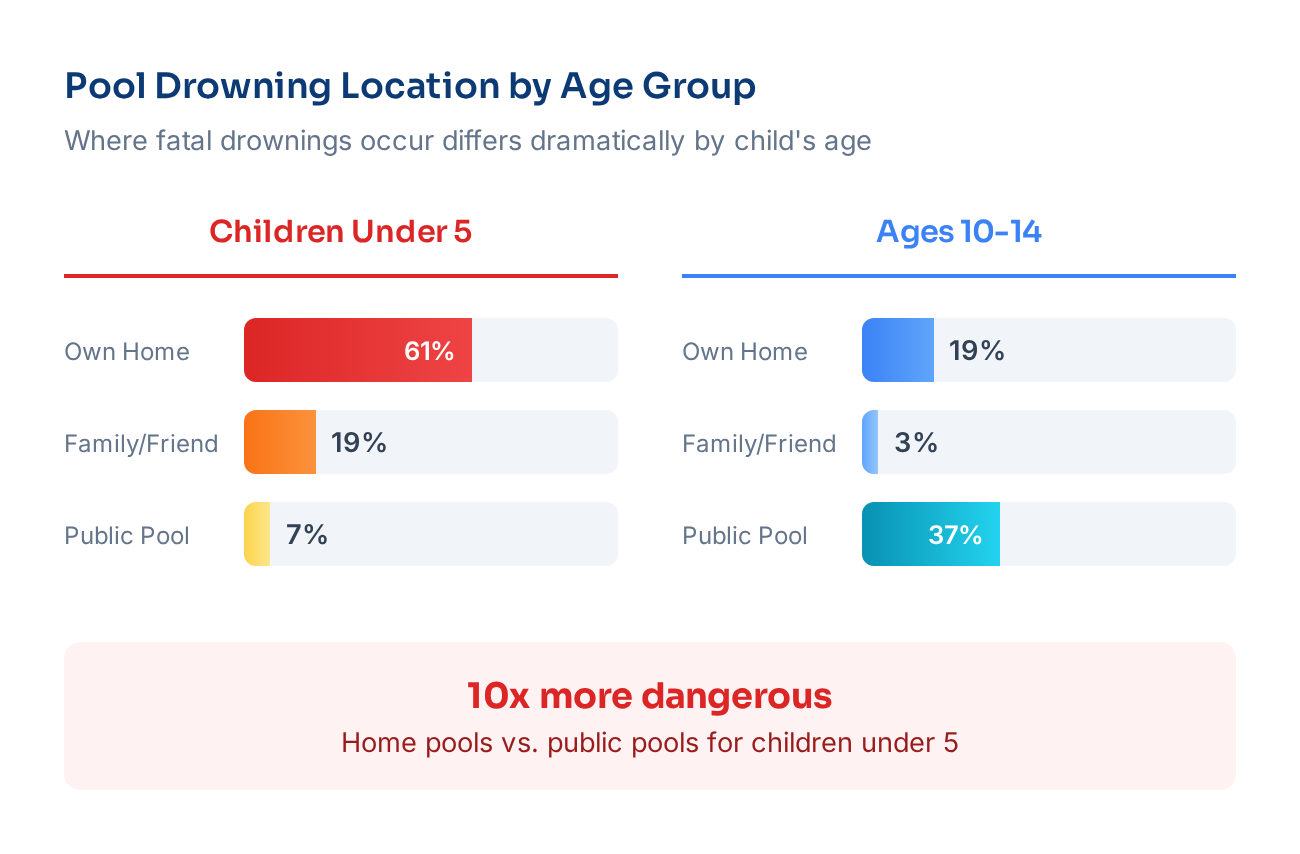
The relationship between a child's age and where drownings occur reveals important patterns. Younger children face the greatest danger at home, while older children's risk shifts toward public settings.[1]CPSC 2025 Submersion ReportAge and location correlationcpsc.gov
For children under 5 years old:
- 61% of fatal drownings occur at the child's own home
- 19% occur at a family member's or friend's home
- Only 7% occur at public/business locations
For children ages 10-14:
- 19% of fatal drownings occur at the child's own home
- 3% occur at a family member's or friend's home
- 37% occur at public/business locations
The 10x statistic: For children under 5, home and family/friend pools combined (86%) are ten times more dangerous than public pools (7%). This makes residential pool barriers critically important for families with toddlers.
Injuries vs. Fatalities by Location
The location pattern differs slightly between fatal drownings and nonfatal injuries requiring emergency department treatment:[1]CPSC 2025 Submersion ReportInjury location datacpsc.gov
- Nonfatal injuries: 43% at residences, 31% at public locations
- Fatal drownings: 74% at residential locations, 13% at public locations
This gap suggests that when drownings occur at public pools, the presence of lifeguards and other safety measures may increase the likelihood of successful rescue. At residential pools, the lack of trained responders means submersion incidents are more likely to become fatal.
The Grandparent Home Risk Factor
One overlooked risk category is pools at grandparents' homes. These residences often have pools installed years ago, before modern barrier requirements. When grandchildren visit:
- The pool exists but barriers may be absent, outdated, or in disrepair
- Grandparents may not be as physically able to supervise actively or respond to emergencies
- The child doesn't live there, so safety equipment and habits aren't routine
- Visits may coincide with gatherings where adult attention is divided
This scenario contributes to the 16% of drownings at "family or friend's home" and the 6% at "neighbor's home."
What This Means for Pool Service Professionals
Location data provides practical guidance for safety conversations:
- Document barrier status: Note fence condition, gate function, and alarm presence in service records
- Flag grandparent homes: When servicing pools at homes that mention grandchildren visiting, consider mentioning barrier options
- Emphasize home risk: Counter the assumption that "it won't happen here"—most incidents happen at home
- Know state requirements: Be familiar with local fence laws to answer customer questions (see our guides on pool fence laws by state)
Data limitation: 14% of fatality locations and 32% of injury locations are "undisclosed" in CPSC data, meaning some incidents cannot be categorized. The actual residential percentage may be even higher.
Sources
- [1] U.S. Consumer Product Safety Commission, "Pool or Spa Submersions: Estimated Nonfatal and Reported Fatal Drownings, 2025 Report." cpsc.gov