How to Branch Into Commercial Pool Service: What Residential Pros Need to Know


Commercial pool service looks attractive from the outside — bigger checks, longer contracts, steady year-round work. And for residential pros who have maxed out their route or want to diversify their revenue, it can be a smart move. But the jump from residential to commercial catches people off guard in ways that have nothing to do with water chemistry.
The pools are bigger, sure. But the real differences are in documentation, liability, equipment complexity, and the politics of dealing with property managers, HOA boards, and health departments. Here's what experienced pros wish they'd known before signing their first commercial contract.
"15 years of pools and if they are high-use commercials it's a completely different job. The amount of tile scrubbing alone is insane. You cash big checks but you get big calls when a 25-year-old underground parking garage floods after years of you recommending the repairs."
— u/R0G3RK0K, r/PoolPros — 15 years in the industry
Key Takeaways
- Documentation is the biggest difference — Health departments want timestamped chemical logs going back months
- Price for liability, not just labor — 2-3x comparable residential pricing is the starting point
- Walk the equipment room before you commit — Commercial systems are heavier, more complex, and often running on 3-phase power
- Set clear scope boundaries in writing — You're not a CPO, lifeguard trainer, or deck maintenance crew
- Look up local regulations first — They vary by state and municipality (e.g., no CYA in NY commercial pools)
The Documentation Burden
This is the single biggest shock for residential pros moving into commercial work. On a residential account, you might jot down FC and pH in your app and move on. On a commercial account, the health department wants timestamped logs of free chlorine, combined chlorine, pH, and ORP — going back months. And they will show up unannounced to check.
If you can't produce those records on the spot, the pool gets shut down. Your client loses revenue. And they're calling you to explain why.
"Biggest thing nobody told me when I started commercial: the documentation burden is no joke. Health department inspectors will want to see chemical logs going back months, timestamped, with readings for FC, pH, and sometimes ORP depending on your county."
— Pool pro, Hawaii
You need an inspection-ready logging system from day one — not a notebook you'll "get around to organizing." A proper chemical tracking system that timestamps every reading and stores it in the cloud is table stakes for commercial work. When the inspector shows up, you should be able to pull up six months of logs on your phone in under 30 seconds.
If you're not already using a commercial pool log book format, start before you take your first commercial account. The documentation requirements will shape everything else about how you service the property.
Walk the Equipment Room First
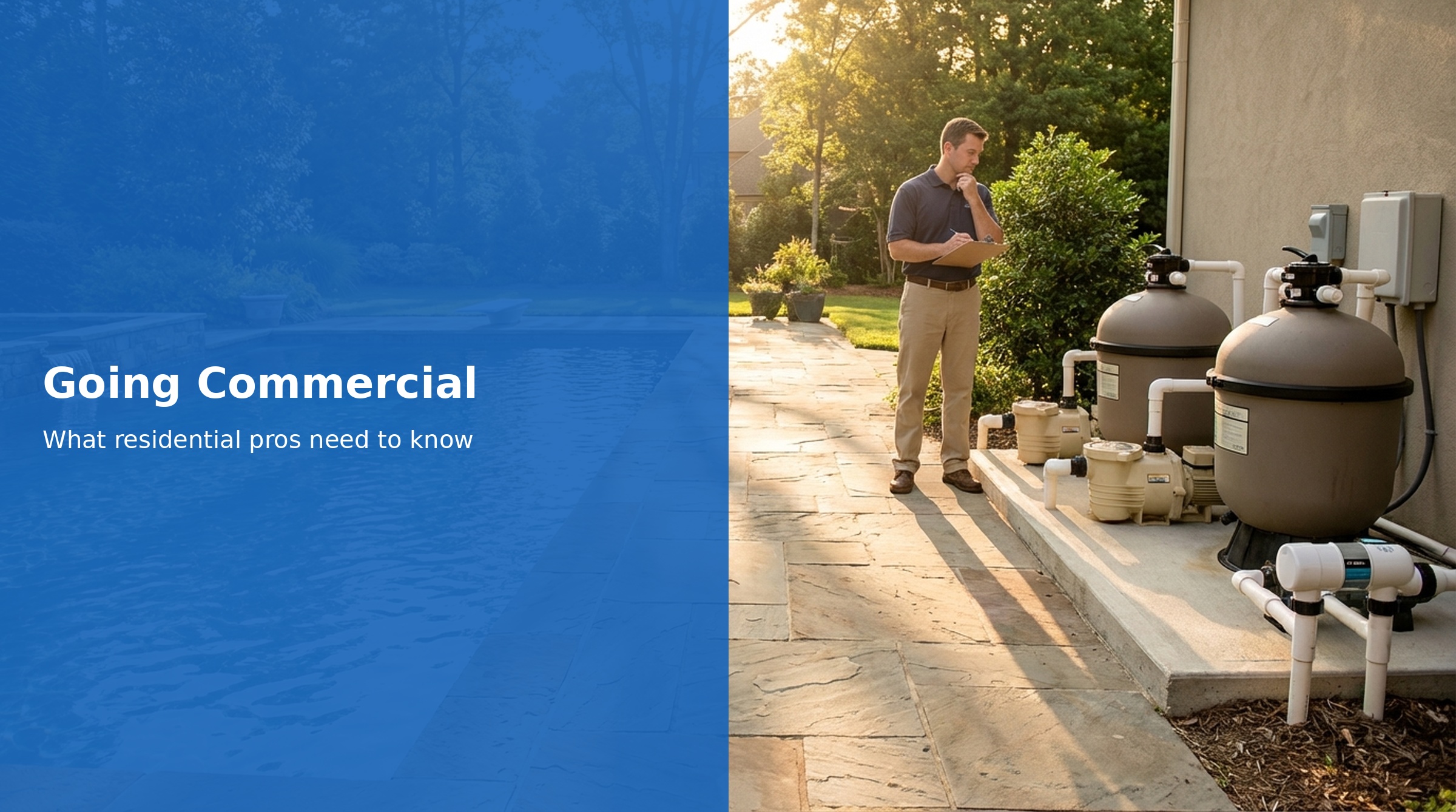
Before you commit to a commercial account, visit the property and spend serious time in the equipment room. This is non-negotiable. What you find in there will determine whether this account is a profitable addition to your business or a liability nightmare.
Here's what to look for:
- Age of everything — Check model numbers and serial numbers. If the pumps, heaters, and filtration are all 15+ years old, you're inheriting a maintenance backlog
- Existing logbook — Is there one? Is it current? A missing or neglected logbook tells you the previous operator wasn't meeting health department standards, and you'll need to build the documentation system from scratch
- Collection tanks and filtration — Commercial pools often use sand filters or DE filters at a scale you've never seen on residential. Understand the system before you quote
- Chemical feed systems — ORP controllers, peristaltic pumps, erosion feeders, 55-gallon drums of liquid chlorine and muriatic acid. This isn't a floating chlorinator
- Electrical — Commercial pumps run on 3-phase power. These are 70 to 400 pound pumps, not the 50-pound Pentair IntelliFlo in your residential customer's backyard
"My biggest tip would be to study the equipment rooms. Where I used to work I picked up two major commercial pools and one of them needed new pumps, chem feeders, heaters, a new autofill, and needed to get up to electrical code. Turned out to be a 30k job, then I took their pool on for service."
— u/inflated_condom, r/PoolPros
Equipment rooms also reveal deferred maintenance that the previous operator never got approved — or never recommended in the first place. Knowing what you're inheriting before you sign is the difference between a profitable contract and an endless repair queue.
"Their equipment is fucked and never any money for repairs or updates. They are always months behind on paying as well. Our worst is 38 years old. People walk off the beach and just hop in."
— u/thescuderia07, r/PoolPros
"There's a lot of 3-phase power in commercial facilities. A small mistake will cause life-altering injury."
— Pool pro with commercial experience
Track everything you find during that initial walkthrough with equipment tracking — model numbers, serial numbers, install dates, condition notes. This becomes your baseline for recommending replacements and budgeting capital expenditures with the property manager.
Pricing Commercial Accounts
The number one mistake residential pros make on their first commercial bid is pricing it like a big residential pool. It's not. The risk profile is completely different.
Start at 2-3x what you'd charge for a comparable residential setup and adjust from there. That multiplier accounts for:
- Emergency response — You will get "drop everything and get here now" calls
- Documentation time — Logging, report generation, health department prep
- Liability exposure — A chemical imbalance at a public pool has legal consequences that don't exist in a backyard
- Equipment complexity — Everything takes longer to service and costs more to repair
- Slow payment cycles — Net 30 to net 60 is common. Sometimes longer
"With commercial properties, the potential earnings are exponentially higher, but so are the headaches. Some properties want daily checks, especially in the busy season, and all that gas and drive time is going to cut into your profit margin."
— u/LMC4547, r/PoolPros
Multiple pros emphasized pricing for liability, not just labor. The risk profile of a commercial pool is fundamentally different from residential.
Use a commercial pool bid calculator to build your quote systematically. Factor in visit frequency, chemical costs at commercial volume, equipment maintenance budget, and your emergency response commitment. Don't wing it.
HOA and Apartment Pricing: Real Numbers
HOA and apartment pools are the most common entry point into commercial service. Here's a practical formula from a pro running multiple commercial accounts:
- Base rate: Take your residential rate, multiply by 2.5, then multiply by the number of weekly service days
- Chemical billing: Bill chemicals separately at cost-plus. Commercial properties rarely pay on time anyway, so billing for the previous month's chemicals is standard practice
- If you bundle chemicals: Take your average residential chemical cost and multiply by 5
As an example, if your residential rate is $180/month for one weekly stop:
- 1x/week commercial: $450/month + chemicals
- 2x/week commercial: $900/month + chemicals
- 3x/week commercial: $1,350/month + chemicals
For a standard community pool with 2-3 weekly stops, $1,200/month is on the low side. Most experienced commercial operators recommend $1,500–$2,000+ depending on pool size, features, and bather load. As one pro put it: "Charge a really high rate. It's almost ridiculous, but they are a ton of work and needy and have multiple bosses."
Don't Forget These Line Items
- Spa drains: Commercial spas get destroyed. Plan on draining every 2–3 months and charge for each drain separately. Some jurisdictions require weekly spa drains
- Filter cleans: Charge double your residential rate. Commercial filter cleans require moving to a special area and extra care keeping common areas clean — a $100 residential filter clean becomes $200+ on a commercial property
- Chemical costs: Summer chemical costs on a commercial pool run roughly 5x residential — $250/month vs. $50/month
- After-hours calls: Build an emergency rate into the contract. You will use it
The Liability Contract
Before you service a single commercial pool, get a service agreement in place that includes a liability waiver. This is non-negotiable.
"We have contracts that waive our liability if someone drowns or an incident occurs with the pool if the entity decided against our recommendations. There have been incidents where no contract was in place and the victim sued both the property and the pool service provider for negligence."
— Pool pro servicing resort and apartment pools
Your contract should clearly state that the property owner is responsible for lifeguard staffing, signage, safety equipment, and bather supervision. You maintain the water and equipment. Have a lawyer review it before you use it.
Know Your Local Regulations
Commercial pool regulations vary dramatically by state and municipality. What's standard practice in Arizona might be a violation in New York. You need to know the rules for your specific jurisdiction before you touch a commercial pool.
Here's how to get up to speed fast:
- Pull last year's inspection report — These are public record in most jurisdictions. They'll tell you exactly what the inspector checks and what the previous operator got dinged for
- Check state and county regulations — Look for your state's health department requirements for public and semi-public pools. Requirements for FC ranges, pH ranges, ORP minimums, and record-keeping periods vary
- Make a cheat sheet — Build a one-page reference from the inspection report format. What do they check? What ranges do they require? What documentation do they want to see?
- Watch for CYA restrictions — Some states (like New York) prohibit cyanuric acid in commercial pools entirely. Others cap it at low levels. Using stabilized chlorine products on a commercial pool where CYA isn't allowed is a fast way to fail an inspection
- Understand ORP requirements — Many commercial jurisdictions require continuous ORP monitoring and logging, not just periodic manual testing
If you don't have your CPO certification yet, get it before bidding on commercial work. It won't teach you everything about running a commercial account day-to-day, but it covers the regulatory framework and gives you credibility with property managers who are evaluating service providers.
Set Scope Boundaries in Writing
This is where residential pros get burned the hardest. On a residential account, the homeowner might ask you to skim leaves off the deck or adjust a timer — and you do it because it takes 30 seconds and keeps them happy. On a commercial account, scope creep will eat you alive.
Your contract needs to spell out exactly what you are and are not doing:
- Water chemistry and filtration — Yes, that's your job
- Equipment maintenance and repair — Define what's included in the contract vs. billed separately
- Lifeguard training and staffing — Not your problem. Period
- Deck maintenance, furniture, umbrellas — Not your problem
- Health department compliance — You maintain the water and equipment. The property owner is responsible for overall compliance including staffing, signage, and safety equipment
"Only allow 2 contacts per property — the treasurer and one pool person. Everyone else goes through them. Otherwise you'll have random board members calling you at 9 PM about the water being too cold."
— Pool pro running all-commercial accounts
Put all of this in the contract before you start. Once you're already servicing the pool, it's much harder to say no to requests that fall outside your scope. For the differences between residential and commercial service models, see commercial vs. residential pool service.
Emergency Response Plan
On a residential account, if the pool turns green on a Wednesday, you deal with it at the next scheduled visit. On a commercial account, green water means the pool closes. Closed pool means angry residents, lost revenue for the property, and a health department violation on the record.
"Drop everything and get here now" trips are part of the job. Build this into your contract and your pricing.
"I guarantee 12-hour on-site response for a fee. I waive the fee for legitimate emergencies — AFR events, major equipment failure, health department shutdowns. Anything else, they pay the emergency rate. It keeps the calls honest."
— Pool pro running commercial accounts
Common emergencies that require same-day response:
- Fecal incidents (AFR events) — Pool must close, be superchlorinated to CDC guidelines, and pass testing before reopening
- Equipment failure — Pump down, heater out, chemical feed system malfunction
- Failed health inspection — Immediate remediation needed to reopen
- Water clarity issues — Cloudy or green water means the pool closes
Build the emergency response commitment into your pricing. If you're guaranteeing 12-hour response, that has a cost — even if most months you never get the call.
Get Ready for Slow Pay
Commercial accounts are notorious for slow-paying invoices. HOA boards meet monthly. Property management companies have approval chains. Municipal accounts run through procurement departments. Net 30 on the contract often means net 60 in practice.
The slow-pay problem isn't theoretical — it's one of the most consistent complaints from pros who've made the switch:
"They are always months behind on paying. Their equipment is never updated and there's never any money for repairs."
— u/thescuderia07, r/PoolPros
This matters for cash flow. If you're spending $500-1,000 per month on chemicals for a commercial account and not getting paid for 60 days, that's real money floating out there. Multiply that across a few commercial accounts and you can find yourself cash-strapped even though you're technically profitable.
- Invoice promptly — The clock starts when you send the invoice, not when you do the work. Use your billing system to send invoices the same day as service
- Set payment terms in the contract — Net 15 or net 30 with late fees. Include the late fee clause even if you rarely enforce it
- Consider requiring a deposit — First and last month's service up front is reasonable for a new commercial account
- Track aging receivables — Know exactly how far behind each account is at all times
Factor slow payment into your pricing. If the average commercial account pays 45 days after invoicing, you're essentially providing 45 days of free financing. That has a cost.
The Learning Curve Is Manageable
If you've been running residential accounts for a few years, you already know water chemistry, equipment troubleshooting, and customer management. Commercial service builds on all of that — it doesn't replace it.
Not everyone who tries commercial work sticks with it — and that's worth knowing before you commit:
"I started in commercial and settled in residential because some of the commercial jobs were incredibly complicated and a bit hazardous — like a commercial sand filter change, Defender DE overhaul, installing an entire pump room over the course of weeks. It takes a good year or so to learn commercial, whereas residential you can get the hang of after a few months."
— u/theonly764hero, r/PoolPros
That's not a reason to avoid commercial altogether — it's a reason to go in with realistic expectations and enough runway to build the skills. If you go in eyes open, the learning curve is manageable:
"Nervous is ok. Just remember you have done this before. Just double the size."
— Pool pro encouraging a colleague
Where you'll need to self-educate:
- Commercial chemical feed systems — ORP controllers, Stenner pumps, Intellichem at scale. Most manufacturer training focuses on residential applications, so you'll need to dig into commercial manuals
- Large filtration systems — Commercial sand filters and DE filters operate on the same principles as residential, but the backwash procedures, pressure tolerances, and media replacement schedules are different at commercial volume
- Health code specifics — Your CPO certification covers the basics. Beyond that, get the actual inspection checklist for your jurisdiction and learn every line item
- Contract negotiation — Residential customers say yes or no. Commercial clients negotiate scope, pricing, response times, and liability clauses. Be prepared to discuss and defend every line item in your proposal
Start with one commercial account. Learn the documentation rhythm, the equipment differences, and the client management dynamics. Then scale from there. Trying to take on five commercial accounts simultaneously as your first foray into commercial service is a recipe for dropped balls and lost contracts.
Commercial accounts need commercial-grade documentation
PoolDial logs every chemical reading with timestamps, generates inspection-ready reports, and tracks equipment across all your properties. Whether you're servicing one commercial pool or twenty, your documentation stays organized and audit-proof.
Start Your Free Trial