
Florida Pool Contractor License Requirements: Chapter 489 Guide


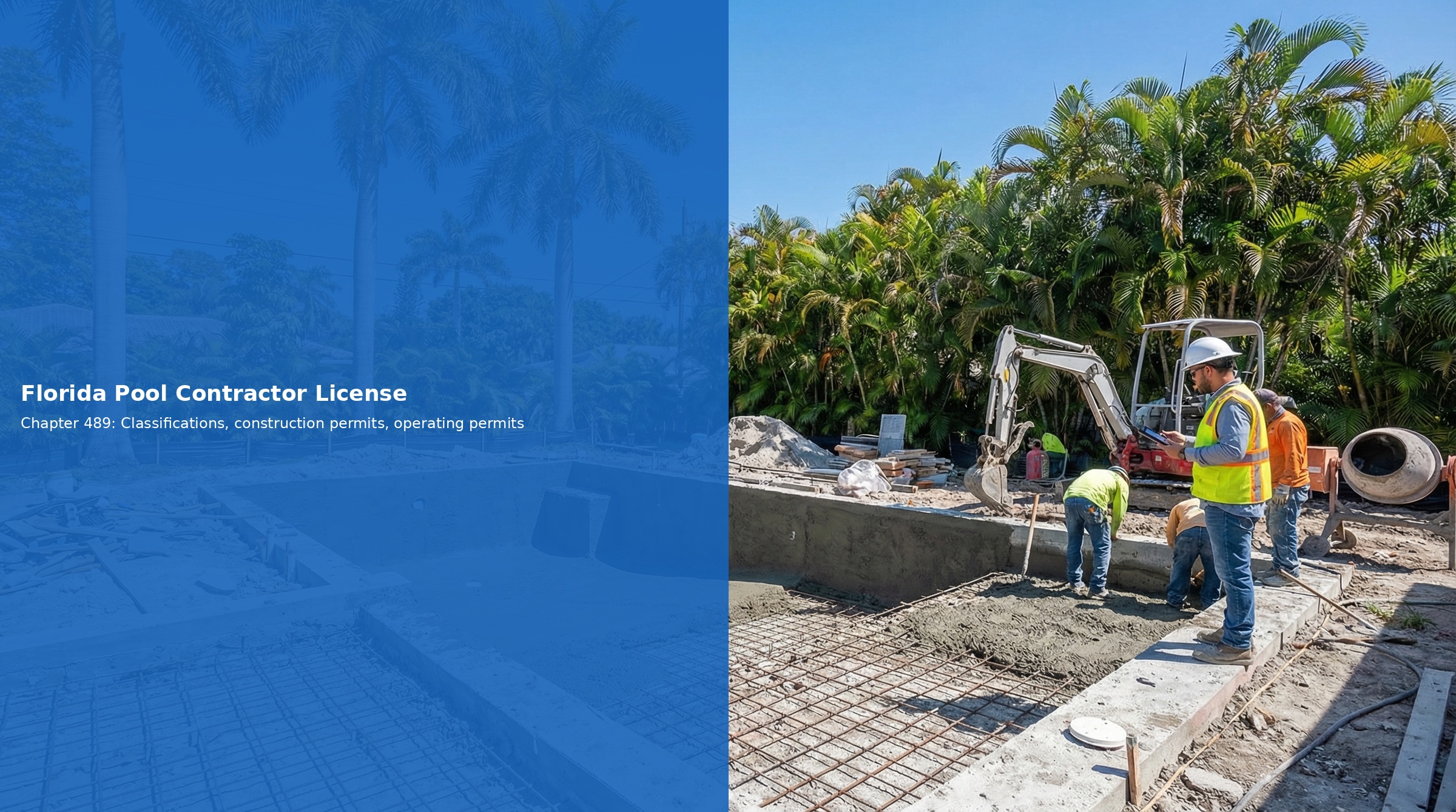
Construction and modification of swimming pools in Florida is a strictly regulated activity that requires a professional license.[1]FAC 64E-9.008Supervision and Safetyflrules.org Whether it is building a new facility or retrofitting an older pool with modern safety features, the state mandates that only qualified contractors perform the work.[2]§515.29, Florida StatutesBarrier Requirementsflsenate.gov This ensures that the structural integrity and safety systems of Florida's 1.5 million pools meet rigorous engineering standards.
Key Takeaways
- License Required — Significant modifications to pools, such as anti-entrapment retrofits, must be done by a licensed contractor[2]§515.29, Florida StatutesBarrier Requirementsflsenate.gov
- Approval Necessary — Any construction, development, or modification of a public pool requires Department of Health approval[1]FAC 64E-9.008Supervision and Safetyflrules.org
- Section 489.105(3) — This section of Florida law defines the categories of contractors (j, k, or l) authorized for specialized pool work[3]§489.105, Florida StatutesContractor Definitionsflsenate.gov
- Operating Permits — Beyond the construction license, a separate permit is required to actually operate a public pool[1]FAC 64E-9.008Supervision and Safetyflrules.org
- Safety Feature Installation — Only licensed professionals have the "sole discretion" to select and install certain safety features on older pools[2]§515.29, Florida StatutesBarrier Requirementsflsenate.gov
Construction and Modification Permits
Before a shovel even hits the ground for a public swimming pool, the owners must obtain specific approval from the Florida Department of Health.[1]FAC 64E-9.008Supervision and Safetyflrules.org Section 514.03 of the Florida Statutes states that it is necessary to receive approval to construct, develop, or modify any public swimming pool or public bathing place. This pre-construction review ensures that the plans meet all state sanitation and safety standards before the facility is built.
Once construction is complete, the regulatory requirements do not end. Every public swimming pool must obtain an operating permit before it can open to the public.[1]FAC 64E-9.008Supervision and Safetyflrules.org This dual-layer of oversight—approval to build and a permit to operate—allows the state to maintain a high level of control over the safety of commercial and multi-family aquatic facilities.
"Approval necessary to construct, develop, or modify public swimming pools or public bathing places... Permit necessary to operate public swimming pool." — §514.03 & §514.031, Florida Statutes
Licensed Contractor Classifications
For specialized safety work, such as installing anti-entrapment devices, Florida law is very specific about who can do the job.[2]§515.29, Florida StatutesBarrier Requirementsflsenate.gov Under Section 514.0315, any public pool built before 1993 that needs to be retrofitted with a safety vacuum release system, an automatic pump shut-off, or a gravity drainage system must hire a licensed contractor. Specifically, the law points to the classifications found in Section 489.105(3)(j), (k), or (l).[3]§489.105, Florida StatutesContractor Definitionsflsenate.gov
These classifications generally cover commercial and residential swimming pool contractors who have demonstrated the expertise required to manage the hydraulics and electrical systems associated with modern pool safety. By mandating these specific licenses, the state ensures that life-saving equipment—designed to prevent "evisceration and body-and-limb suction entrapment"—is installed correctly and functions as intended.[2]§515.29, Florida StatutesBarrier Requirementsflsenate.gov
Responsibilities and Discretion
The law provides the owner or operator of a public swimming pool with the "sole discretion" to choose which safety feature to install on older pools, as long as it meets one of the state-approved options.[2]§515.29, Florida StatutesBarrier Requirementsflsenate.gov However, once that selection is made, the execution of the project must fall to a licensed professional. This professional is responsible for ensuring the system complies with standards from organizations like ASME, ANSI, or ASTM.
Failure to use a licensed contractor for required safety modifications can lead to more than just construction delays; it can result in the denial or revocation of the pool's operating permit.[1]FAC 64E-9.008Supervision and Safetyflrules.org In a market as large as Florida's, maintaining compliance with both Chapter 514 (health and safety) and Chapter 489 (licensing) is essential for any pool service or construction business.
Summary Table
| Requirement | Details | Citation |
|---|---|---|
| Construction Approval | Required before building or modifying public pools | §514.03 F.S. |
| Operating Permit | Required to open a public pool | §514.031 F.S. |
| Authorized Installers | Contractors under s. 489.105(3)(j), (k), or (l) | §514.0315(3) F.S. |
| Safety Standard | ASME/ANSI A112.19.8 (anti-entrapment) | §514.0315(1) F.S. |
| Right of Entry | Department of Health may enter to inspect compliance | §514.04 F.S. |
Sources
- [1] Florida Administrative Code Rule 64E-9.008, Supervision and Safety. flrules.org
- [2] §515.29, Florida Statutes, Barrier Requirements. flsenate.gov
- [3] §489.105, Florida Statutes, Contractor Definitions. flsenate.gov