
Pool Service Truck Setup: The Complete Guide to Stocking Your Route Vehicle


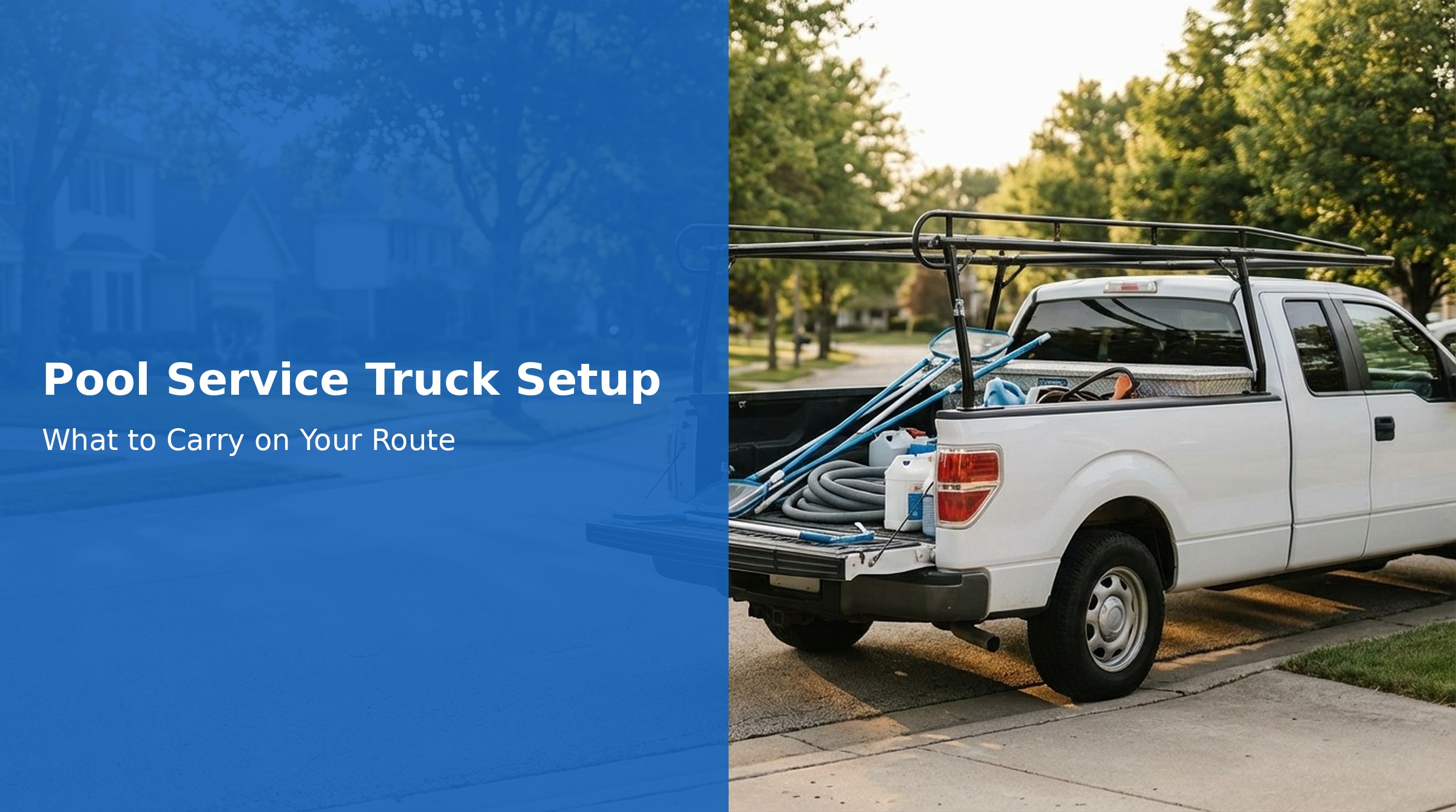
Your truck is your mobile office, warehouse, and workshop. Stock it wrong, and you'll waste hours driving back to the shop for forgotten supplies. Stock it with too much, and you're burning fuel hauling weight you rarely use. Every experienced pool tech has learned this balance the hard way—usually by forgetting a critical tool at the worst possible moment.
This guide compiles wisdom from veteran pool service professionals on exactly what to carry on your truck, what to leave at the shop, and the ongoing debates that divide the industry (looking at you, liquid vs. granular chlorine).
Key Takeaways
- Start light and adjust weekly — Your truck setup will evolve as you learn your route's specific needs
- 4-gallon chlorine cases are easier to handle than 5-gallon buckets
- Don't carry salt daily — It's heavy and usually only needed once or twice per year
- Channel locks are essential — The most-mentioned missing tool from new techs
- Carry a documented spill kit: Match it to each chemical's SDS and your emergency response plan
The Day-One Essentials
Before you hit your first stop, make sure you have these basics covered. This is the minimum viable truck setup—you'll add to it over time as you learn what your specific route demands.
Cleaning Equipment
The 360-degree brush is worth the upgrade. As one tech put it: "I switched last year and never looked back." It handles corners and steps much more efficiently than traditional brushes.
A leaf vacuum like the Riptide is useful, but it doesn't replace a traditional vacuum—especially at the start of season when pools have silt and fine debris that battery-powered units just cloud up.
When a Portable Pump-and-Filter Cart Earns Its Space
A recent dolly discussion started with a technician building a portable pump and cartridge-filter vacuum. One practical answer identified the frame category they had been trying to find:
"We used pressure washer carts. That way you don’t have to stack the pump and filter."
— Pool pro via Reddit
A pressure-washer-style frame can provide a low platform and separate mounting areas, but the label does not make every cart suitable. Verify the cart's load rating, wheel capacity, handle leverage, frame material, dimensions, fastener points, and stability with the actual pump, wet filter, hoses, and captured debris. Do not drill or weld a rated frame without understanding how the change affects capacity and corrosion.
"There's many scenarios when having one is helpful. In my work van, I have a powervac (that mini car battery powered mesh bag vacuum) plus obviously hoses to go through the system. But sometimes you want to vacuum through a cartridge and their system sucks. sometimes you have 2 guys on the job, and one can vacuum while the other can clean their filter or salt cell. Etc."
— Pool pro via Reddit
The second system is most useful when it solves a known route constraint: the customer's circulation system is unavailable or unsuitable, fine debris needs cartridge capture, vacuuming and equipment service can happen in parallel, or a controlled external setup reduces repeated hose changes. It is not an automatic day-one purchase. Record how often those cases occur, the minutes saved, and the vehicle space and payload consumed.
Before putting a custom cart into service:
- weigh the complete wet assembly and keep it within the cart, ramp, lift, and vehicle limits;
- mount components so the center of gravity stays low and the cart cannot tip when hoses pull;
- use rated straps or brackets so the pump and filter cannot shift in transit;
- protect drain plugs, gauges, lids, cords, and hose connections from impact;
- follow the pump and filter manuals for pressure, flow, priming, electrical supply, and safe opening;
- use code-compliant electrical protection and qualified help for any setup near pool water;
- chock or secure the cart on slopes and never leave it where a customer can energize it; and
- drain and sanitize the system between pools when cross-contamination is a concern.
If the cart leaves the truck only a few times per season, keep it at the shop or assign it to a repair vehicle. The goal is not to carry every possible solution. It is to have the right second system available when its saved labor exceeds its transport cost and risk.
Chemicals (Daily Carry)
The exact quantities depend on your route size and pool types. A good rule of thumb: carry enough to service your full day plus 20% buffer. You'll dial this in after your first few weeks.
Test Equipment
The Taylor K-2006 is the industry standard for a reason—it gives you FAS-DPD chlorine testing and accurate readings for pH, alkalinity, calcium hardness, and CYA. Use our chemical dosage calculator to determine exactly how much of each chemical to add based on your readings.
Tools Every Tech Needs
The most common response when new techs ask what they're missing? Channel locks. Followed closely by basic hand tools. You don't need a full toolbox, but you need enough to handle routine adjustments and minor repairs.
Essential Tools
Some techs who do repairs and equipment work also carry a reciprocating saw and more specialized tools. But for standard maintenance routes, the list above covers 95% of what you'll encounter.
Design Storage Around the Vehicle and the Stop
A broad technician tool-list question and a solo operator working from a hatchback point to the same rule: start with the work and storage constraint, not a favorite brand. The hatchback operator described the real constraint in a PoolPros storage question:
"I run my solo pole operation out of my hatchback, and need everything to be as organized as possible."
— Pool pro via Reddit
Build modules by job instead of buying boxes first: daily water testing, electrical diagnosis, plumbing repair, filter cleaning, cleaner parts, and PPE. The daily kit should be reachable without unloading specialty gear. Heavy tools should be restrained low in the vehicle, wet gear should be isolated from clean records and electronics, and chemical storage must follow the product safety information and local rules.
Small route details deserve assigned homes too. A net discussion noted that fine mesh catches more but creates drag and can dump debris if it traps air. A separate operator keeps a bucket in the van for inorganic trash. Match the net to the route's debris and keep a lidded waste container so customer trash never becomes a deck-side judgment call.
Filter Cleaning Supplies
Filter cleaning is where many new techs come up short. You need different supplies depending on whether you're servicing cartridge, sand, or D.E. filters.
Filter Maintenance
The Chlorine Debate: Liquid vs. Granular
Ask ten pool techs what chlorine to use, and you'll get ten different answers. Here's how the debate breaks down:
Advantages
- Doesn't add CYA (stabilizer)
- Doesn't affect calcium hardness
- Fast-acting
- Easy to dose precisely
Considerations
- Heavy to transport
- Degrades over time (especially in heat)
- Can bleach clothing/truck bed
- Some areas have limited availability
Advantages
- Lighter to carry
- Longer shelf life
- Easier storage
- Cal-hypo raises calcium (can be useful)
Considerations
- Dichlor/Trichlor add CYA
- Cal-hypo can cause scaling
- Can cloud water if not dissolved properly
- Risk of CYA buildup over time
The experienced consensus leans toward liquid chlorine for regular service: "Liquid chlorine is king" is a common refrain. The main reason? It doesn't add cyanuric acid or calcium, keeping your water chemistry cleaner long-term.
If you go liquid, get the refillable 4-gallon cases instead of 5-gallon buckets. They're much easier to handle and pour. As one tech noted: "Much easier to use than 5-gallon."
Use our CYA calculator to track stabilizer levels and avoid the buildup that comes from over-relying on stabilized chlorine products.
What NOT to Carry Daily
Just as important as knowing what to carry is knowing what to leave at the shop. These items are too heavy, too rarely used, or better brought on an as-needed basis.
Salt
This is unanimous among experienced techs: don't carry salt on your truck daily. Here's why:
- Salt is heavy—40 lb bags add up fast
- Most pools only need salt added once or twice per year
- You can balance a pool with liquid chlorine until you return with salt
- Many techs have customers order their own salt (it's cheaper on Amazon anyway)
Instead, check salt levels during service. If a pool needs salt, note it and bring the specific amount needed on your next visit. One tech's approach: "I charge $12 a bag. They can get it on Amazon for half that delivered to their front door. So why not? I'll bring in a couple, but no more than 5."
Specialty Chemicals
Keep these at the shop and bring as needed:
- Phosphate remover — Only needed after storms or heavy debris
- Algaecide — For treatment, not routine maintenance
- Flocculant — Occasional use for cloudy pools
- Stain remover/Metal out — As-needed basis
The exception: if you have specific problem pools on your route that regularly need these products, carry small quantities.
Add-On Products Worth Carrying
Some chemicals aren't essential but can generate additional revenue and improve pool quality:
- Enzyme products — Break down oils and organic matter
- Water clarifier (Super Blue, Sea Klear) — Quick fix for hazy water
- Stain and scale control (Orenda SC-1000) — Preventive maintenance
These are easy upsells that provide genuine value to customers while improving your margins. Track what you use with a good cost-per-pool calculator to ensure you're pricing appropriately. When you add a product to a customer's pool, photo documentation of the before and after state is a simple way to justify the charge and build trust over time.
Regional and Seasonal Adjustments
Your truck setup isn't static. Expect to adjust based on:
Climate
- Hot climates: More chlorine consumption, higher CYA needs (tabs add stabilizer faster)
- Rainy areas: May need CYA more often due to dilution
- Hard water regions: More acid, potentially less cal-hypo
Season
- Spring opening: Algaecide, shock, stain treatment
- Summer peak: Maximum chlorine, CYA for new fills
- Fall closing: Winterizing chemicals, cover supplies
- Winter (warm climates): Reduced chemical loads, salt systems may not produce below 65°F
The First-Year Reality
Here's the truth every new pool tech discovers: your truck contents will change almost weekly for the first year. And that's okay.
As one veteran put it: "Don't worry, you'll figure out quickly what is worth carrying daily and what should be taken on certain occasions."
Another recommended: "Honestly if you aren't super busy at first, just schedule a super light first day and figure out what you're missing as you go."
The key is starting with the essentials, tracking what you run out of or wish you had, and adjusting your loadout weekly until you find your sweet spot. Once you're running a full route, see our guide on the pool tech mobile workflow to streamline how you log stops, readings, and notes from the truck.
Track Your Chemical Usage Automatically
PoolDial logs every chemical addition and calculates your true cost per pool. Stop guessing what to carry—let the data tell you. See how pool pros manage their entire business from their phone.
Start Your Free TrialFinal Checklist: Print This
Here's your quick-reference checklist to keep in the truck:
Daily Must-Haves
Building your first route? Check out our complete guide on how to start a pool service business for everything from licensing to pricing.