How to Raise Rates on Inherited Pool Accounts Without Losing Clients


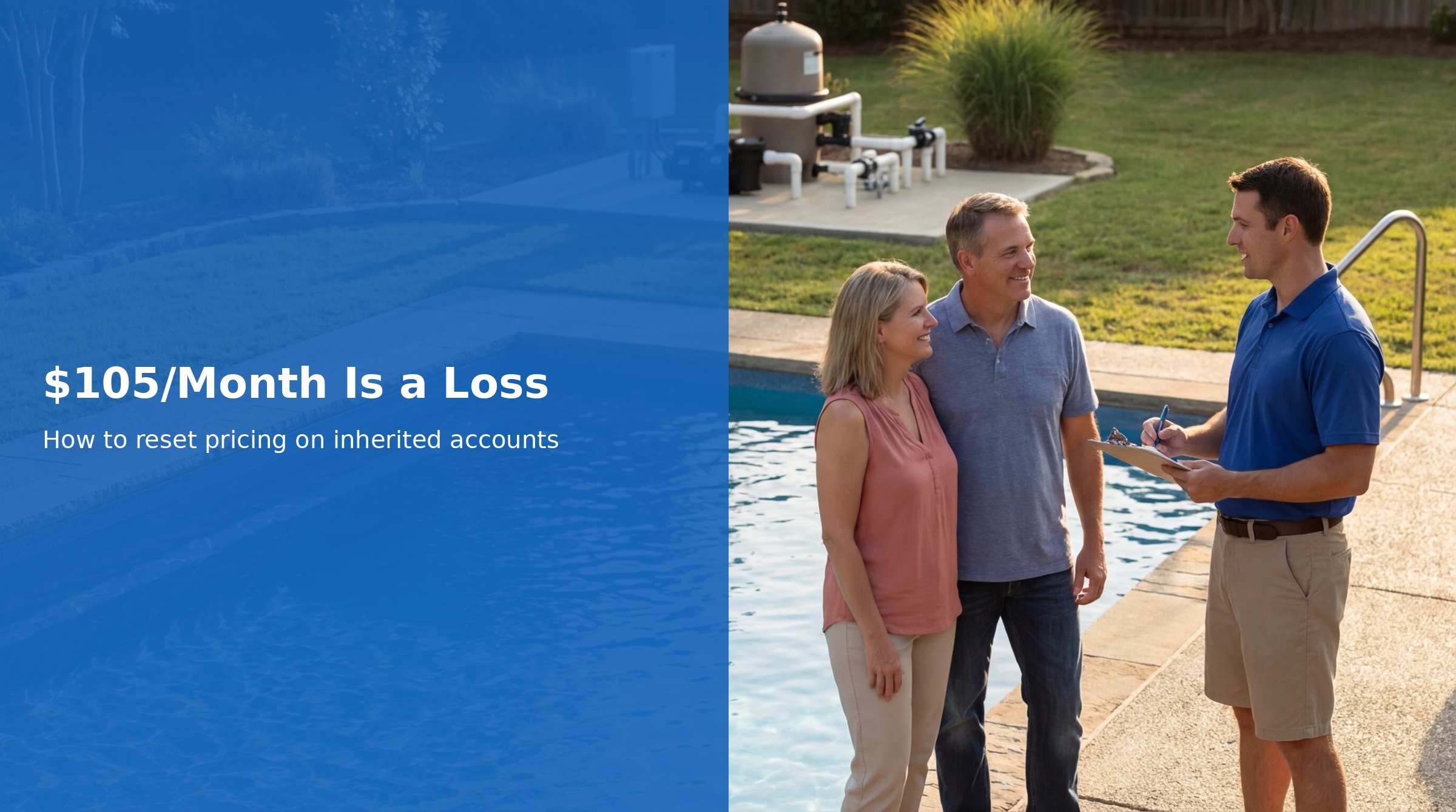
You just picked up a handful of pool accounts — maybe bought a small route, maybe a friend handed them off, maybe your old company gave you the ones that were too far out for them. You open the books and realize: half these customers are paying $105/month for weekly service with chemicals included. No rate increase in years. And now it's your problem.
This is one of the most common situations in pool service, and it's also one of the most stressful. You don't want to lose accounts you just got. But you also can't afford to service pools at a loss. We pulled real advice from experienced pros on how to handle this transition without burning bridges or burning money.
Key Takeaways
- A new owner is a natural pricing reset — Frame it as YOUR rate, not an increase from the old guy
- $105/month with tabs included is a loss — After chemicals, gas, and time, you're paying to work
- Losing 1–2 accounts at a fair rate beats keeping 6 at a loss
- Bake chemicals into the monthly rate — Don't itemize tabs as a separate charge
- The worst time to raise prices is 18 months in — Day one is the easiest reset you'll ever get
The Math on Underpriced Accounts
Before you decide whether to raise rates or how much, run the actual numbers. Most techs who inherit cheap accounts don't realize just how cheap they really are until they see the breakdown.
That's $27/month before paying yourself. At 20 minutes per visit plus drive time, you're looking at roughly $5–7/hour for your labor. As one pro put it bluntly: "That's not a customer, that's a charity client."
This math reframes the entire conversation. You're not asking "can I afford to lose clients?" You're asking "can I afford to keep them at this rate?" The answer is no. Use the cost per pool calculator to run these numbers for your specific situation.
Why a Transition Is the Best Time to Raise Rates
Here's the psychological insight that experienced pros consistently emphasize: when a customer gets a new service provider, they expect different pricing. It's a natural reset. Raising prices 18 months into a relationship feels like a penalty. Raising prices at a provider transition feels like the cost of doing business.
The customers aren't losing their old pool guy and keeping the same price. They're getting a new pool guy with a new price. That's a completely different conversation, and it's one that most customers accept without pushback.
Three Strategies That Work
Strategy 1: The Clean Break (Most Recommended)
Send an intro letter or text to each customer introducing yourself and your rates. Don't reference the old pricing at all. This is your rate. Period.
Bake chemical costs into the new monthly rate. Don't itemize tabs as a separate line. A clean $155–170/month that includes everything feels simple and professional. Customers get weird when you start itemizing chemicals.
Strategy 2: The One-Month Trial
Service the pool for one month at the old rate to demonstrate your quality, then move to your standard pricing.
This works well if the previous service was poor (green pools, high CYA, dirty filters) and you want the customer to see the upgrade before paying more. Get the first month's payment up front.
Strategy 3: The Incremental Approach
Raise rates in two steps — once on transition, and again 3–6 months later. Less shock, but you eat the loss longer.
Some pros recommend raising either the rate OR adding chemical charges, but not both at once. This reduces the sticker shock but extends the period where you're undercharging.
The consensus from the pros we surveyed is clear: Strategy 1 is the strongest. You have a natural excuse to set your own rates, and you should use it. The ones who balk were never going to be good long-term clients anyway.
The "My Last Guy Charged Less" Conversation
You're going to hear this. Every pool pro hears this. Here's how the experienced ones handle it.
The uncomfortable truth is that many underpriced pool services are cutting corners. When pros visit pools from $100–110/month services, they consistently find the same problems: CYA at 200+ ppm, calcium at 900 ppm, filters that haven't been cleaned in 9 months, and pump timers set to 24 hours because no one optimized anything. The customer was getting a low price, but they weren't getting good service.
You don't need to trash the previous company. Just state facts. If you test the water on your first visit and show the customer what's actually going on, the price increase sells itself. This is where chemical tracking becomes a sales tool — when customers can see their water chemistry history and the improvements you're making, the value of professional service becomes obvious.
What's a Fair Monthly Rate in 2026?
Rates vary dramatically by region, but here's what pros across the country reported as their current monthly pricing for weekly residential service:
- SoCal: $150–180/month (chemicals included or billed separately)
- South Florida: $165–180/month (chemicals included, cartridge filter cleanings monthly)
- New Jersey/New York: $100–180/week (yes, per week — shorter season, higher per-visit rate)
- Texas: Higher than you'd expect — some cities reportedly enforce minimum pricing
A recurring theme: $105/month with chemicals included is unsustainable in every market in 2026. Even in the cheapest markets, you need $150+ just to break even after chemicals, fuel, insurance, and overhead. That's before you pay yourself a dollar.
If you're unsure where your market sits, the price increase calculator can help you model different scenarios and see how rate changes affect your annual revenue.
The Underpricing Problem in Pool Service
This topic touched a nerve with the pros we surveyed, and for good reason. The pool service industry has a structural underpricing problem driven by several forces:
- Semi-retired single operators who own their homes outright and have minimal expenses. They can charge $90/month because they're supplementing retirement income, not building a business. But their rates drag the market down for everyone trying to make a living.
- Uninsured/unlicensed operators who can undercut by 30–40% because they're not carrying the same overhead. Until something goes wrong, their customers see no difference.
- Large companies using loss-leader pricing to acquire customers — offering 3 months at 50% off to steal clients, then hiking rates above market after the customer is locked in.
The result is that younger pros trying to build a legitimate, insured, properly-equipped business are squeezed from both sides. They can't match the semi-retired guy's $90/month rate, and they can't match the big company's marketing budget.
The fix for the individual operator is simple, even if it's uncomfortable: charge what you need to charge, explain the value, and let the customers who won't pay a fair rate find someone else. The customers who stay are the ones worth building a business around.
How to Handle Chemical Billing
The thread surfaced three approaches to handling chemical costs:
- Include everything in the monthly rate — Most popular. Clean, simple, no surprises. Set your rate high enough to cover summer chemical costs. This is what most customers prefer.
- Monthly rate + customer buys their own tabs — Some pros have customers buy their own tabs to keep the headline monthly number lower. You still provide liquid chlorine, acid, and specialty chemicals.
- Monthly rate + separate CYA charge 2x/year — One SoCal pro charges $75 for conditioner twice a year. Since tabs maintain CYA levels, this effectively offsets his tab cost for the rest of the year.
The simplest approach is #1: include chemicals and price accordingly. As one pro noted, "customers get weird when you itemize chemicals." A single monthly number is easier to quote, easier to collect, and easier to raise annually. Track your actual chemical costs per customer with your service software so you know which pools are costing more than average and can adjust at renewal.
The Bottom Line
If you're inheriting underpriced accounts, here's your playbook:
- Run the math on every account. Know your actual cost per pool using the cost per pool calculator
- Set your rate on day one. The transition is your best opportunity to reset pricing
- Send a professional intro with your rate and what's included. Don't reference the old price
- Include chemicals in the monthly rate. Keep it clean and simple
- Accept that you'll lose 1–2 accounts. Four accounts at $160 is better than six at $105
- Test the water on your first visit and document what you find. If the previous service was poor, the data will justify your rate
- Raise rates annually going forward so you never fall this far behind again. A small annual increase is easier than a big catch-up jump
The worst thing you can do is start a client relationship undervaluing yourself. It's much harder to raise prices 18 months in than it is on day one when there's a natural reset happening. Use the window while you have it.
Know your cost per pool before you set your rates
PoolDial tracks chemical costs, service time, and customer revenue so you can price every account with confidence.
Start Your Free Trial