


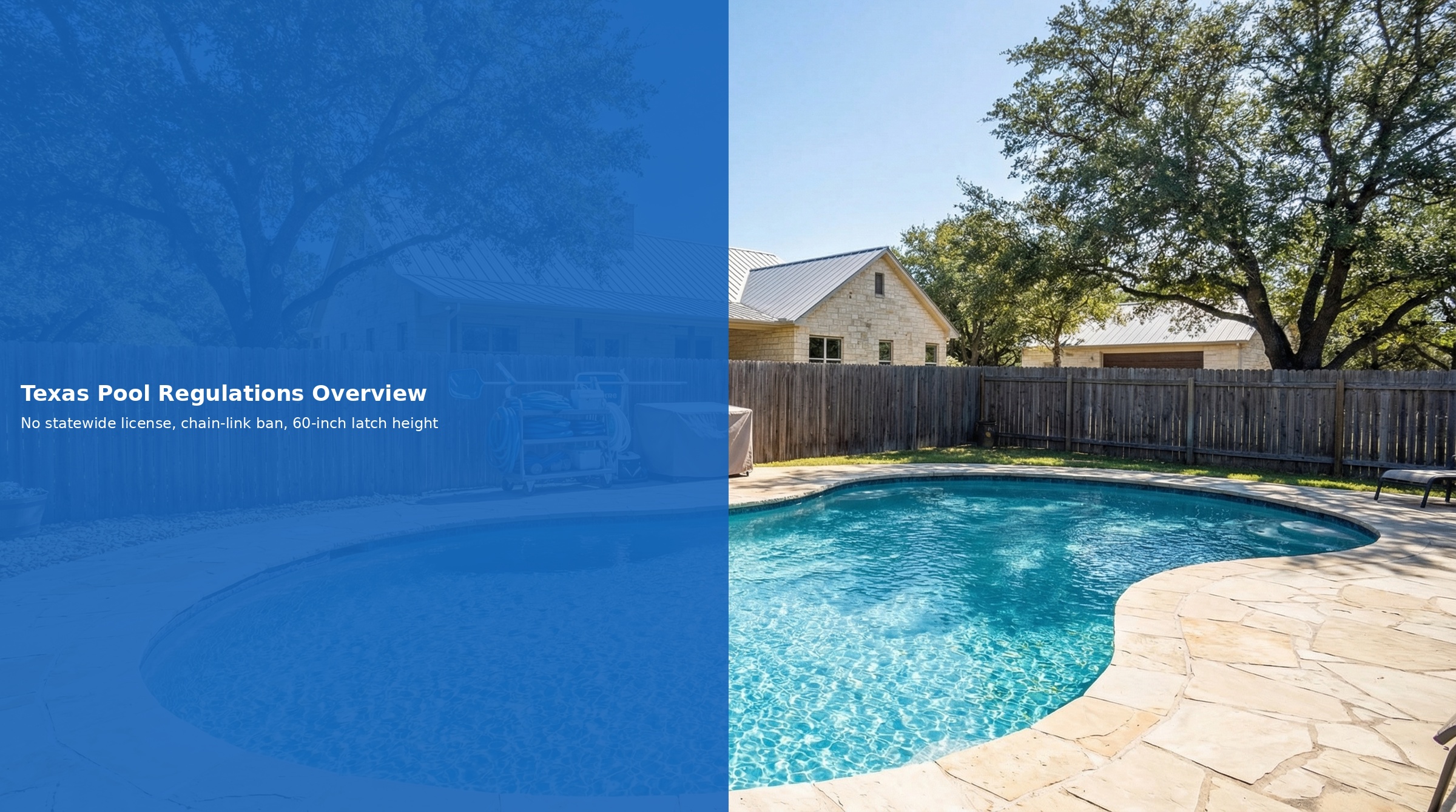
Operating a pool service business or owning a managed aquatic facility in Texas requires navigating a complex web of state statutes and local ordinances. Unlike many other high-market states, Texas maintains a decentralized approach to professional oversight while enforcing strict safety standards for physical barriers and public water quality. Understanding these requirements is essential for legal compliance, liability protection, and ensuring the safety of the second-largest pool market in the United States.[1]H&S Code Chapter 341Minimum Standards of Sanitation and Health Protection Measuresstatutes.capitol.texas.gov
Key Takeaways
- No Statewide License — Texas does not require a general statewide contractor license for pool service or construction[1]H&S Code Chapter 341Minimum Standards of Sanitation and Health Protection Measuresstatutes.capitol.texas.gov
- Chain-Link Ban — Fencing for pools permitted on or after September 1, 1994, cannot be constructed of chain-link material[2]H&S Code Chapter 757Swimming Pool Enclosuresstatutes.capitol.texas.gov
- 60-Inch Latch Height — Most pool gate latches must be positioned at least 60 inches above the ground to prevent child access[4]25 TAC Chapter 265General Sanitation - Public Swimming Pools and Spasdshs.texas.gov
- Certified Operator Mandate — All public and commercial pools must be supervised by a trained and certified operator (CPO)[4]25 TAC Chapter 265General Sanitation - Public Swimming Pools and Spasdshs.texas.gov
- Real Estate Disclosure — Sellers must disclose the presence and condition of pool safety features under the Texas Property Code[3]Property Code Section 5.008Seller's Disclosure of Property Conditionstatutes.capitol.texas.gov
- Local Control — Individual cities like Houston and San Antonio often have their own specific licensing or permit requirements[1]H&S Code Chapter 341Minimum Standards of Sanitation and Health Protection Measuresstatutes.capitol.texas.gov
The Regulatory Landscape in Texas
The defining characteristic of the Texas pool industry is the absence of a statewide pool contractor license. While states like Florida, California, and Arizona require a specific trade license to build or service pools, Texas leaves this oversight to local jurisdictions and specific trade boards. This means that while a "Pool Contractor" license does not exist at the state level, the individuals performing the work must still adhere to the Texas Electrical Safety and Licensing Act and relevant plumbing codes when those specific systems are touched.[1]H&S Code Chapter 341Minimum Standards of Sanitation and Health Protection Measuresstatutes.capitol.texas.gov
For professionals, this regulatory environment places the burden of compliance on the business owner to understand the overlap between state safety codes and local municipal requirements. The Texas Department of State Health Services (DSHS) oversees public health aspects through the Texas Administrative Code (TAC), while the Texas Health and Safety Code provides the statutory backbone for physical safety features like enclosures.[4]25 TAC Chapter 265General Sanitation - Public Swimming Pools and Spasdshs.texas.gov
Barrier and Fence Safety Standards
Texas enforces some of the nation's most specific requirements for pool yard enclosures, primarily through Health and Safety Code Chapter 757. A critical threshold in Texas law is the date of September 1, 1994; any pool for which a building permit was issued on or after this date is subject to a strict ban on chain-link fencing. This regulation was designed to eliminate "climbable" surfaces that could allow unauthorized access by children.[2]H&S Code Chapter 757Swimming Pool Enclosuresstatutes.capitol.texas.gov
"A fence or wall may not be constructed of chain link for a swimming pool or spa for which a building permit was issued on or after September 1, 1994." — Tex. Health & Safety Code Section 757.005(a)
Beyond material requirements, the height and latching mechanisms are strictly regulated. Standard enclosures must have a minimum height of 48 inches, though Class A and B public pools often require 6-foot (72-inch) barriers. Gates must be self-closing and self-latching, with the latch typically positioned at 60 inches to remain out of reach of small children, unless a key or card system is utilized.[4]25 TAC Chapter 265General Sanitation - Public Swimming Pools and Spasdshs.texas.gov
Public Pool and Commercial Compliance
Public pools—classified as Class A (competitive), Class B (general public), or Class C (hotels, apartments, and HOAs)—face more rigorous operational standards than residential pools. Every public facility must be under the direction of a certified operator who has completed an approved course such as the CPO (Certified Pool Operator) or AFO (Aquatic Facility Operator). This operator is responsible for maintaining water chemistry within strict legal limits, including a free available chlorine range of 1.0 to 8.0 ppm for pools.[4]25 TAC Chapter 265General Sanitation - Public Swimming Pools and Spasdshs.texas.gov
"All Class A, Class B, and Class C pools and spas must be maintained under the supervision and direction of a properly trained and certified operator." — 25 TAC Section 265.194(b)
Safety equipment for these facilities is not optional. Texas law requires reaching poles, ring buoys with throwing ropes, and specific emergency signage. For facilities where no lifeguard is provided, the law mandates a "Warning - No Lifeguard on Duty" sign with letters at least 4 inches high. Furthermore, public facilities must provide an emergency summoning device, such as a dedicated 911 phone, located within 200 feet of the water.[4]25 TAC Chapter 265General Sanitation - Public Swimming Pools and Spasdshs.texas.gov
Real Estate Disclosure Requirements
When a residential property with a swimming pool changes hands in Texas, the law requires a high degree of transparency regarding the pool's condition and safety features. This is governed primarily by the Texas Property Code Section 5.008, which mandates the use of a Seller's Disclosure Notice. This document serves as a formal record of what the seller knows about the property, ensuring the buyer is aware of both the pool's functionality and its compliance with safety standards.[3]Property Code Section 5.008Seller's Disclosure of Property Conditionstatutes.capitol.texas.gov
The disclosure goes beyond just the pump and filter. It specifically asks about safety features. Sellers must indicate if the property has a pool heater, a pool cover, or a pool/spa equipment enclosure. Because Texas has such specific laws regarding pool yard enclosures (Chapter 757), this disclosure is a critical step in identifying whether a pool is legally compliant or represents a future liability for the buyer.[3]Property Code Section 5.008Seller's Disclosure of Property Conditionstatutes.capitol.texas.gov
Summary Table
| Requirement | Details | Citation |
|---|---|---|
| Statewide License | None required for general pool service/construction | N/A |
| Fence Height | Minimum 48 inches (4 feet); 72 inches for Class A/B | 25 TAC Section 265.184 |
| Chain-Link Ban | Prohibited for pools built after Sept. 1, 1994 | H&S Code Section 757.005 |
| Gate Latch | 60 inches height (or 42 inches with key/card) | 25 TAC Section 265.184 |
| Water Testing | Every 2 hours for Class A/B; daily for most Class C | 25 TAC Section 265.190 |
| Operator Certification | Required (CPO, AFO, or equivalent) | 25 TAC Section 265.194 |
| Real Estate Disclosure | Pool safety features must be disclosed at sale | Property Code Section 5.008 |
Sources
- [1] Texas Health & Safety Code Chapter 341, Minimum Standards of Sanitation and Health Protection Measures. statutes.capitol.texas.gov
- [2] Texas Health & Safety Code Chapter 757, Swimming Pool Enclosures. statutes.capitol.texas.gov
- [3] Texas Property Code Section 5.008, Seller's Disclosure of Property Condition. statutes.capitol.texas.gov
- [4] Texas Administrative Code Title 25, Chapter 265, Subchapter L - Public Swimming Pools and Spas. dshs.texas.gov