
Do Pool Fences Prevent Drownings? What the Data Shows


The short answer is yes—pool fences substantially reduce childhood drowning risk. But the data reveals important nuances about fence types, failure scenarios, and why barriers work even when supervision fails.[1]Pool Safely ActBarrier effectiveness findingspoolsafely.gov
This article examines the research on pool fence effectiveness, including data on how drownings occur and what types of barriers provide the best protection.
Key Findings
- Four-sided fencing — Specifically recommended by CDC as most effective barrier [2]CDC MMWR Vital SignsFour-sided fencing recommendationcdc.gov
- 62-65% — Drownings involving a gap in supervision [3]CPSC 2023 Submersion ReportDrowning scenario analysiscpsc.gov
- ~10% — Fatal drownings where barrier was circumvented or compromised [3]CPSC 2023 Submersion ReportBarrier failure scenarioscpsc.gov
- House-to-pool access — Most critical safety point for children under 5 [4]CPSC Safety Barrier GuidelinesAccess control recommendationscpsc.gov
The Evidence for Pool Fence Effectiveness
Research consistently shows that pool barriers substantially reduce childhood residential drownings. The Pool and Spa Safety Act, which established federal pool safety requirements, was based on evidence that barriers prevent deaths.[1]Pool Safely ActLegislative findings on barrierspoolsafely.gov
The CDC specifically recommends four-sided isolation fencing—meaning a fence that completely surrounds the pool without using the house as one wall—as the most effective barrier type.[2]CDC MMWR Vital SignsDrowning prevention recommendationscdc.gov
How Child Pool Drownings Happen
CPSC data reveals the circumstances surrounding fatal pool drownings for children under 5. Understanding these scenarios helps explain why fences work—and when they fail.
supervision
or broken
information
Source: CPSC 2023 Submersion Report
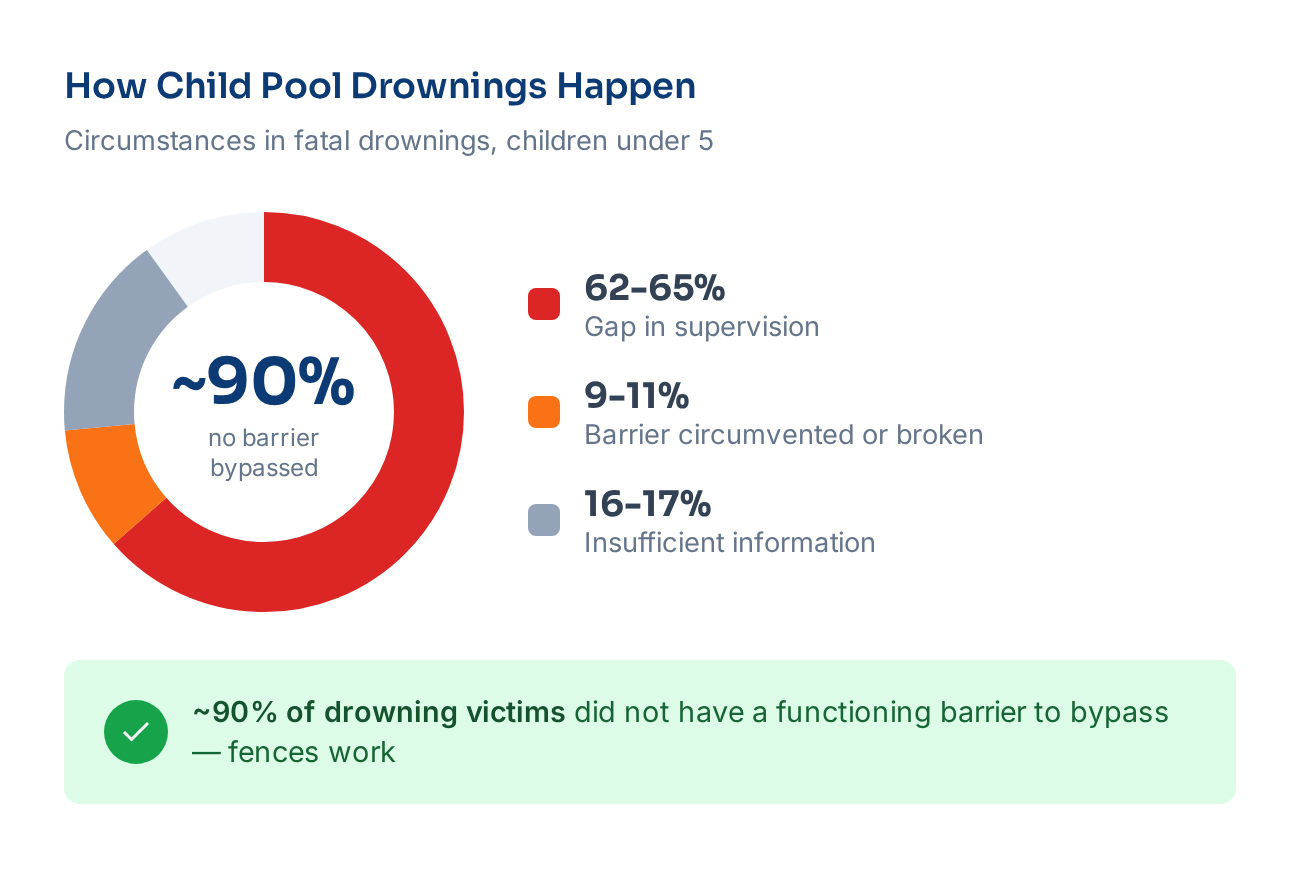
The most striking finding: only about 10% of fatal drownings involved a barrier that was actively circumvented or compromised. This means 90% of children who drowned did not have a functioning barrier to bypass—they had either no fence at all, an open gate, or direct access from the house.
Why Fences Work: The "Silent Drowning" Problem
Drowning is not like it appears in movies. There's no splashing, no screaming, no dramatic struggle. Drowning is fast and silent—a child can slip underwater and lose consciousness in under a minute.
This is precisely why fences are effective: they provide the critical seconds or minutes needed for a caregiver to realize a child is missing before they reach the water.[4]CPSC Safety Barrier GuidelinesLayers of protection conceptcpsc.gov
The barrier advantage: Even a brief lapse in supervision—answering the door, using the bathroom, checking on another child—can be fatal when there's direct pool access. A fence transforms a 30-second lapse into a search for a child who can't reach the water.
Four-Sided vs. Three-Sided Fencing
Not all fencing provides equal protection. The CDC recommends four-sided isolation fencing over three-sided fencing (where the house serves as the fourth wall) for good reason.[2]CDC MMWR Vital SignsFour-sided fencing effectivenesscdc.gov
Four-sided fencing advantages:
- No direct access from the house to the pool
- Child must bypass two barriers (house door + pool gate) to reach water
- Provides protection even when house doors are left open
- Eliminates the "fourth wall" problem where doors become entry points
Three-sided fencing limitations:
- House wall is the most common barrier failure point
- Requires door alarms, self-closing doors, or other secondary measures
- Direct access from the home to pool area
- Risk increases when doors are propped open or alarms malfunction
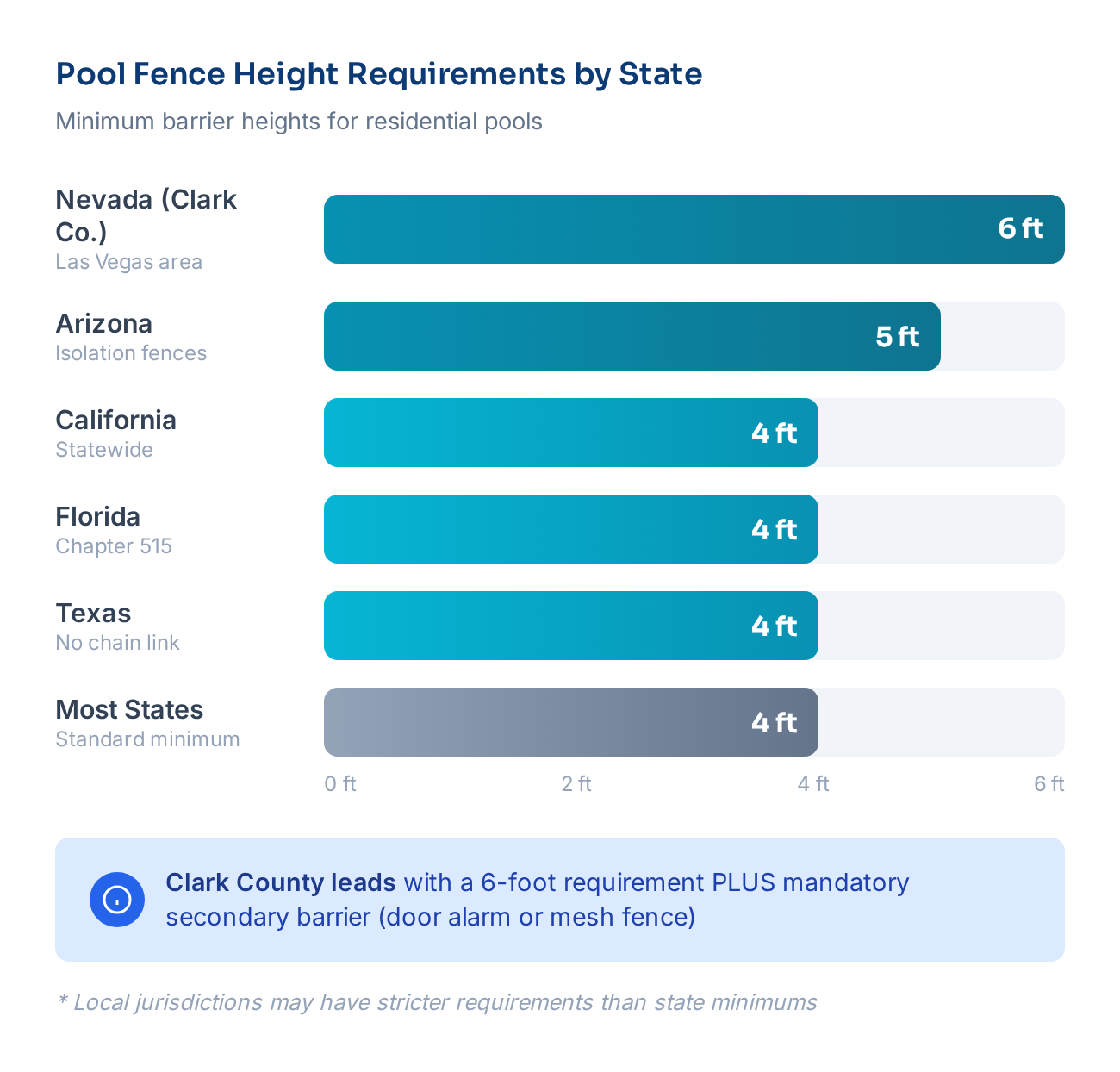
Fence height requirements also vary significantly by state, with stricter jurisdictions requiring taller barriers:
The "Supervision Is Enough" Myth
Some argue that attentive supervision makes fences unnecessary. The data strongly disagrees.
The fact that 62-65% of drownings involve a supervision gap doesn't mean parents were negligent—it means supervision is inherently imperfect. Even the most vigilant caregiver must occasionally:
- Use the bathroom
- Answer the door or phone
- Attend to another child
- Prepare food or clean up
- Deal with an emergency
Barriers provide layers of protection during these inevitable lapses. They're not a substitute for supervision—they're a backup system for when supervision temporarily fails.[4]CPSC Safety Barrier GuidelinesLayers of protectioncpsc.gov
Important: Fences are not a replacement for supervision. The most effective drowning prevention combines both active supervision AND physical barriers. When one fails, the other provides protection.
When Barriers Fail
The approximately 10% of drownings where a barrier was circumvented or compromised provide important lessons. Common failure scenarios include:
- Gate left open: Self-closing mechanisms failed or were propped open
- Gate latch failure: Latch broken, worn, or too low for effectiveness
- Climbable elements: Nearby furniture, equipment, or fence design allowed climbing
- Gaps under fence: Uneven ground or erosion created crawl-through spaces
- House door access: Door alarms disabled, doors propped, or no secondary barrier
The Critical House-to-Pool Access Point
For children under 5, controlling house-to-pool movement is the single most critical safety step. Most toddler drownings occur when a child gains unexpected access to the pool—often through a door that was thought to be closed or locked.[4]CPSC Safety Barrier GuidelinesAccess point controlcpsc.gov
When the house serves as part of the pool barrier, additional measures are essential:
- Door alarms: Alert when any door to pool area is opened
- Self-closing doors: Automatically close after opening
- High door releases: Mechanisms placed out of children's reach (54+ inches)
- Window locks: Prevent access through windows facing pool
What This Means for Pool Service Professionals
Pool service professionals are often the only regular visitors who observe barrier conditions. While fence maintenance isn't typically part of service contracts, documenting issues can be valuable.
Consider documenting:
- Gates that don't self-close or self-latch
- Gaps under fences or between slats
- Climbable objects near fence lines
- Missing or non-functional door alarms
- Pool covers in poor condition
This documentation serves two purposes: it demonstrates professional diligence, and it may prompt homeowners to address safety issues before a tragedy occurs.
Sources
- [1] Pool Safely (CPSC), Virginia Graeme Baker Pool and Spa Safety Act — Legislative findings on barrier effectiveness and drowning prevention. poolsafely.gov
- [2] CDC Morbidity and Mortality Weekly Report, "Vital Signs: Drowning — United States, 1999–2022." Four-sided isolation fencing recommendation. cdc.gov
- [3] U.S. Consumer Product Safety Commission, "2023 Submersion Report" — Drowning scenario analysis and barrier failure data. cpsc.gov
- [4] U.S. Consumer Product Safety Commission, "Safety Barrier Guidelines for Residential Pools" — Access control and layers of protection guidance. cpsc.gov
- [5] Signs.com, "State-by-State Guide to Pool Signage and Fencing Requirements" — Comprehensive state pool fence height and requirement data. signs.com