How Many Children Drown in Pools Each Year?


An average of 357 children under 15 drown in pools and spas each year in the United States.[1]CPSC 2025 Submersion ReportAverage annual fatalities 2020-2022cpsc.gov This number represents pool and spa drownings specifically—the total across all water types exceeds 4,000 annually.
For pool service professionals, understanding drowning frequency and patterns provides crucial context for safety conversations with homeowners—especially during the high-risk summer months.
Key Statistics at a Glance
- 357 — Average annual child pool/spa drowning fatalities (2020-2022)[1]CPSC 2025 Submersion ReportChildren under 15cpsc.gov
- 4,000+ — Total unintentional drowning deaths annually (all ages, all water types)[2]CDC Drowning FactsTotal U.S. drowning deathscdc.gov
- 73% — Portion of child pool drownings occurring May-August[3]CPSC 2022 Submersion ReportSeasonal concentrationcpsc.gov
- 38% — Decline in childhood drowning rates from 1999-2019[4]CDC Data Brief #413Long-term trend improvementcdc.gov
- 2020-2022 — Drowning rates increased significantly vs. 2019[5]CDC MMWR Vital SignsPost-pandemic spikecdc.gov
The Annual Numbers
The CPSC tracks pool and spa drowning fatalities for children under 15. The most recent three-year data shows:
Source: CPSC 2025 Submersion Report
These numbers represent reported fatalities—actual totals may be slightly higher due to reporting delays and incomplete data collection. Fatality data typically takes 2-3 years to finalize.
Beyond fatalities, approximately 6,300 children under 15 are treated in emergency departments annually for nonfatal pool/spa drowning injuries.[1]CPSC 2025 Submersion ReportED-treated nonfatal injuries, 2022-2024 averagecpsc.gov
The Summer Spike: Seasonal Patterns
Pool drownings follow a predictable seasonal pattern, with 73% of all childhood pool fatalities occurring during May through August.[3]CPSC 2022 Submersion ReportSeasonal distributioncpsc.gov
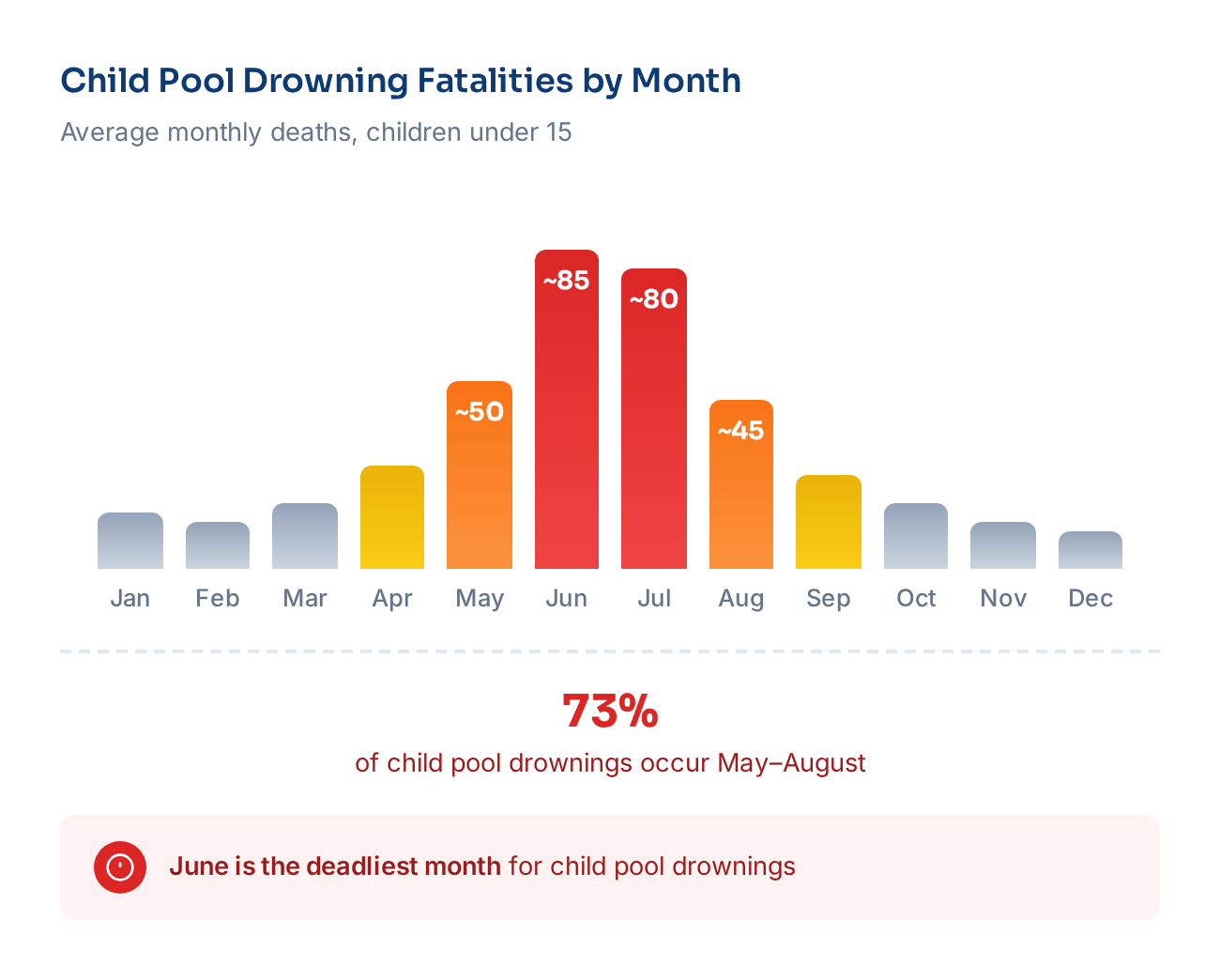
The monthly breakdown shows:
- June: ~85 average fatalities (peak month)
- July: ~80 average fatalities
- May: ~50 average fatalities
- August: ~45 average fatalities
The Memorial Day to Labor Day window: This 100-day period contains the vast majority of child pool drownings. Pool service professionals are on-site during this highest-risk window—making safety awareness part of the job.
Long-Term Trends: Progress and Setbacks
The good news: childhood drowning rates declined 38% between 1999 and 2019, dropping from 1.6 to 1.0 deaths per 100,000 children.[4]CDC Data Brief #41320-year trend analysiscdc.gov
This decline reflects decades of:
- Improved pool barrier requirements in many states
- Greater awareness of supervision importance
- Expansion of learn-to-swim programs
- Better emergency response and medical care
The Post-Pandemic Spike
The bad news: drowning rates increased significantly in 2020, 2021, and 2022 compared to 2019.[5]CDC MMWR Vital SignsPost-COVID drowning increasecdc.gov
Several factors contributed to this reversal:
- Closed public pools: Many community pools and swim programs shut down during 2020-2021
- Fewer lifeguards: Lifeguard shortages persisted even after pools reopened
- Suspended swim lessons: A generation of children missed typical learn-to-swim timing
- Increased home pool use: More families swimming at home without professional supervision
- New pool installations: Record pool sales in 2020-2021 put more pools in backyards
The swim lesson gap: Children who would have learned to swim in 2020-2021 may now be 2-4 years behind on water safety skills. This cohort represents ongoing elevated risk.
Pool Drownings vs. All Drownings
Context matters: the 357 annual child pool/spa deaths are a subset of over 4,000 total unintentional drowning deaths across all ages and water types each year.[2]CDC Drowning FactsTotal U.S. drowning deathscdc.gov
Other drowning settings include:
- Natural bodies of water (lakes, rivers, oceans)
- Bathtubs (particularly for infants)
- Buckets and containers (infants and toddlers)
- Boating accidents
For children specifically, pools represent a disproportionate share of drowning deaths because they're the most common supervised water exposure for young children.
What This Means for Pool Service Professionals
The numbers provide clear guidance for timing and messaging:
- May safety checks: Before peak season begins, note barrier condition and mention safety to customers
- June-July vigilance: Peak drowning months coincide with peak service activity—you're there when risk is highest
- New pool customers: Families with pools installed during 2020-2022 may lack established safety habits
- Post-COVID awareness: Children ages 4-8 today may have missed typical swim lessons during the pandemic
Your role: Pool techs visit more backyards than almost anyone during summer months. A simple mention of fence condition or gate function can reinforce safety without overstepping professional boundaries.
Track Safety Notes for Every Pool
PoolDial lets you document barrier status, gate condition, and safety observations—building a safety profile for every customer.
Start Your Free TrialSources
- [1] U.S. Consumer Product Safety Commission, "Pool or Spa Submersions: Estimated Nonfatal and Reported Fatal Drownings, 2025 Report." cpsc.gov
- [2] Centers for Disease Control and Prevention, "Drowning Facts," 2024. cdc.gov
- [3] U.S. Consumer Product Safety Commission, "Pool or Spa Submersions: Estimated Nonfatal and Reported Fatal Drownings, 2022 Report." cpsc.gov
- [4] CDC National Center for Health Statistics, "Data Brief No. 413: Trends in Unintentional Drowning Deaths, 1999-2019." cdc.gov
- [5] CDC Morbidity and Mortality Weekly Report, "Vital Signs: Drowning Deaths — United States, 2020-2022." cdc.gov