
States With the Strictest Pool Safety Laws


Pool safety regulations vary dramatically across the United States. While some states set a 4-foot minimum fence height, others require 6-foot barriers plus secondary protection devices. Understanding which jurisdictions have the strictest requirements helps pool professionals and homeowners navigate compliance.
This article ranks the strictest pool safety jurisdictions and explains what makes their requirements stand apart from standard codes.
Key Findings
- Clark County, Nevada — Requires 6-foot fences plus mandatory secondary barriers [1]Signs.com State GuideNevada pool fence requirementssigns.com
- Arizona — 5-foot height requirement for isolation fences [1]Signs.com State GuideArizona pool fence requirementssigns.com
- Texas — Unique ban on chain link fencing for pools built after 1994 [1]Signs.com State GuideTexas pool fence requirementssigns.com
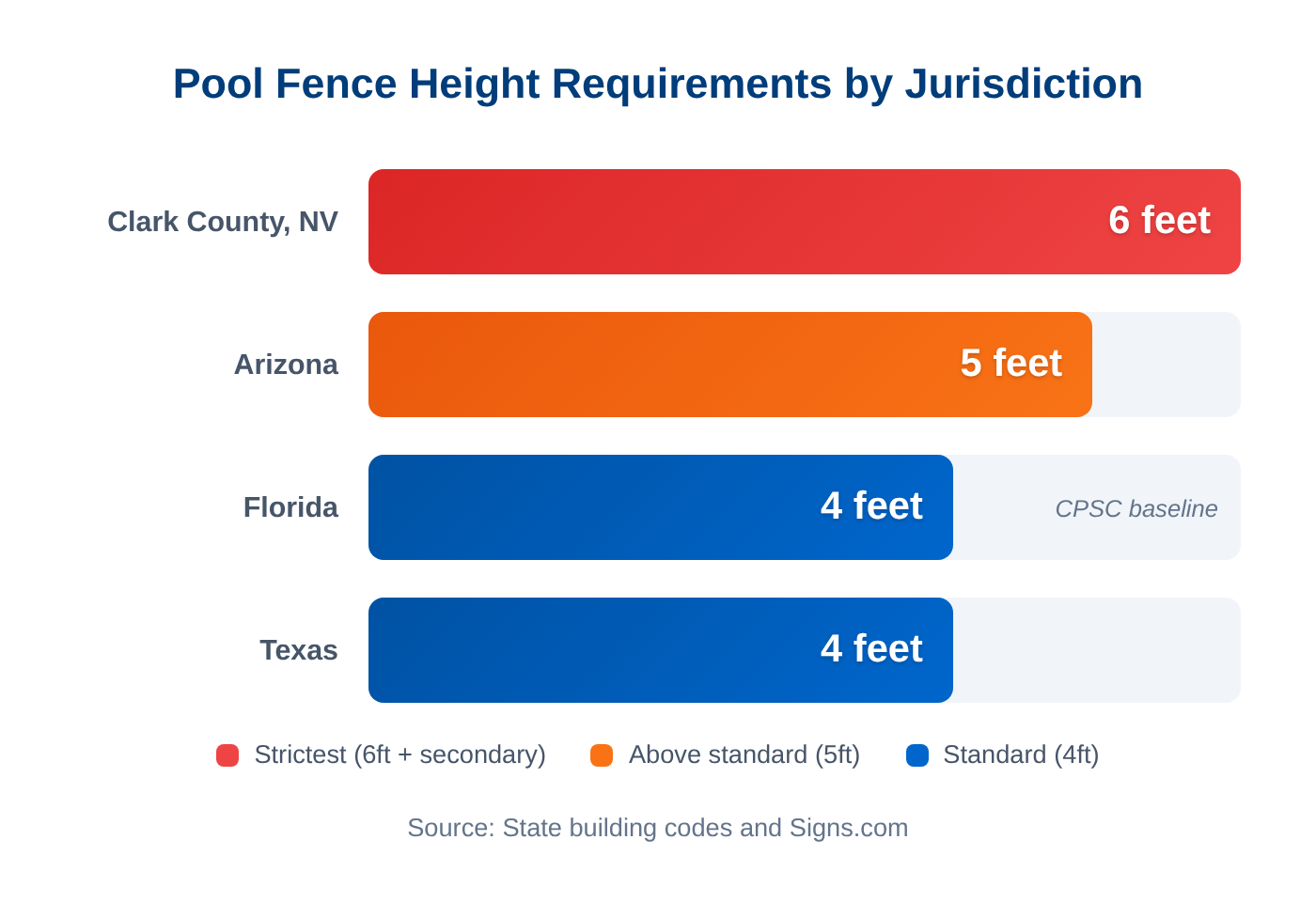
- 50% height variance — Between strictest (6ft Clark County) and standard (4ft most states) [1]Signs.com State GuideState comparison datasigns.com
Strictest Pool Safety Jurisdictions
Based on fence height requirements, secondary barrier mandates, and additional restrictions, here's how the strictest jurisdictions compare:
fence height
isolation fence
standard minimum
Source: Signs.com State Pool Fence Guide
State-by-State Comparison
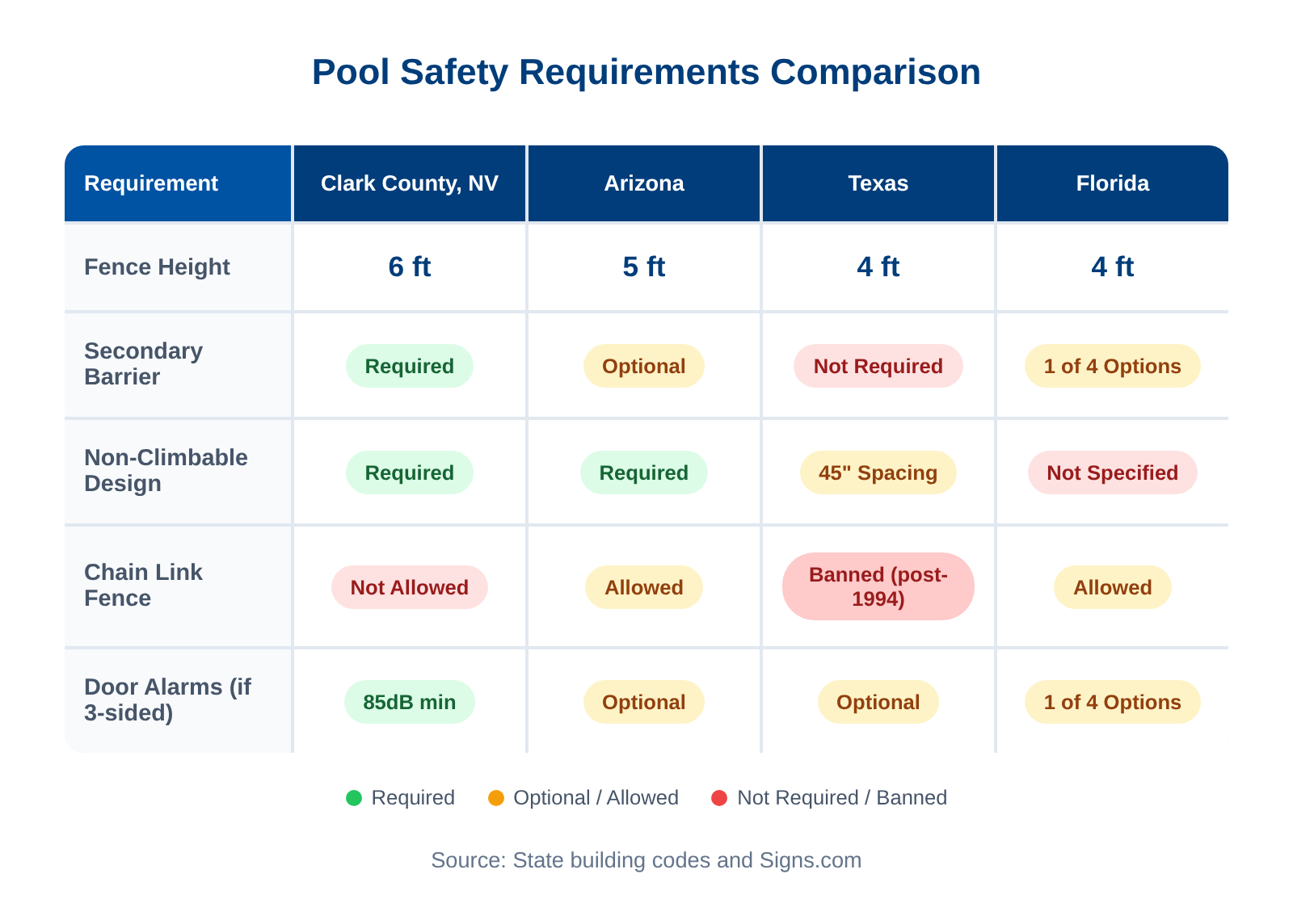
| State/Jurisdiction | Barrier Height | Climbing Restrictions | Secondary Barrier |
|---|---|---|---|
| Nevada (Clark County) | 6 feet | Non-climbable required | Mandatory |
| Arizona | 5 feet | No hand/footholds | Safety covers accepted |
| Texas | 4 feet | Chain link banned | Not required |
| Florida | 4 feet | Not specified | One of four options |
Clark County, Nevada: The Double Barrier Standard
Clark County (Las Vegas) sets the highest bar in the nation by requiring two layers of protection: a 6-foot primary perimeter fence PLUS a secondary device like a mesh fence or door alarm.[1]Signs.com State GuideClark County double barrier requirementsigns.com
Clark County requirements include:
- Primary barrier: 6 feet exterior, 8 feet interior height
- Secondary barrier: Removable mesh fencing (4ft min), UL 2017 door alarms (85 decibel min), or ASTM F1346 power safety covers
- Pet doors: Must be alarmed if providing pool access
- Non-climbable design: No horizontal rails or footholds on fence exterior
Why so strict? Clark County adopted the Southern Nevada Amendments to the 2012 ISPSC, effective July 2014. The region's year-round pool season and high tourism density led officials to exceed national standards.
Arizona: The 5-Foot Standard
Arizona (ARS 36-1681) requires a 5-foot minimum height for isolation fences—one foot taller than the 4-foot CPSC guideline and most state requirements.[1]Signs.com State GuideArizona barrier requirementssigns.com
Arizona requirements include:
- Enclosure height: 5 feet for isolation fences
- With dwelling wall: 4 feet allowed if pool has motorized safety cover
- Opening limits: No gaps larger than 4 inches diameter
- Setback: Fence must be at least 20 inches from water's edge
- Gate direction: Must open outward (away from pool) when residence is part of enclosure
- Mandatory for: Any residence with a child under 6
Texas: The Chain Link Ban
Texas stands out for its unique prohibition on chain link fencing for residential pools built after 1994. The state recognized that chain link mesh provides easy footholds for young children.[1]Signs.com State GuideTexas chain link prohibitionsigns.com
Texas requirements include:
- Minimum height: 4 feet (48 inches)
- Chain link: Prohibited for pools built after 1994
- Latch height: 60 inches (5 feet) above ground, or 42 inches if key/card locked
- Horizontal members: Must be at least 45 inches apart or on pool side only
- Local adoption: Cities like Frisco and Celina have adopted 2018 ISPSC with amendments
Important: Texas requirements apply to new construction. Pools built before 1994 may not be subject to the chain link prohibition, but local jurisdictions may have additional requirements.
Florida: The Four-Option System
Florida's Residential Swimming Pool Safety Act (Chapter 515) requires all pools built after October 2000 to have at least one of four safety features.[2]WaterSmartFLFlorida pool safety requirementswatersmartfl.com
Florida's four approved options:
- Fence with self-closing/self-latching gate
- Approved safety cover (must be fitted, not simple canvas)
- Alarms on all doors/windows leading to pool
- Self-closing/latching doors with release mechanism at least 54 inches high
Additional Florida requirements:
- Minimum fence height: 4 feet
- Gate latch: Pool side, at least 54 inches from bottom and 3 inches below top
- Screen enclosures: Bottom 3 feet must be hardened
The grandfathering gap: Over 90% of Florida pools were built before October 2000. The majority are not legally required to meet current Chapter 515 standards, though voluntary compliance is strongly recommended.
New York: Local Leadership
New York was among the first states to see comprehensive local pool safety laws. Rockville, NY passed requirements in 2012 that exceed many state-level codes.[3]Pool Fence Laws CompilationNew York local requirementsguardianpoolfence.com
Notable New York requirements:
- Minimum height: 4 feet
- Climbing structures: Prohibited near fence line
- Local variation: Requirements vary significantly by municipality
The Federal Baseline: CPSC Guidelines
The U.S. Consumer Product Safety Commission (CPSC) publishes Safety Barrier Guidelines for residential pools. While not legally binding, these guidelines form the basis for most state and local codes.[4]CPSC Safety Barrier GuidelinesFederal pool barrier recommendationscpsc.gov
CPSC baseline recommendations:
- Minimum height: 4 feet (48 inches)
- Opening size: No gaps larger than 4 inches
- Self-closing gates: Recommended
- Self-latching gates: Latch should be out of children's reach
- Four-sided fencing: Recommended over three-sided (using house as fourth wall)
The Enforcement Gap
Having strict laws on the books doesn't guarantee compliance. Key challenges include:
- Inspection capacity: Most jurisdictions lack staff for proactive pool inspections
- Grandfathered pools: Older pools often exempt from current requirements
- Rental properties: Enforcement varies for short-term rentals and vacation homes
- Private vs. public: Residential pools receive less oversight than commercial facilities
What This Means for Pool Professionals
Pool service professionals working across multiple jurisdictions face compliance complexity. Key considerations:
- Know your jurisdiction: Requirements vary not just by state but by county and city
- Document observations: Note fence conditions, gate function, and alarm status during service visits
- Advise on upgrades: Customers may not know their pool predates current codes
- Stay current: Local codes update regularly—2018 ISPSC adoptions are ongoing
Sources
- [1] Signs.com, "State-by-State Guide to Pool Signage and Fencing Requirements" — Comprehensive state pool fence height, latch, and climbing restriction data. signs.com
- [2] WaterSmartFL, "Florida Pool Safety Requirements" — Florida Residential Swimming Pool Safety Act (Chapter 515) requirements and compliance options. watersmartfl.com
- [3] Guardian Pool Fence, "Pool Fence Laws by State" — Compilation of state and local pool fence requirements. guardianpoolfence.com
- [4] U.S. Consumer Product Safety Commission, "Safety Barrier Guidelines for Residential Pools" — Federal baseline recommendations for pool barriers. cpsc.gov