
How a Gas Pool Heater Works: Water, Fire and Safety


The video will appear here when it is live.
Key Takeaways
- Pool water and combustion gas travel through separate paths. Heat crosses the metal heat exchanger between them.
- A call for heat starts a safety sequence. Modern forced-draft heaters prove conditions before and during ignition.
- Water flow, airflow, temperature limits, and flame sensing can all stop combustion when conditions are unsafe.
- Gas pressure, combustion, venting, and live electrical diagnosis belong to qualified service professionals.
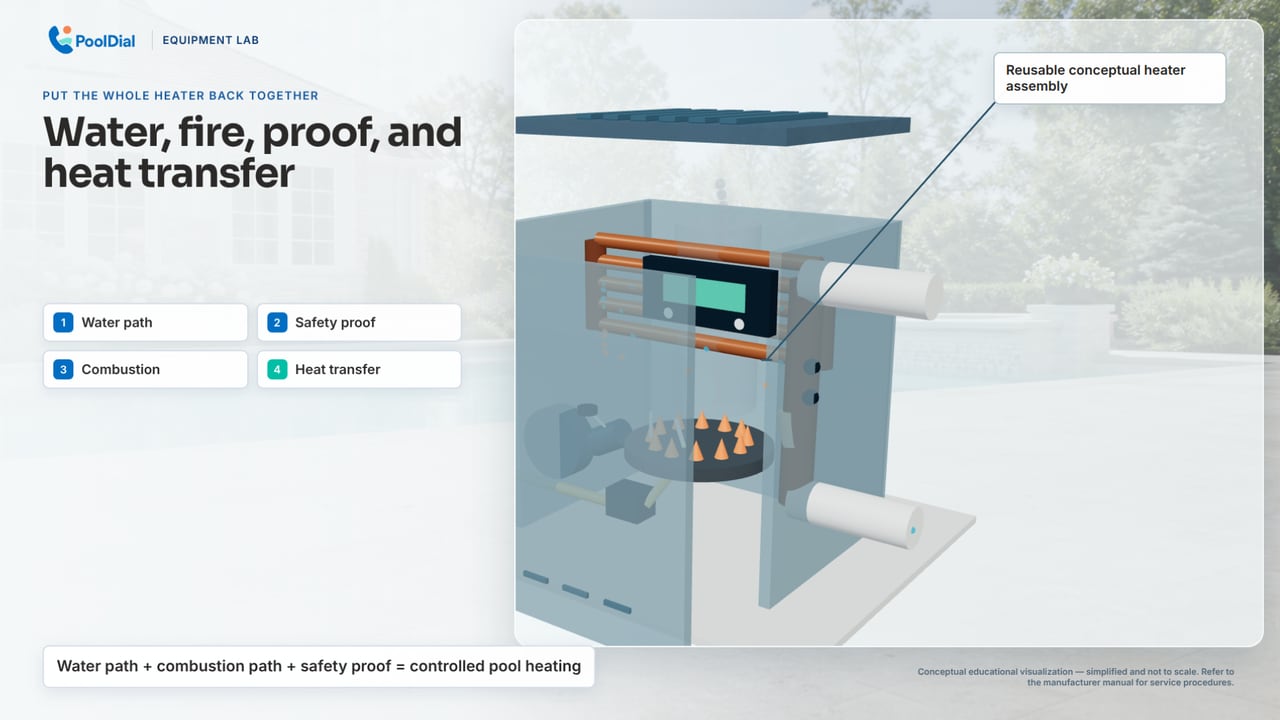
A gas pool heater moves heat across a metal wall. Filtered pool water flows through the heat exchanger. A burner creates hot combustion gas on the other side. The two streams remain separate while heat moves into the water.
Two Paths Through One Heater
The water path usually begins downstream of the pump and filter. Water enters the heater manifold, passes through heat-exchanger tubes or another model-specific waterway, and exits warmer. A bypass may help manage how much water crosses the exchanger.
The combustion path begins with air and fuel. A forced-draft heater uses a blower to move combustion air. An atmospheric heater uses a different burner and vent arrangement. Both require the exact clearances, air supply, gas setup, and venting in their manuals.
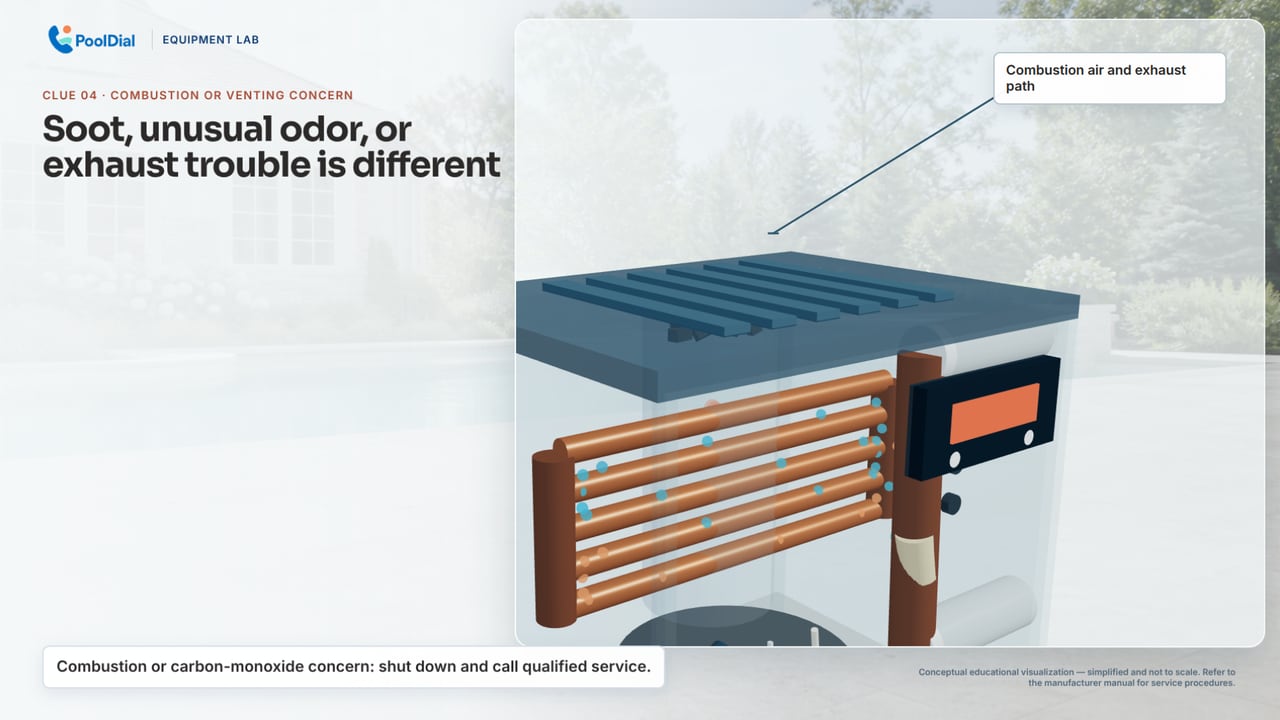
Because heater designs differ, do not copy a bypass position, vent layout, switch setting, or timing from a generic diagram.
The Ignition Safety Sequence
A thermostat call does not simply open the gas valve. In a common forced-draft sequence, the control checks safety inputs, starts the blower, proves airflow, energizes the igniter, opens the gas valve, and verifies flame. If stable flame is not proven, the control closes the valve and may retry before showing a fault or lockout.
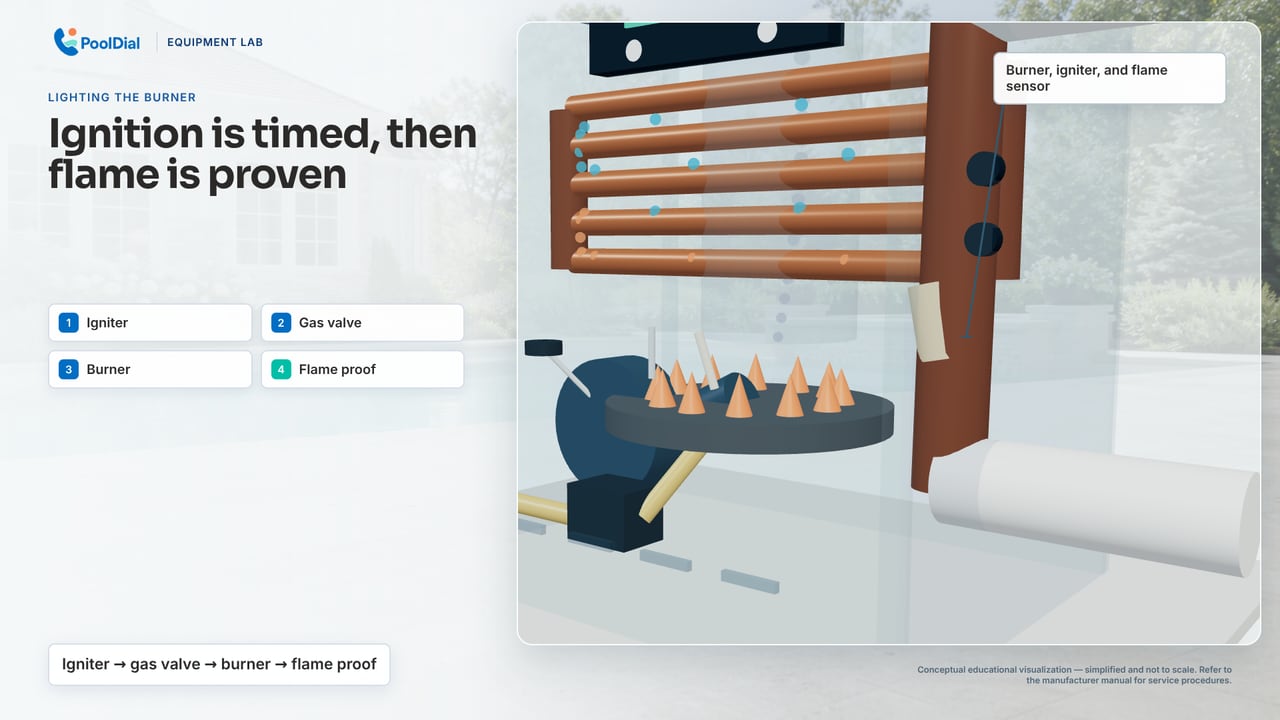
At the end of the heat call, gas shuts off. Some designs continue the fan or water circulation for a period to clear combustion products or residual exchanger heat.
How the Safety Chain Stops Heat
The heater watches conditions that must remain safe. A water-pressure or flow-related switch helps confirm circulation. An airflow switch can prove blower performance on a forced-draft unit. High-limit switches respond to excessive water temperature. Flame sensing confirms that gas is burning when the valve is open.
These devices are interlocks, not annoyances to bypass. A fault code names the circuit or condition the control observed. It does not always name the failed part.
Why Low Flow Can Become a Heater Problem
A clogged basket, dirty filter, wrong valve position, low pump speed, external bypass issue, or scaled exchanger can reduce water movement. The heater may refuse to fire, open a pressure switch, trip a high limit, make boiling or knocking sounds, or shut down.
Scale adds another layer. Deposits inside the water passage restrict flow and insulate the metal from the water it is meant to heat. Poor chemistry can also corrode the exchanger. Record chemistry, flow clues, filter pressure, and the exact heater code before assuming an ignition part has failed.
Fault Pattern Map
| Observed condition | System question | Safe external checks |
|---|---|---|
| Flow or pressure fault | Is enough filtered water reaching the heater? | Pump operation, prime, baskets, filter pressure, valve positions, return flow |
| Airflow fault | Did the forced-draft system prove air movement? | Visible intake or exhaust blockage only, then qualified service |
| Ignition or flame fault | Was flame established and proven? | Gas supply status and exact code, without opening or adjusting gas components |
| High-limit shutdown | Is exchanger temperature rising too far? | Water flow, filter condition, valves, chemistry history, and scale clues |
Stop immediately if you smell gas, see soot, observe flame rollout, find damaged venting, or have a carbon-monoxide alarm. Follow the manual's emergency instructions and use a qualified gas-heater professional.
Estimate Heating Demand
Use the pool heater calculator to estimate heat-up time and energy cost. For model-specific fault trees, start with the Pentair MasterTemp troubleshooter or the Raypak heater troubleshooter.
Frequently Asked Questions
How does a gas pool heater warm the water?
Pool water crosses a heat exchanger while hot combustion gas travels on the other side of the metal. Heat passes through the exchanger wall into the moving water.
Why will a gas pool heater not fire with low flow?
The heater needs enough water movement to carry heat away safely. A flow or pressure interlock can stop ignition when circulation is not proven.
Does an ignition fault mean the igniter is bad?
Not by itself. The code reports where the sequence failed. Fuel supply, airflow, flame sensing, controls, wiring, and other conditions can interrupt ignition, so use the model manual and qualified service.
This guide is an original, generic teaching explanation based on manufacturer documentation. Visuals are simplified and not to scale. The installed equipment manual controls service and safety procedures.
- Pentair, MasterTemp Pool and Spa Heater Installation and User’s Guide, water system, safety switches, ignition, venting, and troubleshooting sections.
- Jandy, JXi Gas-Fired Pool and Spa Heater Installation and Operation Manual, general operation, ignition control, safety components, and water chemistry sections.
- Raypak, Digital 206A–406A Installation and Operation Manual, water connections, bypass, venting, and chemistry sections.