
Pentair IntelliChem ORP Alarms


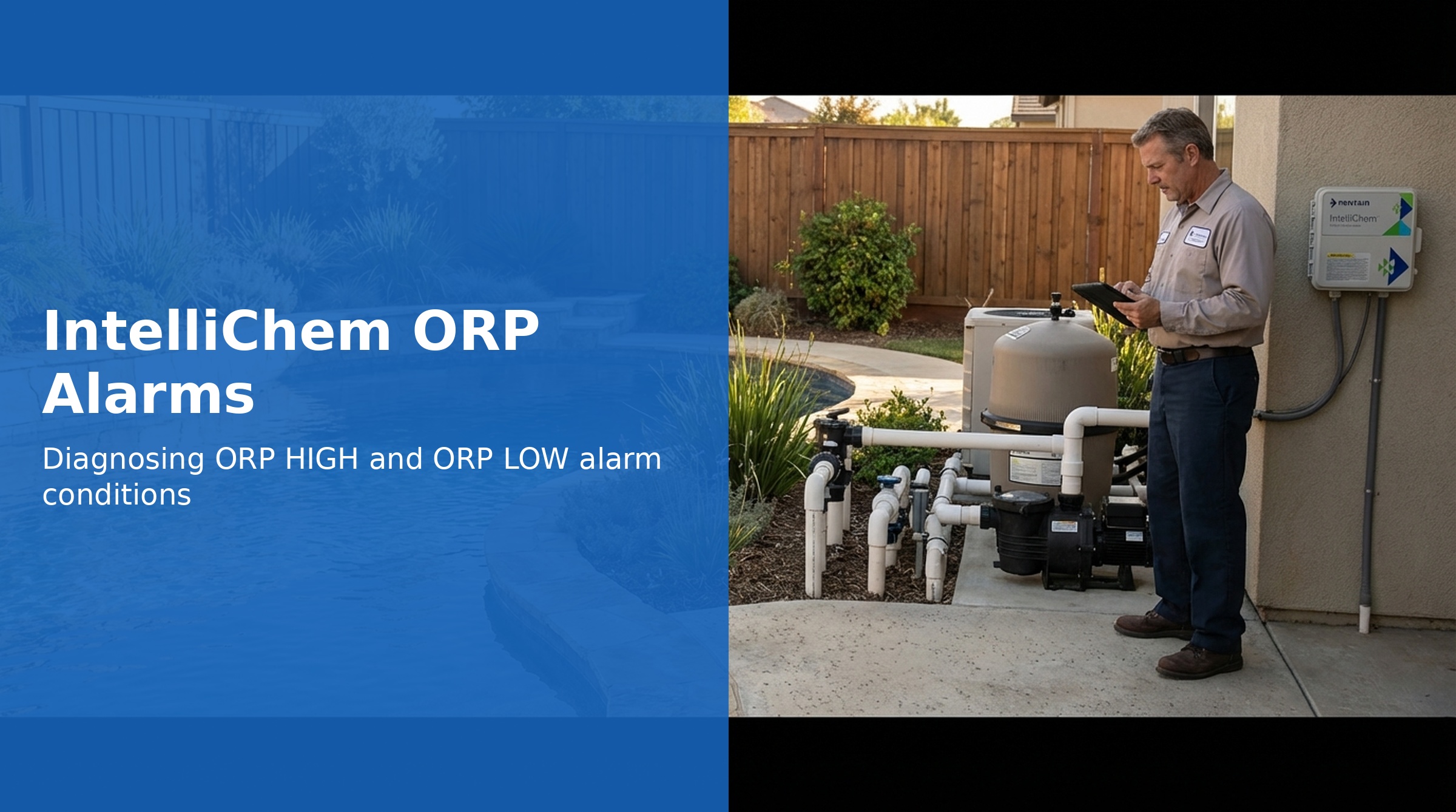
The IntelliChem monitors ORP (Oxidation-Reduction Potential) as a measure of the pool's sanitizer effectiveness. ORP alarms indicate the sanitizer level has moved outside the acceptable range and automatic dosing has not been able to bring it back within the alarm delay period.
ORP alarm thresholds default to High 750 mV (1-hour delay) and Low 650 mV (2-hour delay). The recommended operating range is 650–750 mV with a default set point of 700 mV.
ORP Alarm Thresholds
| Alarm | Default Threshold | Alarm Delay | Set Point Range | Default Set Point |
|---|---|---|---|---|
| ORP HIGH | 750 mV | 1 hour | 400–900 mV | 700 mV |
| ORP LOW | 650 mV | 2 hours | 400–900 mV | 700 mV |
ORP LOW Alarm
The ORP LOW alarm activates when the ORP reading has remained below the low alarm threshold (default 650 mV) for more than 2 hours. Low ORP indicates insufficient sanitizer in the pool — a potential health concern.
Important: ORP Dosing Is Suspended When pH >7.8
Before troubleshooting ORP LOW, check whether the pH >7.8 Lockout is active. The IntelliChem will not dose sanitizer while pH is above the lockout threshold. Resolve the pH issue first — lowering pH into range will resume ORP dosing and often resolves the ORP LOW alarm on its own.
Causes
- pH above 7.8 lockout threshold — ORP dosing suspended
- High cyanuric acid (CYA) suppressing ORP readings — CYA buffers chlorine and significantly lowers ORP even at adequate chlorine levels
- Chlorine supply empty or doser not operating
- Filter run time too short — insufficient time for the system to bring ORP up
- Dose size too small
- Heavy bather load or algae consuming sanitizer faster than dosing can compensate
- ORP probe dirty or degraded — giving an artificially low reading
Troubleshooting Steps
- Check for a pH >7.8 Lockout alarm — resolve pH first
- Check ORP Sensitivity — try setting to "High" for more aggressive dosing, or "Off" to deliver the full dose regardless of current ORP level
- Check chlorine supply container — refill if low and update the Supplies menu gauge
- Confirm the chlorine doser is operating: run a manual dose from the Supplies menu and verify chemical is flowing
- Increase filter run time — more circulation time gives the system more opportunity to raise ORP
- Increase the dose size in ORP Settings
- Test actual chlorine levels with a reagent-based test kit — if free chlorine is adequate but ORP is low, CYA may be suppressing ORP (see CYA note below)
- Run the Probe-Open Test from Diagnostics and clean the ORP sensor if needed
CYA and ORP Suppression
Cyanuric acid (stabilizer) binds with free chlorine, significantly reducing ORP even when free chlorine levels appear adequate. If CYA is above 80 ppm, ORP readings will be chronically suppressed. In pools with high CYA:
- Reduce CYA by partial water replacement (drain and refill)
- Consider lowering the ORP set point to a value achievable with your CYA level
- Always cross-check ORP readings with reagent-based chlorine tests
ORP HIGH Alarm
The ORP HIGH alarm activates when ORP has remained above the high alarm threshold (default 750 mV) for more than 1 hour. Very high ORP can indicate over-chlorination, which is irritating to swimmers and can damage pool surfaces and equipment.
Causes
- Dose size too large — system is over-dosing chlorine
- Mix time too short — ORP is measured before chlorine has fully mixed through the pool
- Daytime CYA-driven ORP swings — ORP can read artificially high early in the morning before CYA-bound chlorine releases, then drop during daylight
- ORP probe giving an artificially high reading — probe may need cleaning or replacement
- Recent manual chlorine addition not yet measured by probe
Troubleshooting Steps
- Reduce the dose size in ORP Settings
- Increase the mix time — allows chlorine to distribute through the pool before the next ORP reading triggers a dose decision
- Try ORP Sensitivity "Low" — delivers smaller doses relative to distance from set point
- Check whether ORP HIGH occurs only during the day — if so, CYA dynamics may be causing false high readings in the morning. Consider adjusting the dosing schedule to avoid early-morning measurements
- Verify ORP probe is clean and reading accurately — clean if needed
ORP Sensitivity Setting
The ORP Sensitivity setting controls how aggressively the IntelliChem doses relative to distance from set point:
- High: Delivers the full programmed dose when ORP is well below set point. Use for pools with consistently low ORP.
- Normal (default): Proportional dosing based on distance from set point.
- Low: Smaller doses relative to deviation. Use when ORP is consistently overshooting or readings are erratic.
- Off: Delivers the full dose regardless of ORP level. Use with caution — monitor closely to avoid over-chlorination.
ORP Sensor Cleaning
A dirty ORP probe can give readings that are too low (ORP LOW alarm) or inconsistent. To clean the ORP sensor:
- Turn off AC power to the IntelliChem at the GFCI switch
- Disconnect the probe connector from the Flow Cell, then unscrew the ORP probe
- Clean the reference junction (white ring at the bottom of the probe) with a soft toothbrush
- Use household liquid dish detergent to remove oils from the probe tip and body
- Rinse thoroughly with fresh water and reinstall
If ORP readings remain inaccurate after cleaning, replace the ORP sensor (P/N 522187).
Sensor Storage
If either probe is removed for more than 1 hour, store it with the plastic storage cap installed, or submerge the tip in a small container of clean water. Do not allow probes to freeze or dry out.